

Mechanical watch complications are defined as any function beyond basic timekeeping, and the types of mechanical watch complications repaired by professionals span chronographs, perpetual calendars, moon phases, minute repeaters, and power reserve indicators. Each complication adds layers of interdependent components that demand specialised tools, specific lubricants, and years of trained expertise to service correctly. A timing deviation of more than 30 seconds per day signals that a watch needs servicing, and complications accelerate that degradation. Watchrepairstation has handled these repairs at trade level since 2008, applying professional standards that protect both function and collector value.
1. What are the most common types of mechanical watch complications repaired?
Chronographs, calendar mechanisms, moon phases, power reserve indicators, and minute repeaters form the core of professional complication repair work. Each one adds mechanical complexity that multiplies the risk of failure during servicing if handled incorrectly.
The most frequently repaired complications share one trait: they interact directly with the base movement. That interaction means a fault in the complication can stop the entire watch, not just the additional function.
Common complications requiring professional repair include:
- Chronograph: A stopwatch function built into the movement, driven by its own gear train and column wheel or cam system.
- Date and day calendar: A disc or hand driven by a 24-hour wheel, prone to friction when the date corrector spring is misaligned.
- Annual and perpetual calendar: Programmes months of varying length automatically; perpetual calendars account for leap years.
- Moon phase: A disc displaying the lunar cycle, accurate to within one day over a set period, requiring precise synchronisation.
- Power reserve indicator: A display showing remaining mainspring tension, calibrated to a specific arc of movement.
- Minute repeater: A striking mechanism that chimes the time on demand, requiring sound calibration of hammers and gongs.
Pro Tip: If your watch has a complication and it is running more than 30 seconds slow per day, do not attempt to regulate it yourself. The fault is likely mechanical, not a simple timing adjustment.
Mechanical watch overhauls are recommended every 5–7 years even for rarely worn pieces, because lubricant degradation affects complications first. That interval shortens for watches worn daily in demanding conditions.
2. How are chronograph complications repaired and adjusted?
Chronograph repair is the most technically demanding of all standard complication work. The mechanism adds a second gear train, a column wheel or cam, a clutch, and a reset heart-piece, all of which must engage and disengage without friction.
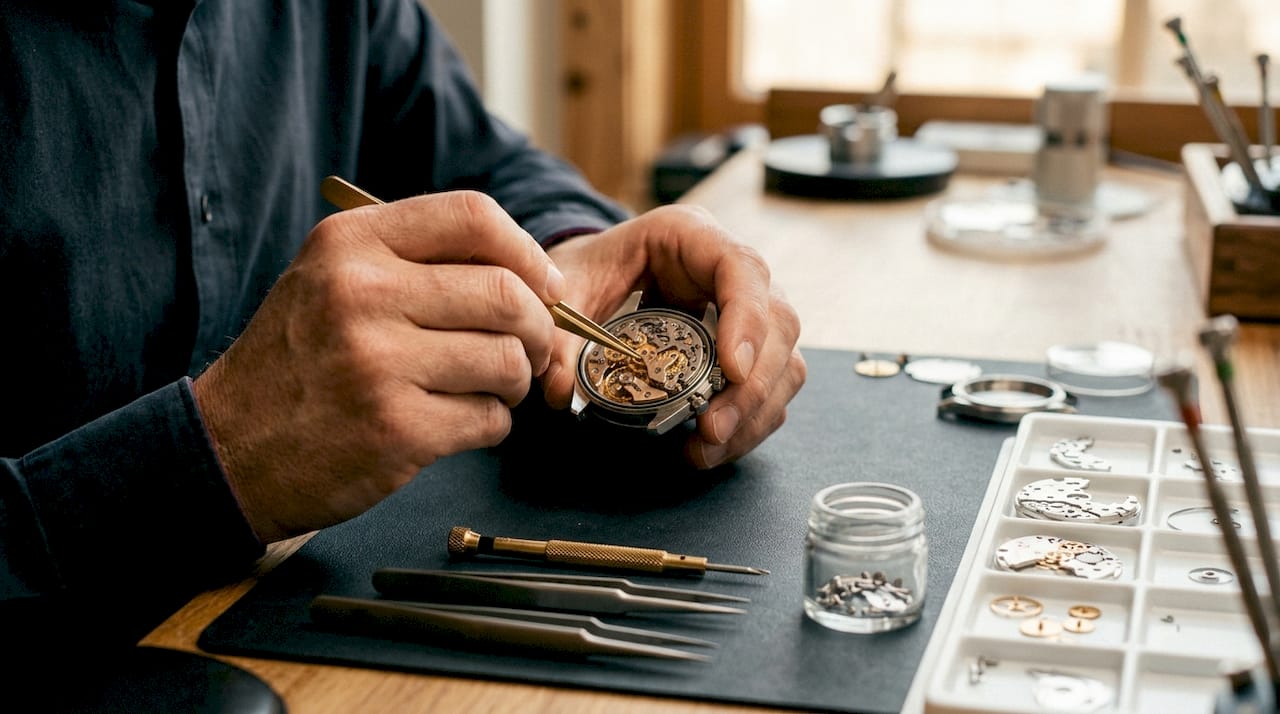
The critical step in chronograph repair is precise gear alignment, known as depthing. Misalignment of even a fraction of a millimetre causes friction that stops the movement entirely. Technicians use a depthing tool to set the correct distance between gear teeth before the movement is closed.
A professional chronograph repair follows this sequence:
- Full disassembly of the chronograph layer from the base movement, keeping both sections separate.
- Ultrasonic cleaning of all components, including the column wheel, clutch lever, and reset cams.
- Inspection of the clutch for wear, and replacement of the chronograph runner if the pivot shows damage.
- Depthing adjustment of the chronograph gear train against the base movement’s fourth wheel.
- Lubrication with the correct oil for each contact point. The chronograph runner typically receives Moebius 9010, a thin synthetic oil suited to high-speed pivots.
- Functional testing of start, stop, and reset functions across multiple cycles before timing regulation.
Pro Tip: Lubrication requires 5–8 different synthetic oils matched to specific components. Misuse of lubricants is the leading cause of post-repair failure, particularly over-oiling on pallet stones.
The reset function is the most common failure point in a chronograph. The heart-piece must return to exactly zero; if the reset hammer is bent or worn, the chronograph hand will not reset cleanly.
3. What unique repair considerations do calendar complications require?
Calendar complications are sensitive to assembly order in a way that no other complication matches. A misplaced screw or incorrectly seated spring does not always cause an immediate failure. It creates subtle friction that appears hours or days later, making diagnosis difficult without full disassembly.
Calendar mechanisms depend on precise assembly; the date corrector spring and jumper placement are the two most common fault points. A jumper that sits fractionally out of position will allow the date disc to slip between positions, displaying a half-date at midnight.
Key repair considerations for calendar complications include:
- Date corrector spring tension: Too little tension allows the date to advance erratically; too much causes the driving wheel to skip.
- Jumper screw torque: Overtightened screws distort the jumper geometry, creating friction against the date disc.
- Annual calendar cam alignment: The cam that programmes month lengths must be set to the correct month before the movement is closed.
- Perpetual calendar lever inspection: The lever system that reads leap years uses multiple interdependent cams; each must be inspected for wear individually.
- Quick-set mechanism: The pusher or crown position used to correct the date must engage cleanly without stressing the corrector lever.
The difference in repair complexity between an annual and a perpetual calendar is significant. An annual calendar requires the technician to programme the cam stack for the current month. A perpetual calendar requires the technician to set the leap year cam to the correct position in its four-year cycle, then verify that all future month transitions will occur correctly.
Authentic manufacturer parts are non-negotiable for calendar repairs. A generic date disc with slightly different tooth spacing will cause the jumper to misfire at every date change.
4. What other complex complications require specialised repair?
Beyond chronographs and calendars, several complications demand repair skills that go beyond standard movement servicing. These are less common in everyday collections but appear regularly in high-value pieces sent to trade repair specialists.
Minute repeaters
A minute repeater strikes the hours, quarter hours, and minutes on demand using hammers and gongs. The repair challenge is acoustic. The hammers must strike the gongs at the correct angle and with the correct force to produce a clear, resonant tone. Bent hammers or gongs that have shifted position produce a muffled or buzzing sound. Calibrating the strike mechanism requires listening as well as measuring.
Moon phase displays
Moon phase mechanisms use a 59-tooth disc driven by a pin on the hour wheel. The disc advances one tooth every 24 hours, completing one full rotation in 29.5 days. Precise synchronisation of the disc to the actual lunar cycle is required after every service. A disc set one tooth out of position will show the wrong moon phase within a fortnight.
Power reserve indicators
A power reserve complication uses a differential gear or a rack-and-pinion system to translate mainspring tension into a display. Calibration requires the technician to wind the mainspring fully, note the indicator position, and then adjust the display linkage until the reading matches the actual power state. An incorrectly calibrated indicator misleads the wearer about when the watch needs winding.
Professional overhauls for complex complications such as perpetual calendars and minute repeaters typically take 10–21 business days, depending on movement complexity and parts availability. That timeline reflects the diagnostic work, not just the physical repair.
5. How do professional repair processes and timelines vary with complication complexity?
The scope and cost of a professional repair scales directly with the number of complications in the movement. A standard three-hand movement overhaul and a perpetual calendar overhaul share the same base steps, but the complication adds hours of additional work.
A full professional overhaul includes total disassembly, ultrasonic cleaning, precise lubrication with specialised oils, regulation, and pressure testing for water resistance. Each of those steps takes longer when complications are present, because every additional component must be cleaned, inspected, and reassembled in the correct sequence.
Restoration repairs cost 2–5 times more than routine movement servicing. That ratio reflects the additional labour for case refinishing, dial reconditioning, and sourcing rare parts for discontinued complications.
| Complication type | Typical turnaround | Relative complexity |
|---|---|---|
| Date calendar | 10–14 business days | Moderate |
| Chronograph | 14–18 business days | High |
| Annual calendar | 14–18 business days | High |
| Perpetual calendar | 18–21 business days | Very high |
| Minute repeater | 18–21 business days | Very high |
Skipping critical steps such as regulated timing checks during servicing causes premature failure, even when the watch appears to function correctly after reassembly. That is the most common outcome of amateur complication repair.
Watches with complex complications should be serviced only by qualified professionals. The technical demands of these movements exceed the capability of general repair tools and standard watchmaking training.
Key takeaways
The most reliable way to protect a mechanical watch with complications is to service it every 5–7 years with a qualified professional who uses authentic parts and correct lubricants.
| Point | Details |
|---|---|
| Service interval matters | Overhauls every 5–7 years prevent lubricant degradation that damages complications first. |
| Depthing is critical for chronographs | Gear misalignment by even a fraction of a millimetre stops a chronograph movement entirely. |
| Assembly order governs calendar repairs | A misplaced jumper screw causes date slippage that only appears hours after reassembly. |
| Authentic parts protect value | Generic replacement components cause functional faults and reduce resale value in collectors’ markets. |
| Complexity drives turnaround time | Minute repeaters and perpetual calendars require up to 21 business days for a full professional overhaul. |
Why I trust specialist hands over general repair shops
The single most damaging misconception I encounter among collectors is that a complication repair is just a standard service with extra steps. It is not. A chronograph column wheel and a date jumper spring require a completely different mental model from a simple three-hand movement. The technician must understand how the complication interacts with the base movement under load, not just how it looks on the bench.
Over-lubrication is the error I see most often in watches that have been through non-specialist shops. Excess oil on pallet stones creates drag that slows the movement, and the owner rarely connects the problem to the recent service. The watch ran fine for two weeks, then started losing time. That pattern almost always points to lubrication error, not a worn component.
The other issue is parts. A collector who owns a perpetual calendar from a major Swiss manufacture is sitting on a piece whose value depends partly on its originality. Fitting a generic lever or a non-original cam to reduce cost destroys that value permanently. Expert repairs prioritise original parts not only for function but for appraisal value. That is not a preference. It is a professional standard.
My advice to any collector with a complication piece is straightforward. Find a specialist with documented experience on your specific movement type, ask about their parts sourcing, and expect a turnaround that reflects the actual complexity of the work. A shop that quotes two days for a perpetual calendar overhaul is not doing the job properly.
— efe
Watchrepairstation’s approach to complication repairs
Watchrepairstation has provided professional mechanical watch repairs to trade clients across the UK since 2008, with a “No Fix, No Cost” guarantee that removes financial risk from every job.

The service covers the full range of complication types, from chronograph depthing and calendar reassembly to moon phase synchronisation and power reserve calibration. Authentic parts are used as standard, and turnaround times reflect the actual complexity of each movement rather than a fixed schedule. Trade partners benefit from competitive pricing and the confidence that every complication is handled by an experienced technician. Visit the watch repair service page to discuss your current repair requirements.
FAQ
What complications are most commonly repaired in mechanical watches?
Chronographs, date and day calendars, moon phases, and power reserve indicators are the most frequently serviced complications. Each requires specialist tools and lubricants beyond those used in standard movement overhauls.
How often should a watch with complications be serviced?
Mechanical watches with complications should be overhauled every 5–7 years. Lubricant degradation affects complication mechanisms before the base movement, so the interval is non-negotiable for preserving function.
Why does chronograph repair take longer than a standard service?
Chronograph repair requires precise depthing of the chronograph gear train and functional testing of start, stop, and reset cycles. That process adds significant time beyond a standard three-hand movement overhaul.
Can a perpetual calendar be repaired without the original parts?
Using non-original parts in a perpetual calendar causes functional faults and reduces the watch’s appraisal value. Authentic manufacturer components are the professional standard for this complication type.
What causes a watch to run slow after a complication service?
Over-lubrication on pallet stones is the most common cause of a mechanical watch slowing after repair. Excess oil creates drag on the escapement, which reduces the watch’s rate within days of servicing.

Leave a Reply