

Regular watch servicing is defined as the periodic disassembly, cleaning, lubrication, and adjustment of a watch movement to maintain accuracy and prevent mechanical wear. A mechanical watch contains hundreds of components operating under tight tolerances, and without servicing, lubricant degradation and friction cause progressive damage that no amount of external care can prevent. Manufacturers and experts recommend servicing every 4–7 years, though modern synthetic lubricants have extended that window for some movements. The importance of watch maintenance goes beyond keeping correct time. It protects the investment, preserves resale value, and prevents minor wear from becoming irreversible damage.
Why watches need regular servicing: the mechanical case
A mechanical watch movement relies entirely on controlled friction. Every pivot, gear tooth, and jewel bearing operates within fractions of a millimetre, and lubricating oils are what keep that friction manageable. Over time, those oils dry out, thicken, or migrate away from the surfaces they protect.
When lubrication fails, metal contacts metal directly. The result is increased friction throughout the gear train, which reduces the energy reaching the balance wheel. That energy loss shows up as a drop in amplitude, the arc through which the balance wheel swings. Amplitude below 200° signals that the movement is under serious stress. A healthy movement typically runs at 270–310°, so a reading below 200° means the watch is close to stopping or running wildly inaccurately.
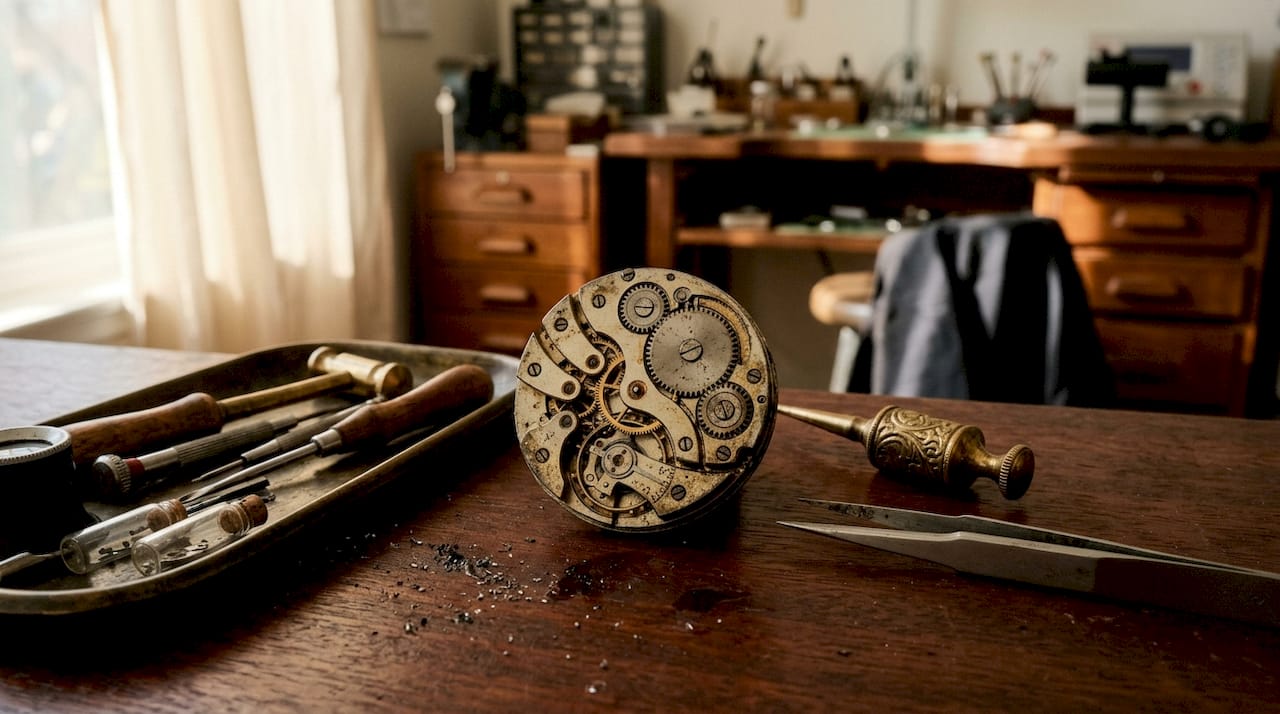
The consequences of ignoring this are expensive. Pivots, the tiny pins on which gear wheels rotate, begin to wear into their jewel bearings. Gear teeth develop flat spots. Once these components are damaged, cleaning and re-oiling is no longer enough. Parts must be replaced, and mechanical wear accelerates when lubrication fails entirely, turning a routine service into a costly repair.
Key signs that lubrication breakdown is underway:
- Accuracy drift of more than ±30 seconds per day on a watch that previously kept good time
- Noticeable reduction in power reserve, the watch running down faster than usual
- A sluggish or jerky seconds hand, particularly on movements with a slow beat rate
- Unusual noise from the movement, such as a faint grinding or scraping
Pro Tip: If your watch is running more than two minutes fast or slow per day, do not wait for the next scheduled service. Take it for a timegrapher check immediately. Catching amplitude loss early can save the cost of replacing worn pivots.
Quartz movements are not immune either. Quartz watches face friction-related wear and moisture sensitivity, and increased battery consumption can indicate that the movement needs attention. Preventative maintenance costs far less than repairing oxidation damage after the fact.
How do diagnostic tools change the servicing decision?
The traditional approach to watch servicing was calendar-based: send the watch in every five years regardless of condition. Modern watchmaking has moved away from that model. The timegrapher, a device that measures amplitude and rate by listening to the movement’s tick, gives a direct read on internal health without opening the case.
Amplitude readings below 220–240° indicate lubrication starvation regardless of how much time has passed since the last service. That single measurement is the best industry method for determining whether a movement needs attention. A watch serviced three years ago that reads 285° is fine. A watch serviced six years ago that reads 260° may also be fine. The number tells the story, not the calendar.
Timegrapher diagnostic checks are often free or low-cost and can prevent unnecessary full overhaul services. Unnecessary disassembly carries its own risk. Every time a movement is taken apart, there is a chance of introducing dust, damaging a delicate component, or misaligning a part during reassembly. A watchmaker who checks diagnostics first and only opens the case when the data justifies it is practising responsible watchmaking.
A symptom-based approach covers several indicators beyond amplitude:
- Accuracy drift: more than ±15 seconds per day on a quality mechanical movement warrants investigation
- Power reserve loss: a watch that previously ran for 42 hours now stops at 28 hours
- Crown stiffness: difficulty winding or setting the time suggests worn keyless works
- Condensation under the crystal: moisture inside the case demands immediate attention
| Indicator | Normal range | Service threshold |
|---|---|---|
| Amplitude | 270–310° | Below 220° |
| Daily rate | ±5–10 seconds | More than ±30 seconds |
| Power reserve | As specified | More than 20% reduction |
| Beat error | Below 0.3 ms | Above 0.8 ms |
Pro Tip: Ask any watchmaker to show you the timegrapher reading before and after a service. A good technician will do this without hesitation. If they cannot, find someone who can.
Does water resistance degrade without use?
Water resistance is not a permanent property. It depends entirely on the condition of rubber gaskets and O-rings that seal the case back, crown, and crystal. Those seals degrade independently of whether the watch is worn or stored. Heat, UV exposure, and simple ageing cause rubber to harden and crack.
Gaskets degrade after 2–4 years, causing seal failure even on watches rated to 100 metres. A watch that passed a pressure test when new may allow water ingress after four years of sitting in a drawer. Moisture intrusion is the leading cause of serious watch damage, and it often affects components well beyond the movement itself.
Water inside a case corrodes the dial, attacks the keyless works, and leaves mineral deposits on jewel bearings. Dial corrosion is frequently irreparable. A corroded gilt dial on a vintage piece cannot be restored without destroying its originality and collector value.
Annual pressure testing is the most cost-effective form of watch insurance available. The test takes minutes and costs very little. It confirms whether the seals are holding and flags any degradation before water gets in.
- Remove the watch before swimming or bathing if the seals have not been tested recently
- Never operate the crown underwater, even on a watch rated for diving
- Rinse the watch with fresh water after salt water exposure to prevent seal corrosion
- Book a pressure test annually if the watch is worn near water regularly
Pro Tip: A watch rated to 30 metres is splash-resistant, not swim-proof. That rating assumes new, intact seals. After two years without testing, treat any watch as water-sensitive regardless of its stated rating.
How often should you service a watch?
Most watches do well with servicing every 4–7 years, but that range is a guideline, not a rule. Heavy daily use shortens intervals because temperature variation, physical shock, and constant winding accelerate lubricant breakdown. A watch worn every day in a physical job may need attention at four years. A watch worn twice a month may be fine at eight.
The practical approach is to combine calendar awareness with symptom monitoring. Check the timegrapher reading every two to three years. If amplitude and rate are within normal ranges, leave the watch alone. Opening a healthy movement introduces risk without benefit.
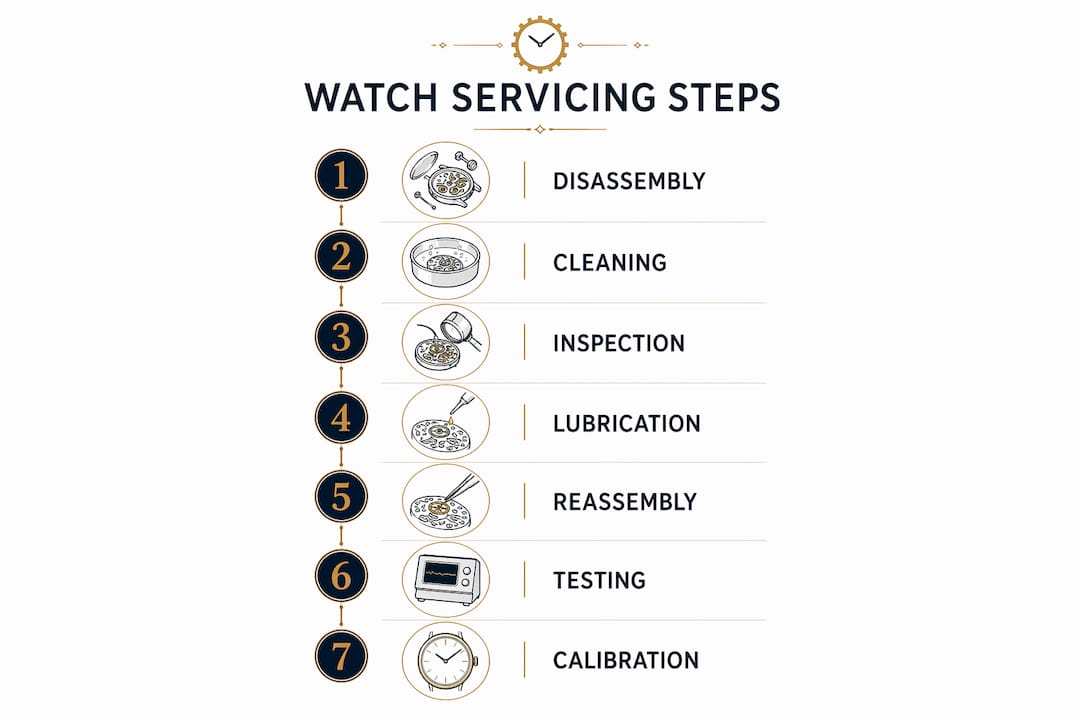
Choosing the right service provider matters as much as timing. The distinction between a full mechanical service and a cosmetic restoration is critical. A full service involves disassembly, ultrasonic cleaning, inspection of every component, replacement of worn parts, re-lubrication, and regulation. Cosmetic work covers polishing, refinishing, and strap replacement. These are separate decisions.
Over-polishing irreversibly removes metal and destroys the sharp case edges that define a watch’s original design. On vintage or collector pieces, aggressive polishing can reduce value significantly. A watchmaker who reaches for the polishing wheel without being asked is not acting in your interest.
What to look for in a service provider:
- Willingness to show timegrapher readings before and after the service
- Clear separation between mechanical work and cosmetic options
- Documented service history returned with the watch
- Transparent pricing with no surprise charges for parts
A documented service history preserves resale value. Buyers of pre-owned watches pay more for pieces with verifiable maintenance records. A single receipt from a qualified watchmaker adds credibility that no amount of polishing can replicate.
Key takeaways
Regular watch servicing preserves mechanical precision, prevents irreversible wear, and protects resale value far more effectively than any cosmetic care.
| Point | Details |
|---|---|
| Service interval guidance | Most watches need servicing every 4–7 years, adjusted for use intensity and diagnostic readings. |
| Amplitude is the key metric | Amplitude below 220° signals lubrication starvation and requires immediate attention. |
| Gaskets degrade independently | Water resistance seals fail after 2–4 years regardless of wear; annual pressure testing prevents costly moisture damage. |
| Symptom-based beats calendar | Use timegrapher readings, accuracy drift, and power reserve loss to decide when to service, not just the date. |
| Cosmetic work is separate | Over-polishing harms collector value; prioritise mechanical integrity over case appearance. |
The part most watch owners get wrong
Watch servicing is not about fixing something broken. It is about preserving something that works. That distinction sounds obvious, but most owners only think about servicing when a watch stops or runs badly. By that point, the damage is already done.
I have seen movements where the owner waited until the watch stopped completely. What could have been a straightforward service became a parts replacement job because the pivots had worn through their jewels. The cost difference is significant, and the outcome is never quite as good as a movement that was caught before damage occurred.
The other mistake I see regularly is over-servicing. Owners who read that watches need servicing every five years send them in on a rigid schedule, even when the movement is running perfectly. Preventative maintenance is more cost-effective than repair, but unnecessary disassembly is not preventative maintenance. It is unnecessary risk.
Mechanical watches require servicing because of their precision and tight tolerances, not because they are fragile. Respecting that precision means using diagnostics to make informed decisions, not following a calendar blindly. The best watchmakers I know will tell you honestly when a watch does not need opening. That honesty is the mark of genuine expertise.
— efe
Professional watch servicing at Watchrepairstation
Watchrepairstation has provided trade-to-trade watch repair services across the UK since 2008, with a “No Fix, No Cost” guarantee that removes financial risk from every job. Their technicians carry out full mechanical overhauls, timegrapher health checks, movement repairs, and battery installations, covering the complete range of servicing needs from routine maintenance to complex restoration.

For watch and jewellery shops looking to offer customers expert servicing without long wait times or inflated costs, Watchrepairstation provides competitive trade pricing and fast turnaround. Every repair is handled by qualified technicians who prioritise mechanical integrity. Visit the services overview to see the full range of options available.
FAQ
How often should a mechanical watch be serviced?
Most mechanical watches need servicing every 4–7 years, though heavy daily use may require earlier attention. A timegrapher check every two to three years gives a more accurate picture than calendar intervals alone.
What happens if you never service a watch?
Lubricants dry out and cause metal-on-metal friction, which wears pivots and gear teeth. Amplitude drops below safe levels and the watch eventually stops or becomes unreliable, often requiring expensive parts replacement.
Can a watch lose water resistance without being damaged?
Yes. Rubber gaskets and O-rings harden and crack after 2–4 years regardless of use, causing seal failure. A watch can lose its water resistance while appearing and running perfectly normally.
What does amplitude mean in watch servicing?
Amplitude is the arc through which the balance wheel swings, measured in degrees. A healthy movement runs at 270–310°. Readings below 220° indicate lubrication starvation and signal that servicing is needed.
Does polishing a watch affect its value?
Over-polishing removes metal and destroys the original case geometry, which reduces collector and resale value on vintage and luxury pieces. Mechanical servicing should always take priority over cosmetic restoration.

Leave a Reply