

Watches lose time because of lubricant degradation, magnetism, power reserve depletion, and environmental damage, each disrupting the movement’s precision in a distinct way. Understanding why watches lose time explained in full means looking beyond the obvious. A watch that runs a few seconds slow each day tells a very different story from one that suddenly drops several minutes overnight. The causes range from chemistry to physics, and most are entirely fixable. Whether you wear a mechanical automatic or a quartz, the principles governing timing accuracy of different watches are grounded in the same core mechanics.
Why watches lose time: the role of lubricant degradation
Lubricant breakdown is the single most common cause of gradual time loss in mechanical watches. Watch oils have a standard service life of approximately 5–7 years. After that point, the oil does not simply disappear. It transforms.
The transition from fluid oil to a sticky sludge changes the friction characteristics inside the movement entirely. Degraded lubricants cause the balance wheel’s amplitude to drop below 220 degrees, the threshold below which consistent timekeeping becomes impossible. A watch running at reduced amplitude will lose seconds or even minutes per day, and the loss will worsen progressively as the oil continues to break down.
The balance wheel is the heartbeat of a mechanical movement. When friction increases around its pivots and jewels, the wheel swings less freely. Less swing means shorter oscillations, and shorter oscillations mean the watch runs slow. This is mechanical watch time accuracy at its most fragile point.
- Amplitude below 220 degrees produces erratic, unreliable timekeeping
- Dried lubricant causes metal-on-metal contact, accelerating wear on pivots and jewels
- Worn pivots create permanent damage that servicing alone cannot reverse
- Lubricant breakdown is invisible without opening the case
Pro Tip: If your mechanical watch has not been serviced in over five years and is losing time gradually, book a full service before the worn lubricant causes irreversible damage to the movement’s components.
Lubricant breakdown is a subtle but critical issue. If ignored, it results in irreversible wear and significantly worsened accuracy. A full service, which includes cleaning, re-oiling, and regulation, restores the movement to its correct operating condition.
How does magnetism cause a watch to lose time?
Magnetism causes the most dramatic and sudden timing failures in mechanical watches. Technicians report that magnetism is responsible for the majority of sudden drastic timing failures. The effect is immediate and often severe, with a magnetised watch capable of losing or gaining several minutes per day rather than the few seconds typical of normal operation.
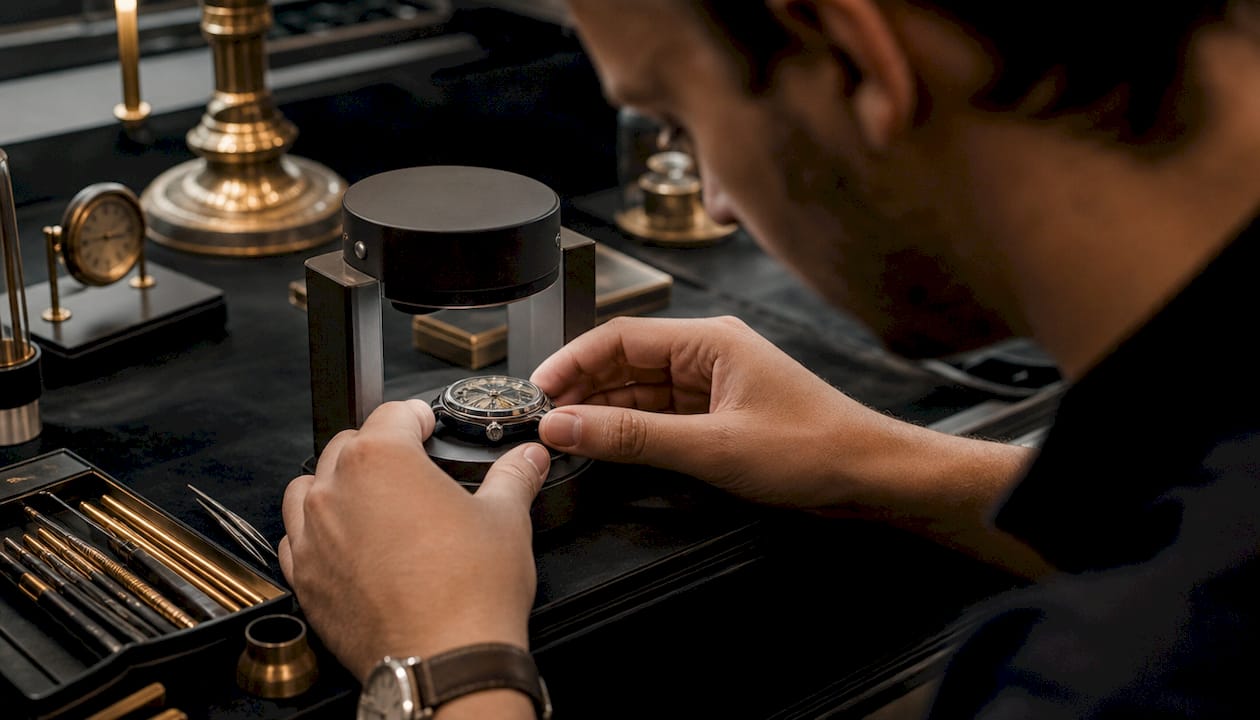
The mechanism is specific. Magnetism causes the hairspring coils to stick together, shortening their effective length. A shorter effective spring length alters the oscillation frequency of the balance wheel. Crucially, this does not always make the watch run fast. Depending on which coils stick and how, the watch can run erratically slow as well. This surprises many wearers who assume magnetism only speeds a watch up.
Common sources of magnetic interference include:
- Smartphone magnets, particularly in cases with magnetic closures
- Laptop speakers and tablet covers with magnetic clasps
- Magnetic bag clasps and jewellery
- Induction hob surfaces and some audio equipment
Pro Tip: Before spending money on a mechanical repair, ask a watchmaker to test for magnetism first. Demagnetisation takes minutes and costs very little. It eliminates the most common cause of sudden timing failure before anything else is opened.
Owners should rule out magnetism as a cause of erratic timing before considering expensive mechanical repairs. A professional demagnetiser restores the hairspring to its correct geometry without any disassembly of the movement.
Does power reserve affect how accurately a watch keeps time?
Power reserve depletion directly affects mechanical watch accuracy, and the effect is predictable. Most automatic watches carry a power reserve of 38–70 hours. As the mainspring unwinds and tension falls, the energy delivered to the balance wheel decreases. Lower energy means reduced amplitude, and reduced amplitude means the watch runs slow.
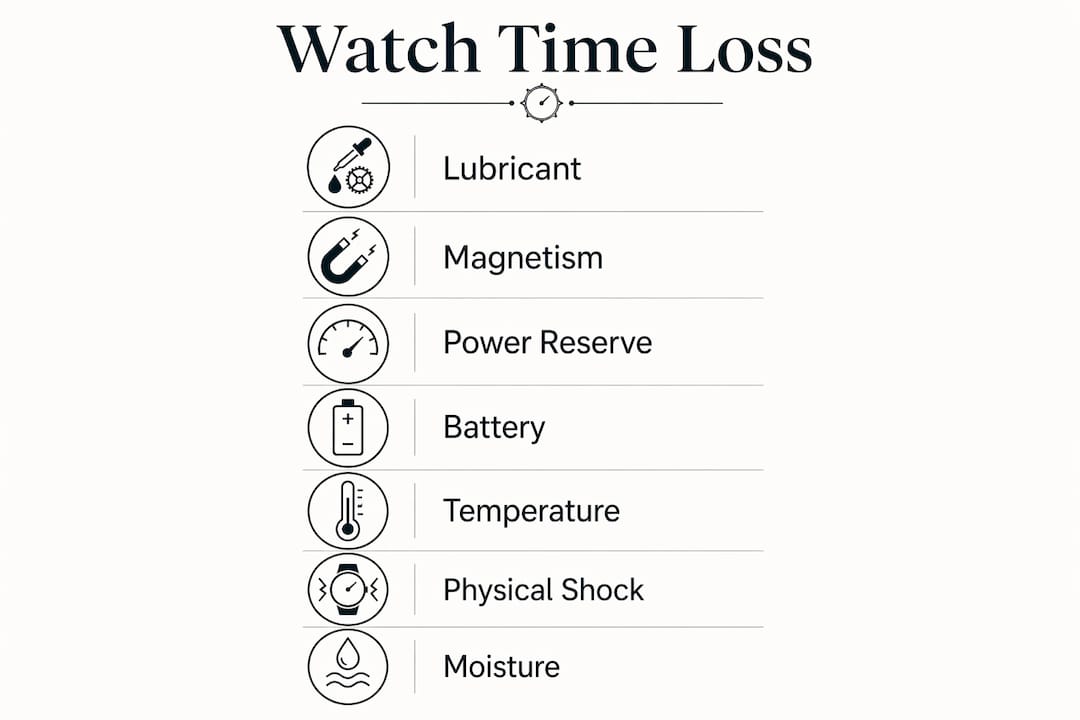
The accuracy drop is most noticeable in the final third of the power reserve. A watch left off the wrist overnight and found running slow in the morning is often simply running low on power, not suffering a mechanical fault. Winding the watch or wearing it through the day resolves the issue entirely.
Positional variance adds another layer. Gravity affects the balance wheel differently depending on the watch’s orientation:
- Dial up: the balance wheel sits horizontally, with gravity acting symmetrically on all sides
- Crown down: gravity pulls the balance wheel to one side, altering its swing
- Crown up: a common resting position that produces a measurably different rate from dial up
- Dial down: often the fastest-running position in an unregulated movement
- Crown left and crown right: produce intermediate rates that watchmakers factor into regulation
Watchmakers regulate movements across multiple positions to reduce this natural variance from gravity and orientation. Higher-grade movements receive more thorough positional regulation. Entry-level automatics may show a wider spread between positions. Wearing the watch regularly reduces amplitude fluctuation because the winding rotor keeps the mainspring tensioned throughout the day.
What else causes a watch to run slow?
Several additional factors cause time loss in both mechanical and quartz watches. Each has a distinct signature that helps identify the cause before opening the case.
Battery depletion in quartz watches
A quartz watch losing time often signals a battery approaching the end of its life. The most telling sign is the second hand jumping in 2–4 second intervals rather than ticking once per second. This behaviour is a built-in warning system in many quartz movements, designed to alert the wearer before the watch stops entirely. A low battery causes erratic timekeeping and progressive time loss before complete failure. Replacing the battery promptly restores full accuracy.
Temperature and its effect on movement precision
Temperature changes affect mechanical watches in two ways. Heat thins lubricants, reducing their effectiveness. It also causes metal components to expand, altering the inertia of the balance wheel. Measurable time loss occurs with significant temperature changes in mechanical watches due to these combined effects. A watch worn in a cold environment and then moved into warmth may show a brief period of inaccuracy as the movement adjusts.
Physical shocks and impacts
Physical shocks can displace delicate internal components, shifting the timekeeping rate even without visible external damage. A knock to the regulator arm or a displaced jewel can alter the movement’s geometry permanently. If a watch begins losing time after a knock or drop, the movement needs inspection.
Moisture ingress
Moisture entering through a compromised gasket or worn crown seal corrodes internal parts before any visible signs appear. Misting under the crystal is the clearest early warning. Poor timekeeping often precedes visible condensation. Early intervention prevents far more serious damage.
| Cause | Watch type affected | Key symptom | Recommended action |
|---|---|---|---|
| Lubricant degradation | Mechanical | Gradual time loss over months | Full service every 5–7 years |
| Magnetism | Mechanical | Sudden erratic gain or loss | Professional demagnetisation |
| Power reserve depletion | Mechanical automatic | Slow rate when off the wrist | Regular wear or manual winding |
| Battery depletion | Quartz | Second hand jumping in intervals | Battery replacement |
| Temperature extremes | Both | Temporary rate change | Avoid extreme environments |
| Physical shock | Both | Time loss after impact | Movement inspection |
| Moisture ingress | Both | Misting, then poor timekeeping | Immediate professional assessment |
Key takeaways
Watches lose time due to lubricant degradation, magnetism, power reserve depletion, battery failure, temperature, physical shock, and moisture, each requiring a different fix.
| Point | Details |
|---|---|
| Lubricant service life | Mechanical watch oils last 5–7 years; degradation causes amplitude to drop below 220 degrees and time loss to worsen. |
| Magnetism is the top sudden cause | Magnetism makes hairspring coils stick together, causing erratic time loss; demagnetisation is a fast, low-cost fix. |
| Power reserve affects accuracy | Accuracy drops in the final third of the power reserve; regular wear or winding prevents this. |
| Quartz watches signal battery failure | A second hand jumping in 2–4 second intervals means the battery is nearly dead and needs replacing. |
| Environmental damage is cumulative | Temperature, shock, and moisture each degrade accuracy over time; early professional inspection limits the damage. |
The thing most wearers get wrong about time loss
People assume that a watch losing time means something is seriously broken. That assumption leads to two mistakes: either they ignore the problem entirely because they think repair will be expensive, or they panic and spend money on unnecessary work.
Minor, consistent time loss in a mechanical watch is normal. Every mechanical movement has a rated accuracy tolerance. A watch running two or three seconds slow per day is not failing. It is operating within the expected range for its movement grade. The problem begins when the rate changes suddenly or worsens progressively.
What I find most telling in practice is the pattern of loss. Gradual worsening over months points to lubricant breakdown. A sudden shift of several minutes points to magnetism. Time loss only when the watch sits off the wrist overnight points to power reserve. Each pattern is a diagnostic clue, and reading it correctly saves both time and money.
The most neglected cause is magnetism, and it frustrates me that so many wearers skip straight to expensive servicing without checking for it first. A demagnetisation test takes two minutes. If it solves the problem, the watch needed no further work at all. Always check the simple things first.
Lubricant servicing, on the other hand, is the one area where delay genuinely costs more. Worn oil does not just reduce accuracy. It accelerates wear on pivots and jewels that cannot be restored without replacement parts. A service at the five-year mark is always cheaper than a repair at the eight-year mark. Daily wear frequency and environment directly affect mechanical wear and timing consistency. A watch worn daily in a stable environment will outlast one stored in fluctuating conditions, even with identical service intervals.
— efe
Watchrepairstation can restore your watch’s accuracy
When time loss points to a problem beyond a simple wind or battery swap, professional diagnosis makes the difference between a minor fix and a costly repair.

Watchrepairstation has provided trade-to-trade watch repair services across the UK since 2008. Their technicians handle the full range of causes behind timing inaccuracy, from lubricant renewal and movement overhauls to demagnetisation and quartz battery replacement. Every repair comes with a “No Fix, No Cost” guarantee, so there is no financial risk in getting a professional assessment. Quick turnaround times mean your customers are not left waiting. Contact Watchrepairstation to book a diagnostic and get your watch running accurately again.
FAQ
Why does my watch lose time when I take it off?
A mechanical automatic watch loses time off the wrist because the mainspring tension drops as the power reserve depletes. Accuracy falls noticeably in the final third of the reserve, typically after 38–70 hours without wear or winding.
Can magnetism make a watch lose time rather than gain it?
Yes. Magnetism causes hairspring coils to stick together, which can make the watch run either fast or erratically slow depending on which coils are affected. Demagnetisation corrects the issue without disassembly.
How often should a mechanical watch be serviced to keep accurate time?
Mechanical watch lubricants have a service life of approximately 5–7 years. Servicing within this interval prevents amplitude loss below 220 degrees and avoids irreversible wear on pivots and jewels.
What does a jumping second hand mean on a quartz watch?
A second hand jumping in 2–4 second intervals is a diagnostic signal that the battery is approaching the end of its life. Replacing the battery restores normal one-second ticking and accurate timekeeping.
Does temperature affect watch accuracy?
Temperature changes affect mechanical watches by thinning lubricants and causing metal components to expand, both of which alter the balance wheel’s behaviour. Significant temperature swings produce measurable time loss until the movement stabilises.

Leave a Reply