

Express watch servicing is defined as a category of rapid, minor watch repairs completed within minutes to 24 hours, covering tasks like battery replacement, band adjustments, and simple crystal or gasket repairs. It is not a full mechanical overhaul. The distinction matters enormously for both individuals and businesses, because confusing the two leads to unmet expectations, wasted time, and watches returned in worse condition than expected. Understanding what is express watch servicing sets the right expectations from the start and helps you choose the correct service every time.
What types of services qualify as express watch servicing?
Express watch servicing covers a defined set of minor, non-invasive tasks. These are repairs that do not require movement disassembly or multi-day calibration. The most common types of express watch repair services are battery replacement, band adjustments, crystal swaps, gasket replacements, and basic bracelet cleaning.
Battery replacement is the most frequent express task. A battery swap takes roughly 10–15 minutes and requires no movement work whatsoever. Band adjustments and link removals typically take 15–20 minutes and are completed while the customer waits. Simple crystal replacements and gasket swaps, which restore water resistance to a basic level, fall within the express category when no movement damage is present.

Ultrasonic bracelet cleaning is another quick maintenance option. The bracelet is removed, placed in an ultrasonic bath, and returned clean within minutes. This is cosmetic maintenance, not mechanical servicing.
The table below summarises the most common express services, their typical durations, and approximate cost ranges in the UK market.
| Service type | Typical duration | Approximate cost range |
|---|---|---|
| Battery replacement | 10–15 minutes | £15–£30 |
| Band adjustment or repair | 15–20 minutes | £20–£25 |
| Crystal replacement | 30–60 minutes | £30–£80 |
| Gasket replacement | 20–40 minutes | £25–£60 |
| Ultrasonic bracelet cleaning | 15–30 minutes | £15–£35 |
What express servicing does not cover is equally important. Express services fix broken parts rapidly, but they do not address internal mechanical wear, lubricant degradation, or calibration drift. Any repair requiring movement removal, lubrication, or multi-day timing tests falls outside the express category entirely.
How does express watch servicing differ from a full overhaul?
A full mechanical overhaul is a completely different process. It involves removing the movement, disassembling every component, cleaning parts ultrasonically, replacing worn pieces, re-lubricating, reassembling, and then running multi-day timing tests. The entire process typically takes 2–6 weeks. Expecting express speed from a full overhaul is not realistic, and any shop promising a same-day full overhaul should be treated with caution.
Attempting to compress a full overhaul into a same-day service risks insufficient lubrication and incomplete timing calibration. Both failures cause long-term damage that costs far more to correct later. The time requirements are not arbitrary. Lubricants need time to settle, and timing accuracy must be verified across multiple positions and temperatures.
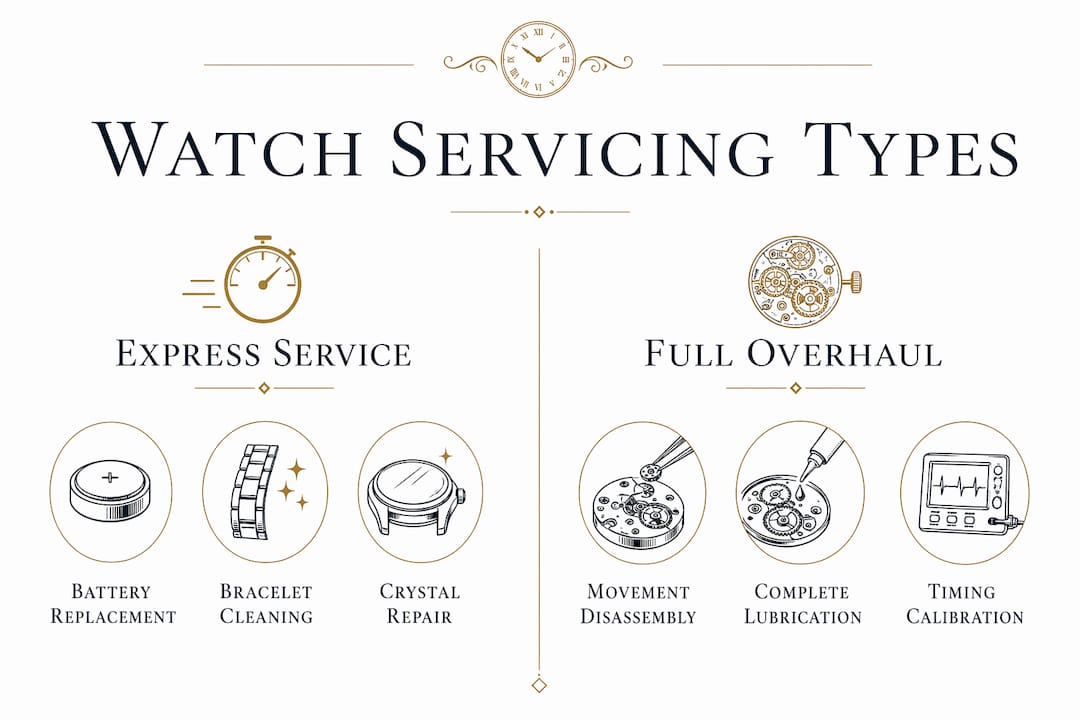
The key conceptual difference is this: express servicing is reactive, while full servicing is preventative. Repair addresses existing faults such as a dead battery or cracked crystal. Full servicing prevents future faults by replacing lubricants and worn components before they fail. Delayed full servicing often creates the very faults that then require expensive repairs.
Pro Tip: If your mechanical watch is losing or gaining more than 30 seconds per day, or if you notice condensation under the crystal, these are signs the watch needs a full service, not an express repair. Accuracy drift beyond this threshold indicates lubricant degradation that no quick fix can address.
Signs that indicate a full service rather than an express repair:
- Consistent timekeeping errors exceeding 30 seconds per day
- Condensation or fogging inside the crystal
- A crown that feels stiff or gritty when setting the time
- Visible corrosion or moisture damage inside the case
- A watch that has not been serviced within the last 5–7 years
High-quality servicing uses timing machines such as the Witschi Watch Expert to verify accuracy across multiple positions. Express servicing cannot replicate these checks. That is not a criticism of express servicing. It simply confirms that the two categories serve entirely different purposes.
What are the pricing tiers and standards for express watch services in 2026?
The watch service industry in 2026 organises repair complexity into three clear tiers. Understanding these tiers helps individuals and businesses assess whether a quote is fair and whether the service matches the actual need.
Level 1 covers immediate express tasks such as battery replacement, priced at approximately £15–£30. Level 2 covers water resistance testing, minor movement adjustments, and simple part replacements, ranging from £25–£80. Level 3 is the full mechanical overhaul, which costs £200 to over £1,000 depending on the brand, movement complexity, and parts required.
The table below compares the three service tiers by scope, typical lead time, and cost range.
| Service level | Scope | Typical lead time | Cost range |
|---|---|---|---|
| Level 1: Express | Battery, band, crystal, gasket | Minutes to 24 hours | £15–£80 |
| Level 2: Intermediate | Water resistance testing, minor repairs | 1–5 days | £25–£150 |
| Level 3: Full overhaul | Movement disassembly, lubrication, calibration | 2–6 weeks | £200–£1,000+ |
Pricing varies by watch type. A battery replacement in a basic quartz watch costs less than the same task on a luxury dress watch with a complex case back. Crystal replacements on sapphire-crystal watches cost more than mineral glass equivalents. Transparency on these variables before work begins is the mark of a professional provider.
What are the benefits and limitations of fast watch servicing?
Fast watch servicing delivers clear advantages for both individuals and businesses. The most direct benefit is minimal downtime. A watch returned within the hour or by the next day keeps a customer satisfied and a business’s reputation intact. Express servicing reduces customer wait times and avoids the frustration that comes with weeks-long repair queues.
Cost efficiency is the second major benefit. Express tasks are priced as minor interventions, not full overhauls. For a watch that simply needs a new battery or a resized bracelet, paying for a full service would be wasteful and unnecessary.
The limitations are equally real and should not be ignored.
- Express servicing cannot address internal mechanical deterioration
- Cosmetic freshness does not indicate mechanical health; a clean bracelet and new battery do not mean the movement is sound
- Quick fixes may mask underlying problems that worsen over time
- Shops without in-house watchmakers introduce delays and quality risks when outsourcing express tasks
Businesses with in-house express servicing capabilities manage repair timelines better and maintain tighter quality control than those relying on third parties. Outsourcing introduces unknown handling and unpredictable lead times, which defeats the purpose of offering express repairs in the first place.
Pro Tip: Use express servicing as a first line of response, not a substitute for planned maintenance. Schedule a full mechanical service every 5–7 years alongside express repairs as needed. This combination extends watch life and prevents costly failures.
How to choose a reliable express watch servicing provider in 2026
Choosing the right provider for fast watch servicing requires more than checking turnaround times. The following criteria separate professional providers from those cutting corners.
-
In-house certified watchmakers. Independent certified watchmakers provide faster express repairs and more personalised service than brand-authorised centres, which typically have longer queues and higher costs. Confirm that repairs are carried out on-site, not sent away.
-
Free inspection and written estimate. Professional shops provide free inspection and written estimates before any work begins. This protects you from unexpected charges and confirms the provider understands the scope of the job.
-
Warranty on completed repairs. Any reputable express service provider stands behind their work with a written warranty. Ask specifically what the warranty covers and for how long.
-
Transparent pricing aligned with service tiers. A provider who cannot explain why a repair falls into Level 1 versus Level 2 is not operating to industry standards. Pricing should match the scope of work clearly and without ambiguity.
-
Genuine parts and proper tools. Express repairs using non-genuine batteries or incorrect gaskets create problems within months. Confirm that the provider uses manufacturer-compatible parts and appropriate tools for the watch type.
-
Realistic turnaround promises. High-quality watch servicing is validated by rigorous testing, not just speed. A provider promising a same-day full overhaul is not delivering quality work. Express turnarounds apply to express tasks only.
Key takeaways
Express watch servicing is the correct choice for minor, time-sensitive repairs, but it cannot replace a full mechanical overhaul and should be paired with planned preventative maintenance every 5–7 years.
| Point | Details |
|---|---|
| Express scope is limited | Battery, band, crystal, and gasket repairs qualify; movement overhauls do not. |
| Turnaround is minutes to 24 hours | Full overhauls take 2–6 weeks; any same-day overhaul claim signals poor quality. |
| Three pricing tiers exist | Level 1 (£15–£80), Level 2 (£25–£150), Level 3 (£200–£1,000+) reflect service complexity. |
| Pair express with full servicing | Schedule a full mechanical service every 5–7 years alongside express repairs as needed. |
| Choose in-house providers | Shops with on-site watchmakers deliver faster, more reliable express repairs than outsourcing. |
Why the industry still gets express servicing wrong
The biggest misconception I encounter is that “express” means the same as “quick full service.” It does not, and the confusion causes real harm. Customers bring in a mechanical watch that has not been serviced in a decade, ask for a battery change, and assume the job is done. The battery gets replaced. The watch looks fine. Six months later, the movement seizes because the lubricants dried out years ago.
The trend I find encouraging is the growth of integrated repair shops that handle both express tasks and full overhauls under one roof. These businesses can triage a watch correctly on arrival, complete the express task if that is genuinely all that is needed, and flag when a full service is overdue. That kind of honest assessment is what builds long-term customer trust.
What I think the industry still underinvests in is customer education. Most people do not know that a watch losing 45 seconds a day needs a full service, not a battery. Shops that take two minutes to explain this distinction retain customers for life. Those that simply replace the battery and say nothing lose them when the watch fails again.
My advice to any business offering watch repair services: build express servicing into your offering, but train your team to recognise when a watch needs more than a quick fix. The short-term revenue from an unnecessary express repair is not worth the long-term cost of a dissatisfied customer.
— efe
Watchrepairstation: fast, expert watch servicing for trade partners
Watchrepairstation has provided trade-to-trade watch repair services across the UK since 2008, with in-house expert watchmakers handling everything from battery replacements to full mechanical overhauls. Every express task, including battery installation, band adjustments, and crystal replacements, is carried out on-site by certified technicians, not outsourced.
Watch and jewellery shops partnering with Watchrepairstation benefit from the “No Fix, No Cost” guarantee, transparent pricing, and quick turnaround times on most express repairs. Free inspections and clear written quotes come before any work begins. For businesses that need to protect their reputation and keep customers satisfied without long wait times, Watchrepairstation offers the reliability and speed that express servicing demands.
FAQ
What is express watch servicing?
Express watch servicing is a category of rapid, minor watch repairs, such as battery replacement, band adjustments, and crystal or gasket swaps, completed within minutes to 24 hours. It does not include full mechanical overhauls, which require 2–6 weeks.
How long does an express watch service take?
Battery replacements typically take 10–15 minutes, band adjustments take 15–20 minutes, and crystal or gasket replacements take 30–60 minutes. All express tasks are completed the same day or within 24 hours.
Can express servicing fix a watch that keeps losing time?
Not reliably. A mechanical watch losing more than 30 seconds per day indicates lubricant degradation or worn components, both of which require a full mechanical overhaul rather than an express repair.
How much does express watch servicing cost in the UK?
Battery replacements cost approximately £15–£30, band repairs cost £20–£25, and crystal or gasket replacements range from £25–£80. Costs vary by watch type and the complexity of the task.
How often should I combine express servicing with a full service?
Express repairs can be carried out as needed throughout a watch’s life. A full mechanical overhaul should be scheduled every 5–7 years to replace lubricants and worn parts before they cause failures that no express service can correct.

Leave a Reply