

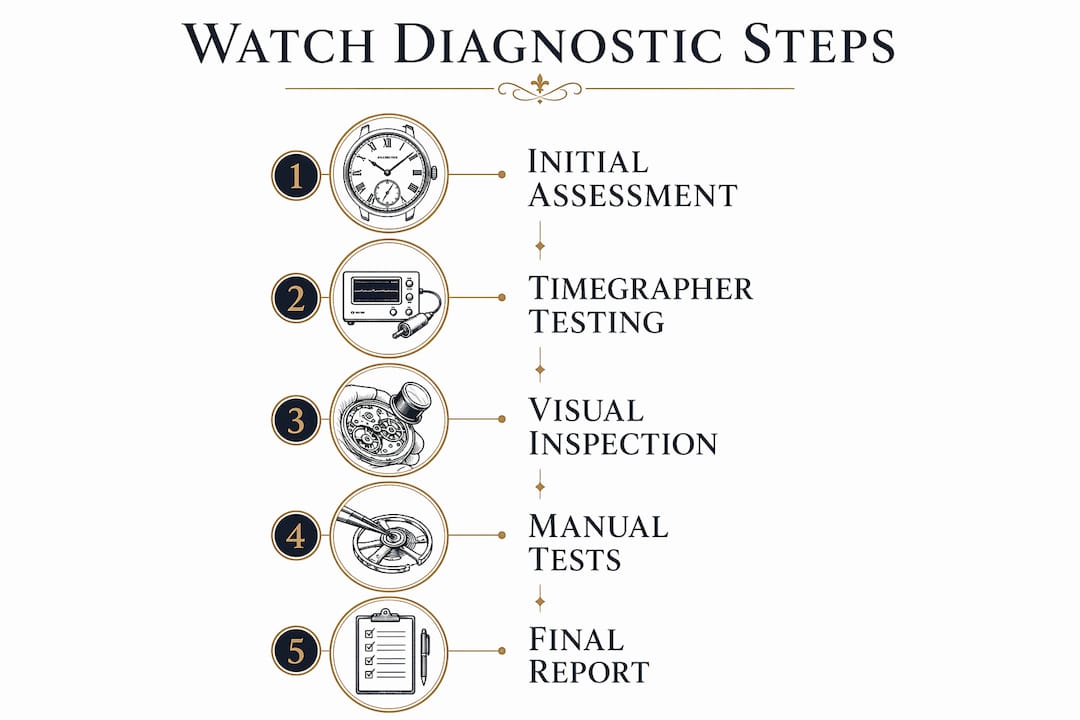
A watch diagnostic check is a formal evaluation of a timepiece’s movement and case health, using tests such as timekeeping accuracy, power reserve, and water resistance to detect faults before they escalate. In the watchmaking trade, this process is more precisely called a condition assessment or pre-service inspection. Both terms describe the same goal: establishing a baseline of how a watch is performing without immediately opening it for repair. The initial assessment phase lasts 15–30 minutes and covers timegrapher testing, visual inspection, and case condition checks. That short window of observation can save a collector hundreds of pounds by catching a problem early.
What does a watch diagnostic check involve for mechanical watches?
A mechanical watch diagnostic follows a staged process designed to gather information before any tools touch the movement. Experienced watchmakers spend 5–10 minutes observing a watch under magnification, listening to the movement, and checking crown action before opening the caseback. This prevents unnecessary case opening and the rough handling that can introduce additional damage.
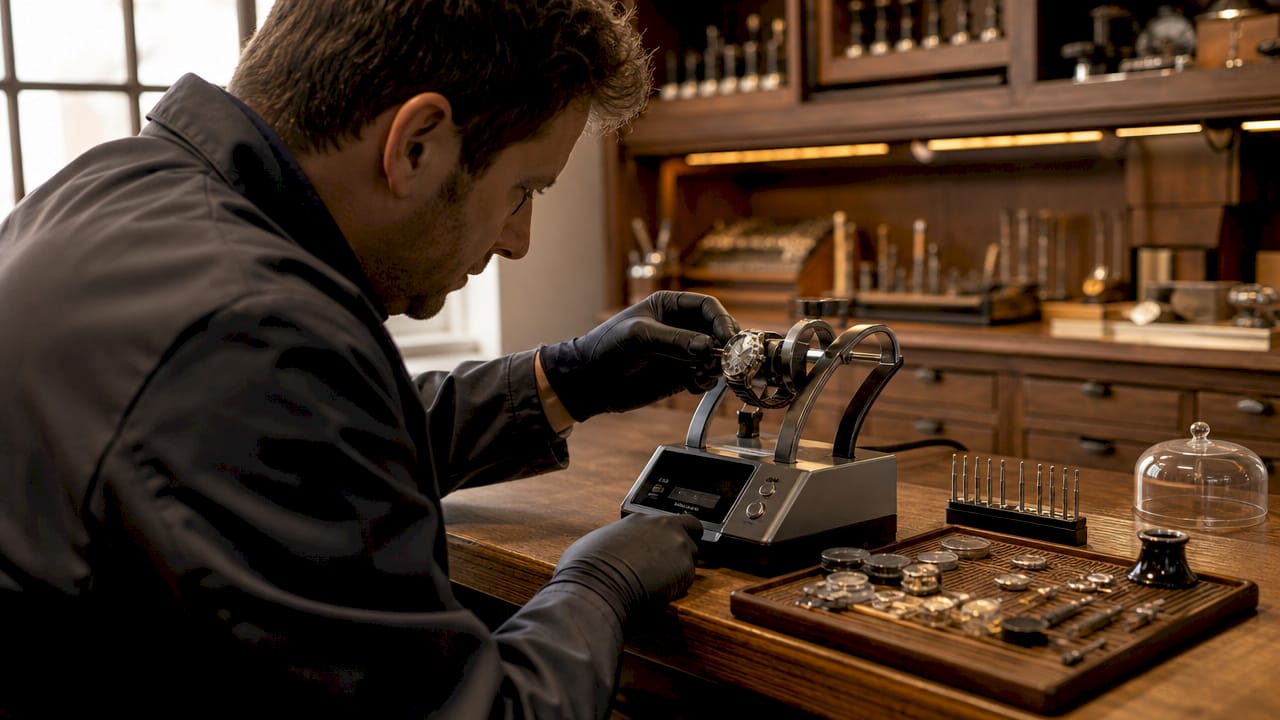
Timegrapher testing
The timegrapher is the most informative single tool in mechanical watch repair diagnostics. It measures three values: rate (seconds gained or lost per day), amplitude (the swing of the balance wheel in degrees), and beat error (the timing asymmetry between tick and tock). Ideal values sit at approximately +5 sec/day for rate, 270–310° for amplitude, and below 0.4 ms for beat error. A reading outside these ranges tells the technician whether the watch needs regulation or has a deeper mechanical fault.
Multi-position testing on the timegrapher adds further detail. Rate variations between dial-up and crown-down positions point to balance wheel poising errors. That distinction matters because poising errors require a different repair pathway than simple regulation.
Visual and physical inspection
After timegrapher testing, the technician examines the case, crystal, crown, and caseback under magnification. Crown and caseback inspection for moisture residue or signs of forced opening is a vital non-invasive step. It reveals potential movement corruption without opening the watch at all.
The technician also tests manual winding resistance. A crown that winds without any resistance, or one that grinds, signals problems with the mainspring or keyless works. A wobbly crown points to a worn or damaged stem, which can compromise the water resistance seal.
Pro Tip: Before handing your watch to any technician, note the exact symptoms you have observed: when the issue started, whether the watch was exposed to moisture, and any changes in how the crown feels. This information directly improves diagnostic accuracy.
Key signs that trigger a mechanical watch diagnostic check:
- Daily timekeeping variations of more than a few seconds
- Reduced power reserve compared to the manufacturer’s specification
- Winding resistance that feels absent, uneven, or grinding
- A crown that wobbles, sticks, or feels loose
- Visible condensation under the crystal
How are smartwatch diagnostics conducted?
Smartwatch diagnostics take a fundamentally different approach from mechanical watch repair diagnostics. Rather than physical tools like the timegrapher, smartwatch checks are software-based, testing up to 18 hardware components via paired apps. Battery health, sensors, touchscreen response, and connectivity modules are all evaluated within a single session.
A full manual diagnostic session for a smartwatch spans around 60 minutes. That time covers physical inspection of the case and strap lugs, firmware updates, sensor calibration, and battery health verification. The scope is broader than most owners expect.
The contrast with mechanical diagnostics is instructive. A mechanical watch functioning check relies on a technician’s trained senses and analogue instruments. A smartwatch check relies on software reading hardware registers and returning pass or fail values. Neither approach is superior; they reflect the fundamentally different architectures of the two watch types.
Components typically tested during a smartwatch diagnostic:
- Battery capacity and charge cycle count
- Heart rate and SpO2 sensor accuracy
- GPS and Bluetooth connectivity
- Touchscreen sensitivity and dead zones
- Accelerometer and gyroscope calibration
- Microphone and speaker function
- Water resistance gasket condition
Pro Tip: Keeping your smartwatch firmware up to date is itself a form of ongoing diagnostics. Manufacturers regularly release updates that recalibrate sensors and correct software faults that would otherwise require a manual service visit.
Why preventive diagnostics matter: benefits and risks of skipping checks
Preventative diagnostics identify small mechanical risks like lubricant degradation or gear friction before they require costly full overhauls. A watch movement contains dozens of components that rely on correctly viscous lubricants. Those lubricants dry out over time, and the friction that follows accelerates wear on pivots, jewels, and gear teeth.
The financial logic is straightforward. A diagnostic check costs a fraction of a full movement overhaul. Catching degraded lubrication early means a targeted service rather than a complete strip-down and rebuild.
Many owners misinterpret minor symptoms as trivial, yet these often signal serious underlying issues. A wobbly crown or faint condensation under the crystal can escalate from a simple seal replacement to total movement failure if left unaddressed. Ignoring these symptoms can transform a £50 repair into a £500 overhaul.
The risks of skipping watch maintenance procedures are concrete and well-documented. Moisture that enters through a worn crown seal corrodes steel components within the movement. Corrosion on a balance staff or escape wheel pivot is irreversible without replacing the affected part. In severe cases, moisture damage renders a movement beyond economic repair.
Common overlooked symptoms that warrant immediate diagnostics:
- Minor condensation inside the crystal after a shower or swim
- A crown that has become slightly harder or easier to pull out
- The second hand stuttering rather than sweeping smoothly
- The watch stopping at the same time each day, which can indicate a date mechanism fault
- Unusual sounds from the movement, such as a faint scraping or rattling
A watch stopping at the same time daily often points to a date mechanism problem rather than a simple power reserve issue. That distinction changes the repair pathway entirely, which is exactly why a diagnostic check precedes any repair work.
When should watch owners seek a diagnostic check?
The clearest trigger for a professional watch functioning check is any change in normal behaviour. Irregular timekeeping, a drop in power reserve, or unusual crown behaviour all warrant professional attention. The question is not whether to seek a diagnostic, but how urgently.
Urgency increases significantly after specific events. Moisture exposure, a hard impact, or a drop onto a hard surface all create conditions where internal damage may not be immediately visible. A watch that survives a fall and appears to run normally can still have a cracked jewel or a bent pivot that will cause failure weeks later.
For quartz watches, the diagnostic process helps distinguish a simple battery replacement from a more complex fault. A quartz movement that drains batteries unusually quickly, or that stops intermittently, may have a coil fault or a leaking battery that has corroded the movement. Replacing the battery without diagnosing the root cause wastes money and time.
A checklist for owners preparing for a diagnostic intake:
- Note when the issue first appeared and whether it was sudden or gradual.
- Record any moisture exposure, impacts, or drops since the last service.
- Describe any changes in crown feel, winding resistance, or setting behaviour.
- Note whether the watch has been serviced before and when.
- Bring any original paperwork, warranty cards, or previous service records.
Providing these details improves technician assessment accuracy and diagnostic outcome. A technician who knows a watch was submerged three months ago will inspect the seals and movement for corrosion as a priority, rather than starting from scratch.
Pro Tip: If your watch has regular servicing needs, keep a simple log of service dates, battery changes, and any incidents. This history is as valuable to a watchmaker as a service history is to a car mechanic.
Key takeaways
A watch diagnostic check is the most cost-effective step a collector can take, because early detection of lubricant degradation, seal failure, or rate deviation prevents full movement overhauls.
| Point | Details |
|---|---|
| Diagnostic check definition | A formal evaluation of movement and case health using timegrapher, visual inspection, and water resistance tests. |
| Mechanical watch tools | The timegrapher measures rate, amplitude, and beat error to distinguish regulation needs from deeper faults. |
| Smartwatch diagnostics | Software-based checks test up to 18 hardware components including battery, sensors, and connectivity modules. |
| Preventive value | Early diagnosis of lubricant degradation or seal wear prevents costly full overhauls and irreversible corrosion damage. |
| Owner preparation | Providing a detailed symptom history and incident log to the technician directly improves diagnostic accuracy and outcome. |
Why I think most collectors underestimate the diagnostic check
The watch community talks endlessly about servicing intervals, movement finishing, and complication counts. The diagnostic check rarely gets the same attention. That is a mistake I have seen cost collectors real money.
A diagnostic check is not a lesser version of a service. It is a distinct professional act. The technician’s job at that stage is to gather information without disturbing the watch. A good technician will tell you things about your watch’s condition that you could not discover yourself, even with a loupe and a steady hand. The timegrapher reading alone, taken in five positions, reveals more about a movement’s health than years of casual ownership observation.
The part that most owners miss is the conversation at intake. Describing your watch’s symptoms clearly and completely is not just helpful. It changes what the technician looks for first. A collector who mentions that their watch lost 30 seconds one morning after a cold walk sends the technician directly to the balance wheel and hairspring. A collector who says only “it’s running slow” gives the technician nothing to prioritise.
Responsible watch ownership means treating diagnostics as a scheduled event, not a crisis response. A watch that has not been serviced in five years and shows no obvious symptoms still benefits from a condition assessment. Lubricants degrade on a timeline, not on a symptom schedule. The diagnostic check is how you find out where you are on that timeline before the watch tells you in a more expensive way.
— efe
Watchrepairstation’s expert diagnostic and repair service
Watchrepairstation has provided professional watch repair and diagnostics across the UK since 2008, with a trade-focused approach that puts expert technicians on every job.

Every watch that arrives at Watchrepairstation undergoes a thorough condition assessment using a timegrapher, visual inspection under magnification, and case integrity checks. Findings are communicated clearly before any repair work begins, so you know exactly what your watch needs and why. The professional watch repair service covers everything from diagnostic assessment through to full movement overhaul, with Watchrepairstation’s “No Fix, No Cost” guarantee removing all financial risk. Whether your watch shows clear signs of malfunction or you simply want a baseline check on a valued piece, Watchrepairstation’s technicians deliver a thorough, transparent assessment with fast turnaround times.
FAQ
What is a watch diagnostic check?
A watch diagnostic check is a professional evaluation of a timepiece’s movement and case condition using tools such as a timegrapher and visual inspection. It identifies faults and establishes a performance baseline without necessarily opening the watch for repair.
How long does a watch diagnostic check take?
The initial assessment phase typically lasts 15–30 minutes for a mechanical watch. A full smartwatch diagnostic session, including firmware updates and sensor calibration, spans around 60 minutes.
What are the signs of watch malfunction that need a diagnostic?
Key signs include irregular timekeeping, reduced power reserve, a wobbly or stiff crown, condensation under the crystal, and unusual sounds from the movement. Any of these symptoms warrants a professional diagnostic check.
Can a diagnostic check replace a full service?
A diagnostic check identifies what a watch needs; it does not replace a service. If the assessment reveals degraded lubrication or worn components, a targeted service or full overhaul will follow based on the findings.
How often should a mechanical watch have a diagnostic check?
Most watchmakers recommend a condition assessment every three to five years for regularly worn mechanical watches, regardless of whether obvious symptoms are present. Lubricant degradation follows a time-based schedule, not a symptom-based one.

Leave a Reply