

A watch service is the comprehensive maintenance process that restores a timepiece’s mechanical reliability and extends its working life. It covers everything from a simple battery swap on a quartz watch to a full movement overhaul on a mechanical calibre. Most watch enthusiasts understand that watches need care, but few realise how much invisible damage accumulates between services. Watchrepairstation has handled thousands of movements since 2008, and the pattern is consistent: watches that arrive late for service always cost more to restore than those brought in on schedule.
What does a watch service actually mean?
A watch service is defined as a structured maintenance intervention on a timepiece’s movement, case, and seals to restore accurate function and prevent wear. The industry recognises three tiers: quick services such as battery replacement, routine maintenance covering gasket changes and cleaning, and full mechanical overhauls that strip the movement to its last component.
The most important thing to understand is that a watch can appear to run perfectly while suffering serious internal damage. Lubricants dry out and turn abrasive inside the movement, grinding metal surfaces that cannot be restored without replacement parts. A watch that runs a few minutes fast or slow each day is not just inconvenient. It is signalling that something inside needs attention.
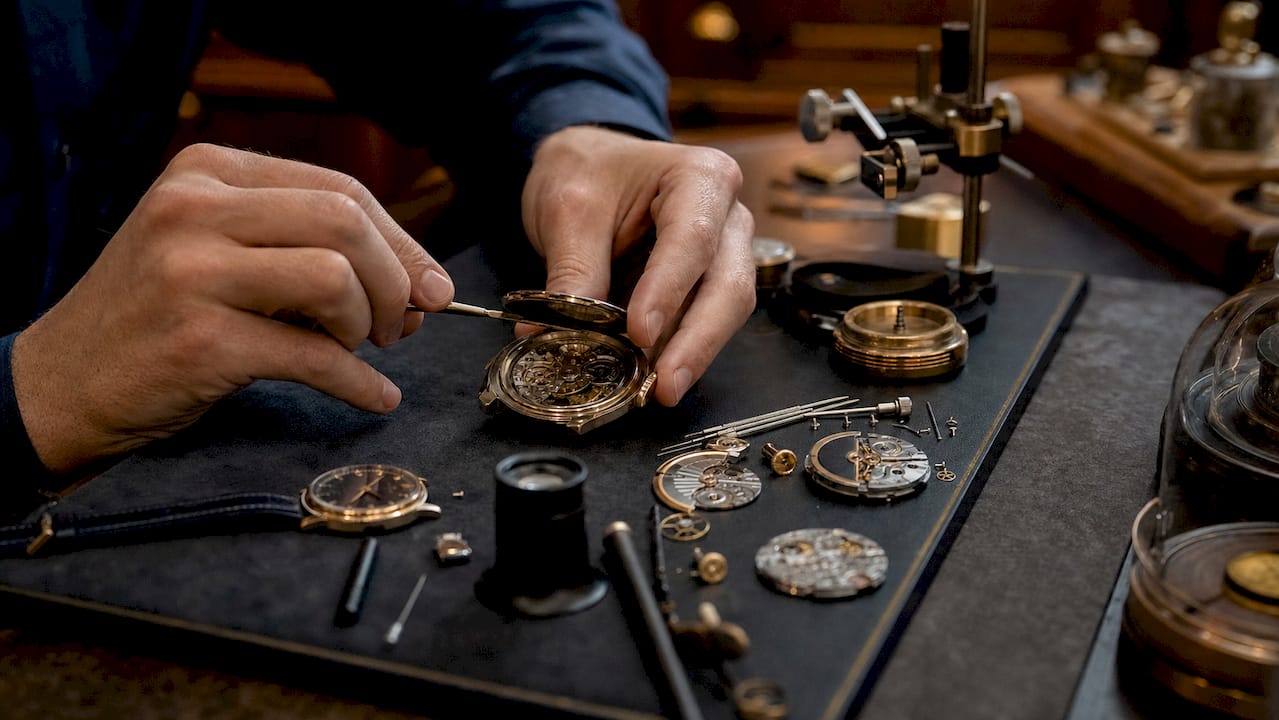
Professional standards recommend full overhauls every 5–7 years for mechanical watches and battery replacements every 2–3 years for quartz models. Those intervals exist because lubricants have a finite lifespan, not because watchmakers want repeat business. Ignoring them turns a routine service into an expensive parts replacement job.
What does a full mechanical watch service include?
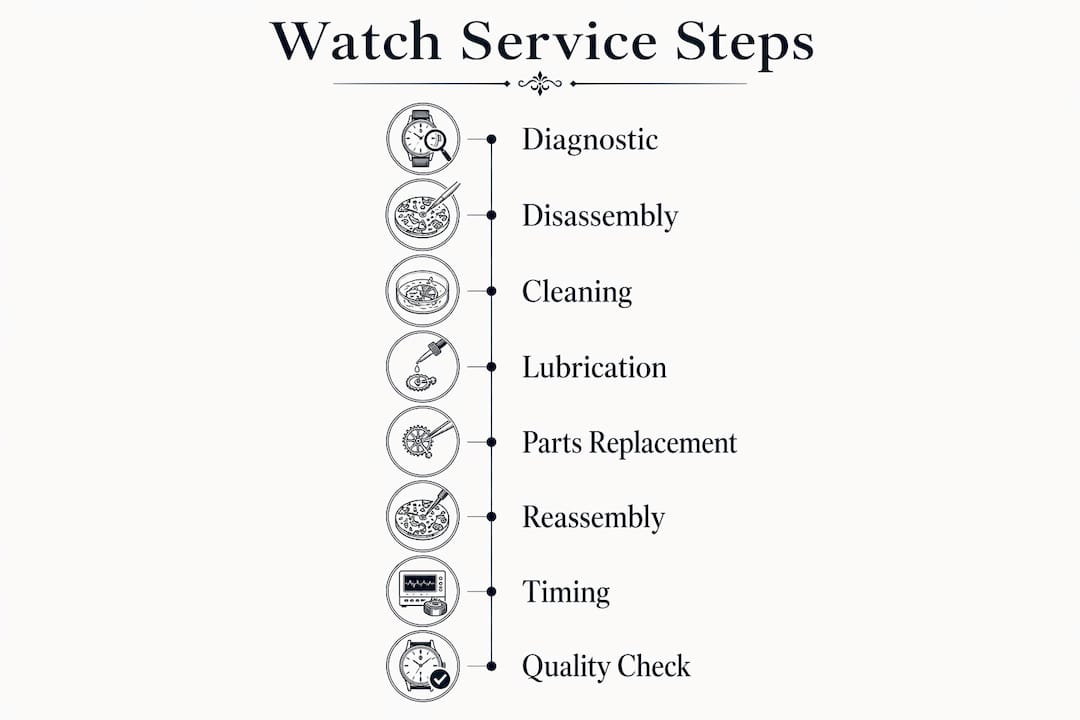
A comprehensive mechanical service follows an eight-step protocol that leaves nothing to chance. Each step builds on the last, and skipping any one of them compromises the result.
- Diagnostic inspection. The technician documents the watch’s condition, noting accuracy, power reserve, and any visible damage. A thorough diagnostic check at this stage prevents disputes later about pre-existing damage.
- Complete disassembly. Every component is removed, including the mainspring, balance wheel, escapement, and all gear trains. Nothing stays assembled.
- Ultrasonic cleaning. Parts are placed in an ultrasonic bath that removes old lubricant, dust, and oxidation without scratching delicate surfaces.
- Parts assessment and replacement. Worn components such as jewels, springs, and gaskets are identified. The technician decides which parts to replace based on function, not cosmetics.
- Lubrication. Specific lubricants are applied to specific points. The wrong oil in the wrong place causes more damage than no oil at all.
- Reassembly. The movement is rebuilt in sequence. This step requires the most skill and the most time.
- Timing regulation. The reassembled movement is tested on a timing machine across multiple positions to confirm accuracy within acceptable tolerances.
- Final quality testing. This includes pressure testing for water resistance and a running period to confirm stable performance.
Turnaround times range from 4–12 weeks depending on parts availability and movement complexity. Simple three-hand movements sit at the lower end. Complicated calibres with chronographs or perpetual calendars sit at the upper end.
Pro Tip: Ask your service provider for a timing machine printout after the overhaul. A reputable technician will provide one without hesitation, and it gives you a performance baseline for the next service.
| Service step | Purpose |
|---|---|
| Diagnostic inspection | Documents condition and identifies faults before work begins |
| Ultrasonic cleaning | Removes old lubricant and debris without abrasion |
| Parts replacement | Restores worn components to maintain function and longevity |
| Lubrication | Applies correct oils to correct points for smooth operation |
| Pressure testing | Confirms water resistance after resealing |
What are the different types of watch service?
Not every watch needs a full overhaul. Matching the service type to the watch’s actual condition saves money and avoids unnecessary intervention.
Quick services cover battery replacement and gasket changes. Battery replacement for quartz watches takes minutes and is recommended every 2–3 years. A dead battery left inside a watch leaks acid that corrodes the movement. Gasket inspection and replacement should accompany every battery change to maintain the case seal.
Routine maintenance suits watches that are running well but showing early signs of wear. This level covers:
- Case and bracelet cleaning using appropriate methods that avoid polishing
- Crown and pusher seal inspection
- External pressure testing to confirm water resistance ratings are still valid
- Visual inspection of the movement through the caseback where possible
Full mechanical overhauls are the correct choice when a watch shows any of these symptoms:
- Gaining or losing more than 30 seconds per day
- Stopping unexpectedly despite a full power reserve
- A grinding or rattling sensation when the crown is turned
- Any moisture ingress or fogging under the crystal
- More than 5–7 years since the last service
Vintage watch service follows the same eight-step process but demands additional care. Original parts are prioritised over modern replacements wherever function allows. The goal with a vintage piece is to restore reliability without erasing the evidence of age that gives the watch its character and value.
Express servicing options exist for watches that need a faster turnaround without the full overhaul scope. These suit watches that are mechanically sound but need cleaning and relubrication rather than parts replacement.
How do you choose between authorised centres and independent watchmakers?
The choice between a manufacturer-authorised service centre and an independent watchmaker depends on the watch’s age, rarity, and what the owner values most.
Authorised centres offer genuine manufacturer parts, warranty protection, and documented service history that supports resale value. For a watch still under warranty or a current-production model from a major brand, the authorised route protects both the guarantee and the investment. The trade-off is time. Authorised centres typically take 4–12 weeks for complex overhauls, and costs are set by the manufacturer with little room for negotiation.
Independent watchmakers offer faster turnarounds, typically 1–3 weeks for routine repairs, and more flexibility on parts decisions. For vintage pieces, an experienced independent specialist is often the better choice. They understand the importance of preserving original components and are less likely to replace serviceable parts simply because a manufacturer’s protocol says to. The key is verifying their credentials and asking for references on similar work.
Pro Tip: Always request an itemised written quote before authorising any work. A clear quote listing labour, parts, warranty, and testing protocols prevents disputes and tells you immediately whether the provider understands the scope of your watch’s needs.
The watch repair service options available to you will vary by region, but the evaluation criteria remain constant: ask about parts sourcing, turnaround time, warranty on the work, and whether they provide a post-service timing report.
Best practices for watch maintenance and record keeping
Proactive monitoring prevents small problems from becoming expensive ones. The most useful habit is checking your watch’s accuracy weekly against a reliable time source. A sudden change in rate, even if the watch is still within acceptable tolerance, signals that something has shifted inside the movement.
Water resistance is not a permanent property. Gaskets degrade due to UV light, chemicals, and temperature changes, meaning a watch rated to 100 metres can fail in a shower if the seals have not been tested recently. Annual pressure testing is the correct approach for any watch worn near water.
Service records and authentication certificates are two entirely different documents. Service receipts document performed maintenance but say nothing about whether the components inside are original. An archive extract from the manufacturer confirms the factory configuration. Collectors must hold both to fully establish a watch’s provenance.
Practical record-keeping habits worth adopting:
- Keep every service invoice, noting the date, work performed, and parts replaced
- Photograph the movement before and after service if the technician permits
- Store archive extracts and authentication certificates separately from service records
- Note the service provider’s warranty period and what it covers
- Record the timing machine results from each service to track performance trends over time
Cosmetic work deserves a separate decision from mechanical servicing. Unnecessary polishing permanently removes metal and erases the sharp case edges that define a watch’s original form. On a vintage or collectible piece, a polished case can reduce value significantly. The movement is the priority. The case tells the story of the watch’s life.
Key takeaways
A watch service is a structured maintenance process that preserves mechanical reliability, prevents irreversible wear, and protects long-term value through timely overhauls, correct lubrication, and accurate record keeping.
| Point | Details |
|---|---|
| Service intervals matter | Mechanical watches need a full overhaul every 5–7 years to prevent lubricant damage. |
| Invisible wear is real | A watch can run and still suffer serious internal damage from dried-out lubricants. |
| Match service to condition | Battery changes, routine maintenance, and full overhauls each suit different situations. |
| Records and certificates differ | Service invoices document repairs; archive extracts confirm original factory configuration. |
| Polishing reduces value | Cosmetic work on vintage pieces removes original metal and should be a separate decision. |
The movement-first principle: why I never start with the case
The most common mistake I see watch owners make is judging a service by how the watch looks when it comes back. A beautifully polished case on a poorly serviced movement is the worst possible outcome. The movement is the watch. The case is the housing.
My approach has always been movement-first. Every decision during a service starts with the question: does this improve mechanical reliability? Cosmetic work is optional and should only happen after the owner explicitly requests it and understands the consequences for originality. A watch with honest wear on its case and a perfectly serviced movement is worth more, in every sense, than a polished watch with a neglected calibre.
The other thing I feel strongly about is timing. Watchmakers who tell you to wait until a watch stops before servicing it are giving you expensive advice. Dried-out lubricants cause abrasion long before a watch stops running. By the time it stops, the damage is done. Service on schedule, not on failure.
Choosing a service provider is also a decision worth taking seriously. Ask to see examples of similar work. Ask what happens if a part is unavailable. Ask whether they will call you before replacing anything not listed on the original quote. A provider who answers those questions clearly and confidently is the right choice, regardless of whether they are authorised or independent.
— efe
Professional watch servicing at Watchrepairstation
Watchrepairstation has provided trade-to-trade watch repairs across the UK since 2008, with a “No Fix, No Cost” guarantee that removes all financial risk from the process.

Every repair goes through certified technicians who follow the full eight-step service protocol, from diagnostic inspection through to pressure testing and timing regulation. Whether you need a professional watch repair for a mechanical movement or a battery replacement service with full resealing and pressure testing, Watchrepairstation handles it with the same standard of care. Trade partners benefit from competitive pricing, fast turnaround times, and itemised invoices that make record keeping straightforward. Contact Watchrepairstation for a quote and find out why watch and jewellery shops across the UK trust them to protect their customers’ timepieces.
FAQ
What is a watch service and what does it include?
A watch service is a structured maintenance process covering inspection, disassembly, cleaning, lubrication, parts replacement, reassembly, timing regulation, and pressure testing. The scope varies by service tier, from a quick battery change to a full mechanical overhaul.
How often should a mechanical watch be serviced?
Mechanical watches require a full overhaul every 5–7 years to replace dried lubricants and address internal wear before it causes permanent damage.
What is a watch service certificate?
A watch service certificate is a document issued after servicing that records the work performed, parts replaced, and any testing carried out. It differs from an authentication certificate or archive extract, which confirms a watch’s original factory configuration and component originality.
What is a vintage watch service?
A vintage watch service follows the same eight-step overhaul process as a standard mechanical service but prioritises preserving original components and avoids unnecessary polishing to protect the watch’s historical integrity and collector value.
How do I know if my watch needs a service?
Key signals include gaining or losing more than 30 seconds per day, stopping unexpectedly, a grinding sensation when winding, moisture under the crystal, or more than 5–7 years since the last overhaul.

Leave a Reply