

Watch dial restoration is the methodical repair or renewal of a watch face to preserve its usability and character while respecting its historical and collector value. The process ranges from conservative surface cleaning to a full strip-and-rebuild, chosen according to the dial’s condition and the watch’s significance. Getting this decision right separates a timepiece that retains its provenance from one that loses it permanently. This guide covers the core techniques, the originality versus restoration debate, professional procedures, and safe home practices for collectors who want to act with confidence.
What are the main watch dial restoration techniques?
Watch dial restoration, known in horological circles as dial conservation or refinishing, divides into three distinct approaches: conservative cleaning, full restoration, and laser cleaning. Each serves a different level of damage, and choosing the wrong one causes irreversible harm.
Conservative cleaning suits roughly 20% of watches, specifically those with only surface dirt or light oxidation. This approach uses soft brushes, isopropyl alcohol, and lint-free cloths to lift contamination without disturbing the original finish. The result is a cleaner dial that retains every mark of honest age.
Full restoration applies when corrosion is active, paint is flaking, or the dial has become illegible. The technician strips the dial to its bare metal plate, addresses structural damage, then rebuilds the finish using pad printing, archival lacquers, and period-correct typography. Archival paint recipes mimic 1950s lacquer and age naturally, avoiding the flat, plasticky appearance of modern acrylic finishes.
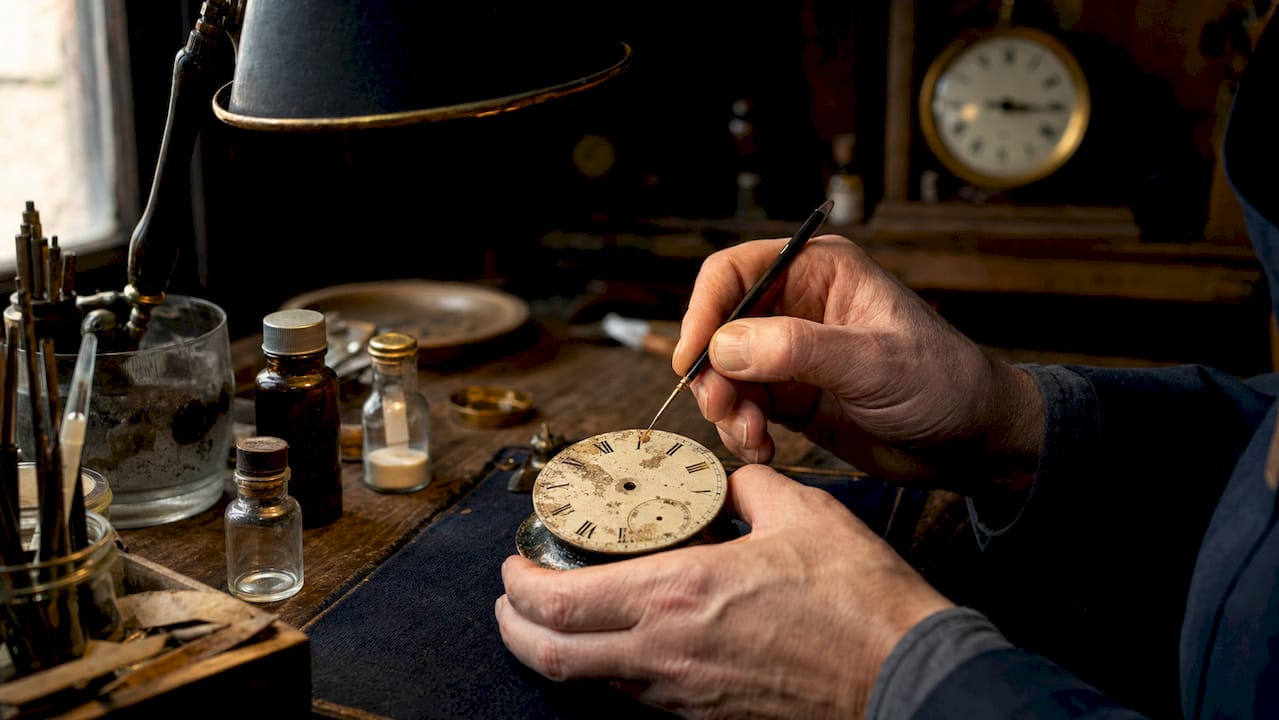
Laser cleaning works well for light surface oxidation but carries real risk for fragile printing or cracked lacquer. The non-contact method removes oxidation without abrasion, yet the heat pulse can destroy original patina on unstable dials. Technicians test on non-critical areas before committing to a full pass.
The key distinctions between the three approaches are:
- Conservative cleaning: surface dirt and light tarnish only; no finish alteration
- Full restoration: active corrosion, severe paint loss, or illegibility; complete rebuild
- Laser cleaning: light oxidation on stable dials; requires pre-testing on a hidden area
- Refinishing: cosmetic renewal of colour and texture without structural repair
Pro Tip: Never conflate cleaning with restoration. Cleaning removes contamination. Restoration rebuilds structure. Applying restoration techniques to a dial that only needs cleaning destroys value that cannot be recovered.
How do collectors balance originality versus restoration?
The collector community prizes stable patina over a fresh look. A tropical dial, one that has shifted from black to rich brown through decades of UV exposure, commands a significant premium precisely because that colour cannot be replicated. Aged lume plots that have turned cream or gold tell the story of the watch’s life. Erasing that story with a fresh white lume application destroys the very quality collectors pay for.
The critical distinction is between stable patina and active damage. Stable patina is cosmetic and adds character. Active corrosion eats into the metal substrate and will eventually destroy the dial entirely if left untreated. Restoration is justified when damage is progressing, not merely because a dial looks worn.
True restoration should be felt, not seen. The goal is to stabilise what exists and improve usability, not to make a vintage dial look as though it left the factory yesterday. Over-restoration erases provenance and, with it, a significant portion of market value.
Over-polishing and aggressive refinishing reduce provenance and market value on high-end pieces. The practical guidance for collectors breaks down as follows:
- Investment pieces: preserve patina at all costs; intervene only to halt active corrosion
- Personal wear pieces: restoration for legibility and aesthetics is reasonable if the watch is not a market rarity
- Damaged dials on common references: full restoration is often the right call when the alternative is an unreadable dial
- Tropical or faded dials: never restore the colour; stabilise the surface only
Balancing aesthetics and authenticity is the central tension in every restoration decision. A watch restored for daily wear and a watch preserved for resale require entirely different approaches, and conflating the two is the most common mistake collectors make.
What practical steps does professional dial restoration involve?
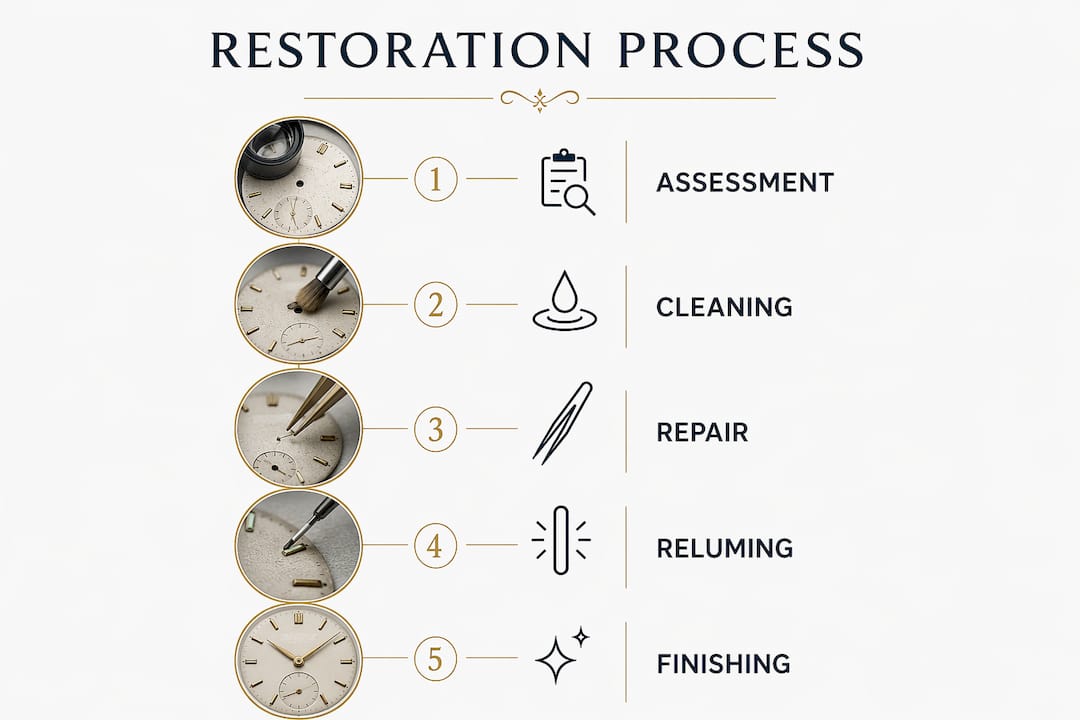
Professional watch dial restoration follows a documented sequence that protects both the dial and the technician. Skipping any stage introduces risk that compounds at every subsequent step.
- Pre-restoration documentation: Photograph the dial at 40x magnification before touching it. High-resolution microphotography at 40x is the industry standard for proving condition before and after work. This protects the technician and gives the collector a verifiable record.
- Hazardous material assessment: Identify whether the dial contains radium. Dials produced before 1960 frequently used radium-based lume. Radium in pre-1960 dials requires strict PPE, including nitrile gloves, a respirator, and a controlled, well-ventilated environment. Disturbing radium without protection is a genuine health risk.
- Structural repair: Address corrosion, broken dial feet, and delamination before any cosmetic work begins. Professionals use specialised epoxy or soldering for dial feet. Cyanoacrylate adhesive outgasses and causes permanent crystal fogging, so it has no place in a professional workshop.
- Finish application: Pad printing replicates original typography and indices with period-correct fonts and inks. Precision lathes cut or restore guilloche patterns. Archival lacquers are applied in thin, controlled coats to match the original depth of colour.
- Mechanical fit verification: Dial feet position, date window alignment, and hand clearance are checked against the movement before final assembly. A 0.2mm clearance standard prevents the hands from catching on the dial surface during operation.
- Post-restoration documentation: Repeat the 40x microphotography to confirm quality. Pad-printed logos and indices are examined for registration accuracy and ink adhesion.
Pro Tip: Ask any restoration workshop for their pre and post documentation as a condition of the job. A professional who cannot provide 40x images of their work is not operating to the standard the piece deserves.
How can enthusiasts safely clean and relume a dial at home?
Home restoration is realistic for two tasks: polishing acrylic dial covers and reluming indices on non-radioactive dials. Both require patience and the right materials. Neither should be attempted on a radioactive vintage dial without specialist training.
Polishing an acrylic dial cover
- Clean the surface with a damp, lint-free cloth to remove loose debris.
- Wet-sand with 1,000 grit paper using circular strokes, keeping the surface wet throughout.
- Progress through 2,000 grit, then 3,000 grit, rinsing between each stage.
- Apply a specialised polish such as PolyWatch with a soft cloth using firm circular pressure. Avoid paper towels, which introduce fine scratches.
- Buff to clarity with a clean microfibre cloth.
Reluming indices
Reluming requires lume powder, a binder such as glow-in-the-dark medium, a fine brush, and a steady hand. Adjusting the powder-to-binder ratio is critical. Too much powder produces a crumbly, uneven application that sags before curing. Too much binder produces a thin, weak glow. A 1:1 ratio by volume is a reliable starting point for most index sizes.
Colour matching matters. Modern Super-LumiNova comes in grades from C1 (warm cream) to C3 (bright white). Match the existing lume colour before mixing. Apply in a single, confident stroke per index and allow to cure in a dust-free environment for 24 hours before testing the glow output.
Pro Tip: Never sand or disturb the lume on a pre-1960 dial without first having it tested for radioactivity. Many collectors own radium-dialled watches without knowing it. A Geiger counter test costs very little and could protect your health.
What common pitfalls should enthusiasts avoid?
Restoration mistakes are often permanent. The following errors appear repeatedly across both amateur and inexperienced professional work.
- Using superglue on dial feet: Cyanoacrylate adhesive outgasses inside a sealed case and deposits a permanent white film on the crystal and dial surface. The damage is irreversible without a full strip and rebuild.
- Mismatched dial thickness: Fitting a replacement or restored dial that differs in thickness from the original shifts hand clearance. Even a 0.1mm discrepancy can cause the seconds hand to drag across the dial surface.
- Over-polishing bezels: Re-cutting fluted bezels preserves their light play and value. Polishing them flat removes the crisp edges that define the watch’s silhouette and reduces its market value permanently.
- Ignoring radioactive material protocols: Sanding or drilling a radium dial without PPE releases radioactive dust. This is not a theoretical risk. Several documented cases exist of collectors contaminating their workshops.
- Selecting workshops without documented experience: Expert restoration requires mastery of historic printing techniques and period materials. A workshop that cannot demonstrate this knowledge will produce a dial that looks wrong to any experienced collector.
The regular servicing of a watch also reduces the likelihood of dial damage reaching a point where full restoration becomes necessary. Prevention is always cheaper than reconstruction.
Key takeaways
Watch dial restoration requires matching the intervention to the damage: conservative cleaning for surface contamination, full restoration only for active corrosion or structural failure, and never at the cost of stable, value-adding patina.
| Point | Details |
|---|---|
| Match technique to damage | Conservative cleaning suits 20% of cases; full restoration applies only when corrosion is active or the dial is illegible. |
| Preserve stable patina | Tropical dials and aged lume add collector value; restore only when damage is progressing, not merely cosmetic. |
| Document before and after | 40x microphotography before and after work is the professional standard for proving restoration quality. |
| Radium demands strict safety | Pre-1960 dials may contain radium; always test before sanding or reluming and use full PPE if radioactivity is confirmed. |
| Avoid superglue and over-polishing | Cyanoacrylate causes permanent crystal fogging; over-polished bezels lose their defining edges and market value. |
The soul of a dial is not something you can reprint
I have handled a lot of watches over the years, and the ones that stay with me are rarely the ones that came back from restoration looking pristine. They are the ones where the technician understood what to leave alone. A 1960s Rolex with a faded gilt dial tells you something. It tells you it was worn, that someone valued it enough to keep it running for six decades. The moment you strip that dial and reprint it, you are not restoring the watch. You are replacing its history with a facsimile.
The hardest conversation in this field is telling a collector that their watch is worth more with a damaged-looking dial than a perfect one. The market for tropical dials, for honest wear, for untouched originality is real and growing. Collectors who understand this do not restore for cosmetic reasons. They restore to halt damage, to preserve function, and to give a watch another generation of useful life.
My advice is simple. If a watch runs well and the dial is stable, leave it. If the dial is actively deteriorating and affecting legibility or mechanical function, find a workshop with documented experience and ask to see their pre and post photography. The watch repair process should always serve the watch, not the technician’s preference for a clean finish.
— efe
Watchrepairstation’s professional dial restoration services
Watchrepairstation has provided trade-to-trade watch repairs across the UK since 2008, working to horological standards that protect both the watch and its value.

For collectors and trade partners who need dial work done correctly, Watchrepairstation offers professional watch restoration services covering everything from conservative cleaning to full dial rebuilds. Every job carries the “No Fix, No Cost” guarantee, meaning there is zero financial risk if the work cannot be completed to the required standard. Technicians assess each dial individually and recommend the least invasive intervention that achieves the desired outcome. Contact Watchrepairstation to discuss the right approach for your timepiece before committing to any restoration work.
FAQ
What is watch dial restoration?
Watch dial restoration is the professional repair or renewal of a watch face, ranging from conservative surface cleaning to a full strip-and-rebuild, chosen based on the dial’s condition and collector value.
When should I restore a vintage watch dial?
Restore a vintage dial only when damage is active, such as corrosion spreading or paint flaking, not simply because the dial looks aged. Stable patina, including tropical colouring and aged lume, adds collector value and should be preserved.
Is it safe to relume a vintage watch dial at home?
Home reluming is safe on post-1960 dials using modern Super-LumiNova. Pre-1960 dials may contain radium and require a Geiger counter test before any sanding or lume work is attempted.
Why does superglue damage watch dials?
Cyanoacrylate adhesive outgasses inside a sealed watch case and deposits a permanent white film on the crystal and dial surface. Professional technicians use specialised epoxy or soldering for dial foot repairs instead.
How do professionals verify restoration quality?
High-resolution microphotography at 40x magnification is the industry standard for documenting dial condition before and after restoration, confirming that pad-printed logos and indices meet the required accuracy.

Leave a Reply