

Why watch repair tracking matters for customers and shops
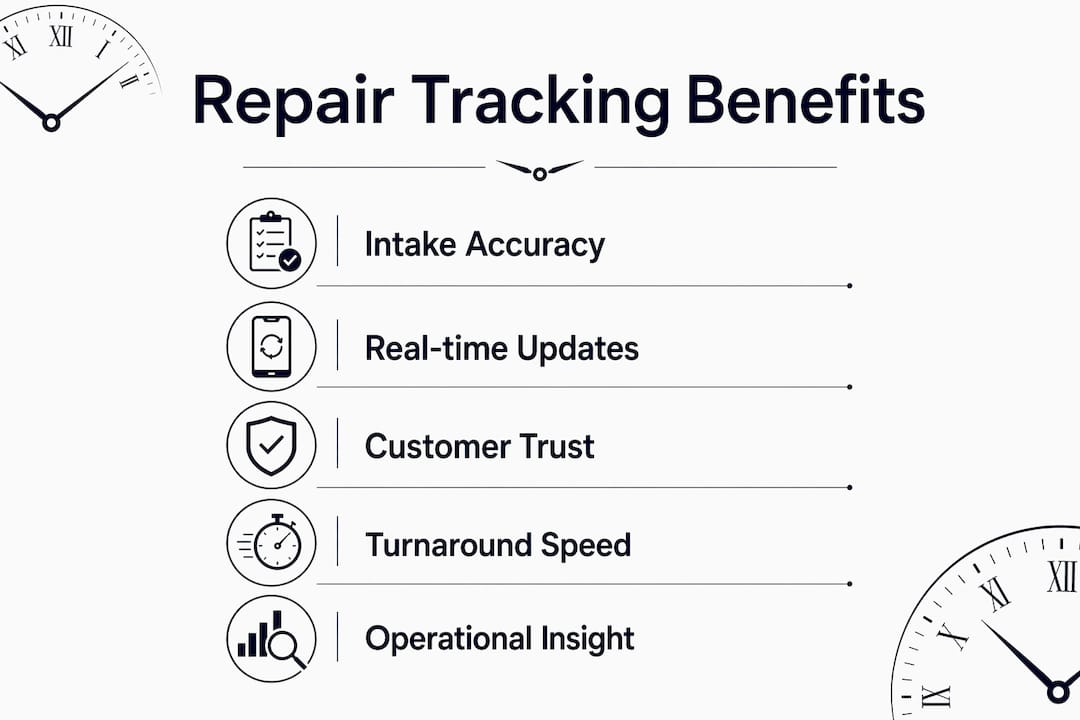
Repair tracking is the systematic monitoring of a timepiece’s progress through every stage of service, from the moment it crosses your counter to the moment it leaves. For UK watch shops and their customers, it is the single most effective way to prevent disputes, reduce revenue leakage, and build the kind of trust that brings collectors back year after year.
Here is what structured tracking delivers in practice:
- Transparency on timelines. Customers know exactly where their watch is in the repair process, removing the anxiety that drives repeated phone calls.
- Documented chain of custody. A timestamped audit trail records who handled the piece, what was authorised, and when, providing legal protection for both parties.
- Pre-existing condition records. Intake photographs and condition notes prevent “you scratched it” disputes before they start.
- Reduced revenue loss. Uncollected watches and unbilled jobs are among the most common profit drains in repair businesses. Tracking flags both.
- Insurance and legal protection. A complete chain-of-custody record supports insurance claims and liability defences when high-value pieces are involved.
- Service quality assurance. Assigning technician names and repair stages to each job creates accountability at every step.
- Compliance with 2026 UK industry standards. Platforms such as Datopia Flow and Watchrepairstation’s own trade service model reflect the growing expectation that professional workshops operate with full digital documentation.
The Responsible Jewellery Council defines chain-of-custody standards for precious materials in supply chains. The same principle applies directly to watch repair: every piece in your care is a material under your responsibility, and the record you keep is your proof.
How repair timelines work and why tracking keeps customers calm
A watch repair is rarely a single event. It moves through several distinct phases, and without visibility into those phases, customers fill the silence with worry.
The standard stages run roughly as follows:
- Intake and logging. Serial number capture, condition photography, and job ticket creation.
- Diagnostics. The technician inspects the movement and documents findings before any work begins.
- Parts sourcing. Crowns, gaskets, mainsprings, and crystals may need ordering, sometimes from overseas suppliers.
- Servicing. The actual repair or overhaul, which for a full movement service can take several days at the bench.
- Quality check. Timing tests, pressure tests, and visual inspection before the piece is cleared.
- Dispatch or collection notification. The customer is informed the watch is ready.
Turnaround times vary considerably. A battery replacement may be done the same day. A movement overhaul on a vintage piece can take three to six weeks, particularly if parts are on back order. Without automated status updates at each stage, customers have no way of knowing whether their watch is waiting for a part or sitting finished on a shelf. Automated status notifications reduce inbound calls and improve shop efficiency, freeing staff to focus on the bench rather than the phone.
Setting realistic expectations at intake is just as important as the updates themselves. If a customer is told “two to three weeks” and the watch is ready in ten days, that is a pleasant surprise. The reverse is a complaint waiting to happen.

Ethical and quality considerations in watch repair tracking
Handling someone’s watch carries a professional obligation that goes beyond technical skill. Many pieces brought in for service are heirlooms, anniversary gifts, or watches worth more than the customer’s monthly salary. The ethical standards around tracking reflect that weight.
Key considerations include:
- Chain of custody as a legal safeguard. Intake photo logs act as legal documents, recording pre-existing scratches, dents, and marks with timestamps before any work begins. If a dispute arises after collection, the record answers the question.
- Customer consent and approval workflows. No repair should proceed beyond diagnostics without the customer’s explicit authorisation of the quoted cost. Digital approval workflows capture that consent and timestamp it.
- Movement integrity. Swapping a movement without clear communication is one of the most serious ethical failures in the trade. Tracking records which movement was received and which was returned.
- Technician accountability. Assigning named technicians to each repair stage creates a clear record of who did what and when.
- Trust as the core product. When a customer hands over a watch that belonged to their grandfather, they are not buying a technical service. They are buying confidence that the piece will be treated with care. Documented tracking is how you demonstrate that confidence.
- UK repair ethics in 2026. The shift toward digital documentation is now an expectation, not a differentiator. Shops that still rely on handwritten job cards are operating below the standard serious customers expect.
How repair tracking software improves UK workshop operations
Paper-based repair tracking costs more than most shop owners realise. Paper-based processes cause revenue losses through lost tickets, incomplete billing, and inefficient administration. The hidden costs compound: technician time spent chasing job status, front-desk time fielding update calls, and unbilled jobs that simply disappear.
Purpose-built repair tracking software addresses each of these:
- Digital serial number and photo logs replace paper tickets with searchable, timestamped records tied to each individual piece.
- Automated customer notifications send SMS or email updates at every status change, eliminating the need for manual calls.
- Warranty and parts tracking links every component used to the specific job, creating a complete service record for future visits.
- Digital signatures at collection provide a tamper-proof record that the piece was returned in the agreed condition.
- Repair triaging and approval workflows stop jobs from proceeding without authorisation, protecting both the shop and the customer.
- Ageing alerts flag jobs that are approaching or past their promised collection date, preventing uncollected inventory from building up.
Platforms like Datopia Flow and the systems used by Watchrepairstation’s trade partners reflect this standard. Standardising workflows, task tracking, and automated status visibility transforms repair departments into reliable, profitable operations rather than administrative burdens.
Pro Tip: Integrate your repair tracking software with your parts inventory from day one. When a part is logged against a job ticket, stock levels update automatically, so you never quote a turnaround time you cannot meet.
How tracking builds customer trust and improves service quality
Trust is not built in a single interaction. It accumulates through consistent, transparent communication over multiple visits. Repair tracking is the mechanism that makes that consistency possible.
- Reduced uncertainty. Customers who receive updates at each repair milestone do not need to call. Automated updates at key milestones shift the burden off staff and increase customer confidence without adding workload.
- Complete service histories. When a customer returns with the same watch two years later, a searchable service record tells the technician exactly what was done, which parts were used, and what the customer’s preferences were. That level of recall builds loyalty.
- Timely follow-up. Automated notifications for pickups reduce orphaned inventory and improve cash flow. A watch sitting uncollected for three months is a revenue problem and a storage problem.
- Heirloom and luxury watch handling. When the piece is a five-figure chronograph or a watch with sentimental value beyond its market price, the audit trail is not a formality. It is the evidence that the shop treated the piece with the care it deserved.
- Watchrepairstation’s trade model. As a trade-to-trade partner operating since 2008, Watchrepairstation’s watch repair service is built around transparency and accountability, giving partner shops the documentation they need to maintain their own customer relationships with confidence.
Digital tracking systems reduce average service turnaround time and improve customer retention when automated repair status notifications are enabled. For an independent shop competing for repeat business from collectors and luxury watch owners, both outcomes translate directly to revenue.
Best practices for implementing repair tracking in a UK watch shop
Getting tracking right from the start saves considerable pain later. These are the practices that matter most for small to medium UK workshops:
- Standardise intake. Every job starts the same way: serial number logged, condition photographed, job ticket created. No exceptions, regardless of how simple the repair appears.
- Assign unique job identifiers. A job number tied to the serial number and customer record makes every piece searchable at any point in the workflow.
- Automate customer notifications. Set up status triggers so customers receive an update when the job moves from diagnostics to repair, and again when it is ready for collection.
- Maintain a searchable repair history. Serial number logging is the baseline for professional watch repair, enabling warranty claims, parts tracking, and historical service records across multiple visits.
- Implement ageing alerts. Jobs that sit past their promised date are both a customer satisfaction risk and a revenue risk. Automated alerts prompt action before a piece becomes uncollected inventory.
- Train staff consistently. Data entry is only useful if it is complete and accurate. A technician who skips the condition photography on a “quick” job creates the exact liability the system is designed to prevent.
- Use digital approvals. Verbal authorisations are unenforceable. A timestamped digital approval, sent to the customer and stored against the job ticket, is the only record worth keeping.
For shops handling heirloom jewellery appraisal alongside watch repairs, the same documentation standards apply. Condition records, valuations, and service histories all belong in the same searchable system.
Pro Tip: Link your repair tracking to your inventory management from the outset. When warranty terms are set at intake and parts are deducted automatically as they are used, your billing reconciles itself. Manual cross-referencing is where errors creep in.
How task-tracking gives you real visibility across every job
Task-tracking is the granular layer beneath job-level status updates. Where a status update tells a customer “your watch is in repair,” task-tracking tells the technician and shop manager exactly which step of that repair is in progress, who is responsible for it, and how long it has been sitting there.
In a busy workshop, this distinction matters. A movement overhaul involves disassembly, cleaning, inspection, parts replacement, reassembly, lubrication, regulation, and timing tests. Each of those is a discrete task. Without task-level visibility, a job can appear “in progress” for three weeks while actually sitting idle between two steps because a part arrived and nobody noticed.
Good task-tracking assigns each step to a named technician, timestamps the start and completion, and flags exceptions automatically. When a job stalls at “awaiting parts” for longer than expected, the system surfaces it rather than waiting for a customer complaint to reveal the delay. That kind of progress transparency is what separates a professionally managed workshop from one that runs on memory and goodwill.
For shop managers, task-level data also answers the questions that drive operational decisions: which job types take longest, where bottlenecks form, and which technicians are carrying the most volume. None of that is visible from a paper job card.
What goes wrong without repair tracking
The consequences of running without a tracking system are predictable, and they compound over time.
Lost job tickets are the most immediate problem. When a paper ticket goes missing, the job does not get billed. The customer collects the watch, pays nothing, and the shop absorbs the cost of the labour and parts with no record that the work was ever done. This is not a rare edge case. It happens regularly in shops that rely on handwritten cards and verbal updates.
Damage disputes are the most damaging consequence. Without intake photographs, a shop has no defence when a customer claims a scratch appeared during the repair. The shop’s word against the customer’s word is not a position any professional business should accept. A timestamped photo taken at intake, attached to the digital job ticket, resolves the dispute immediately.
Uncollected watches create a different kind of problem. A watch sitting on a shelf for six months is tied-up capital, a storage burden, and a legal grey area. Without automated follow-up notifications, shops have no systematic way to prompt collection, and the problem quietly grows.
Staff inefficiency is the least visible cost. Every “is it ready?” call that reaches the front desk represents a failure of communication that the tracking system should have prevented. Multiply that by twenty calls a week across a busy shop, and the administrative overhead becomes a genuine drag on productivity.
Finally, there is the reputational cost. A customer who feels uninformed about a repair they care about does not usually complain directly. They simply do not return, and they tell people why.
Repair tracking in practice: how UK workshops get it right
The clearest illustration of why watch repair tracking matters comes from looking at how well-run UK workshops actually operate, rather than how they aspire to.
A trade-focused workshop handling volume repairs for jewellery retailers across the UK cannot afford ambiguity. When a retailer sends in twenty watches from their shop floor, they need to know the status of each piece individually, not a collective “they’re being worked on.” Watchrepairstation’s trade model addresses this directly: partner shops receive clear communication at each stage, and the “No Fix, No Cost” guarantee is only credible because the documentation behind it is complete.
For a smaller independent workshop, the shift from paper to digital tracking often starts with a single pain point. A shop that has experienced one serious damage dispute, or one watch that went missing for a fortnight because a job ticket fell behind a counter, tends to adopt digital tracking quickly. The intake photography alone, timestamped and attached to a digital ticket, removes the single most common source of customer conflict.
The quality assurance practices that define professional workshops in 2026 are built on exactly this foundation: every piece documented, every stage recorded, every customer informed. Shops that operate this way do not just avoid problems. They build the kind of reputation that generates referrals from collectors and trade partners alike.
For shops exploring watch repair triaging as part of their intake workflow, the connection to tracking is direct. Triaging assigns priority and repair pathway at intake, and tracking ensures that pathway is followed and documented through to completion.
Key takeaways
Repair tracking is the foundation of professional watch service: without it, disputes, revenue leakage, and customer attrition are inevitable.
| Point | Details |
|---|---|
| Chain of custody protects everyone | Timestamped intake photos and job records provide legal evidence if a damage dispute arises. |
| Automated updates reduce call volume | Status notifications at each repair milestone remove the need for customers to chase progress. |
| Serial number logging is non-negotiable | Logging the serial number at intake enables warranty claims, parts tracking, and full service history. |
| Ageing alerts prevent revenue leakage | Automated follow-ups for uncollected jobs protect cash flow and reduce orphaned inventory. |
| Task-level tracking surfaces hidden delays | Granular step-by-step visibility identifies bottlenecks before they become customer complaints. |
Work with a trade partner who tracks every repair
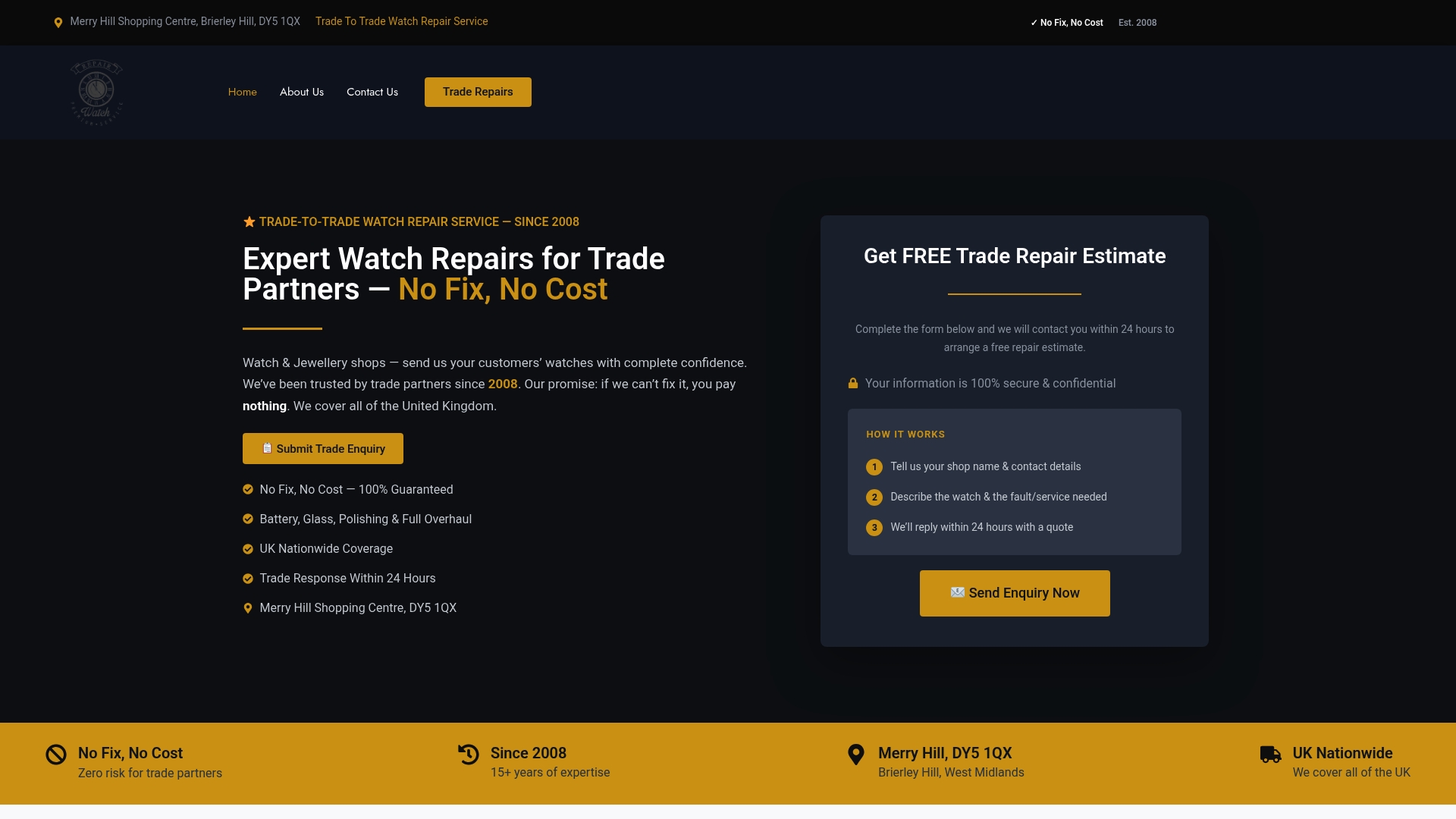
Watchrepairstation has operated as a trade-to-trade repair specialist since 2008, and every job that passes through the workshop is documented, tracked, and covered by a “No Fix, No Cost” guarantee. Partner shops across the UK rely on Watchrepairstation to handle the repairs their customers bring in, with the transparency and accountability that protects both the retailer’s reputation and the end customer’s trust.
If your shop is managing repairs without a reliable tracking system, or if turnaround times and customer communication are creating pressure, Watchrepairstation’s professional watch repair service is built to solve exactly that. Fast turnarounds, expert technicians, and zero financial risk for your business.

Leave a Reply