

A watch condition assessment is a structured evaluation of a timepiece’s cosmetic appearance, mechanical health, and originality. It covers everything from case sharpness and dial integrity to movement accuracy and service history, giving buyers, sellers, and collectors a common reference point when no universal grading scale exists.
The assessment typically examines these core categories:
- Case shape and finishing — sharpness of edges, presence of scratches, dents, or refinishing marks
- Dial and hands — originality, patina, damage, or replacement signs
- Crystal and bezel — chips, scratches, correct fit, and rotation function
- Bracelet or strap and clasp — stretch, surface wear, and clasp security
- Movement condition and accuracy — timekeeping performance and internal health
- Originality — whether parts are factory-correct and unpolished
- Completeness — box, papers, spare links, hang tags, and service records
Platforms such as Wristcheck Grade and auction houses including Sotheby’s apply their own grading language to these categories, but the underlying inspection criteria remain broadly consistent across the UK market. The grade itself is only a starting point. A watch labelled “Excellent” by one seller may not match another’s definition, which is why understanding what sits behind the label matters far more than the label alone.
How the grading process works: 10 key steps
A thorough watch condition evaluation follows a logical sequence, moving from the outside in and from the visible to the measurable. Here is how professional assessors typically approach it.
-
Initial holistic viewing. Before reaching for a loupe, assess the watch as a whole. Sotheby’s specialist Jonathon Burford describes this as the “sniff test”: a quick read of the watch’s overall coherence. Mismatched wear between the case and bracelet, or a dial that looks too fresh against aged lugs, signals something worth investigating.
-
Case inspection. Examine the case under good light for scratches, dents, and evidence of polishing. Sharp case lines are a sign of originality; rounded edges suggest the watch has been buffed, which reduces collector value.
-
Dial and hands evaluation. Check for fading, moisture damage, replaced indices, or repainted surfaces. Original dials, even with honest patina, are preferable to refinished ones. Mismatched hands are a red flag.
-
Crystal and bezel check. Assess the crystal for chips and deep scratches. On rotating bezels, test the click action: it should be firm and precise, with no slipping between positions.
-
Bracelet and clasp assessment. Look for stretch in the links, surface wear on the centre links, and whether the clasp snaps shut cleanly. A worn bracelet can meaningfully affect both the grade and the resale price.
-
Crown and pusher function. A screw-down crown should thread fully flush without wobbling. Push-in crowns must seat correctly. Crowns that wobble when withdrawn often indicate internal stem damage.
-
Movement performance check. Wind the watch and observe timekeeping over a period. For mechanical watches, check amplitude and rate using a timing machine. For quartz pieces, confirm the seconds hand steps cleanly once per second.
-
Originality verification. Confirm that the movement, dial, hands, and case are all correct for the reference. Replaced parts, even high-quality ones, reduce authenticity and typically lower the grade.
-
Completeness review. Original box, papers, spare links, and service records all contribute to the overall grade. A watch with full documentation commands a premium over an identical piece sold without it.
-
Documentation and grading. Record findings with photographs from multiple angles, written notes on what has and has not been polished or replaced, and a final grade with supporting evidence. A grade without evidence is an opinion, not an assessment.
Vintage versus modern watches. The grading process differs in one important respect between vintage and modern pieces. On a vintage watch, original patina on the dial and case is desirable, not a deduction. A modern watch, by contrast, is expected to look closer to new condition. Grading terms such as Mint (near-perfect, extremely light wear), Near Mint (light wear visible only on close inspection), Excellent (minor visible wear), and Very Good (clear moderate use) apply to both categories, but the threshold for each grade shifts depending on the watch’s age.
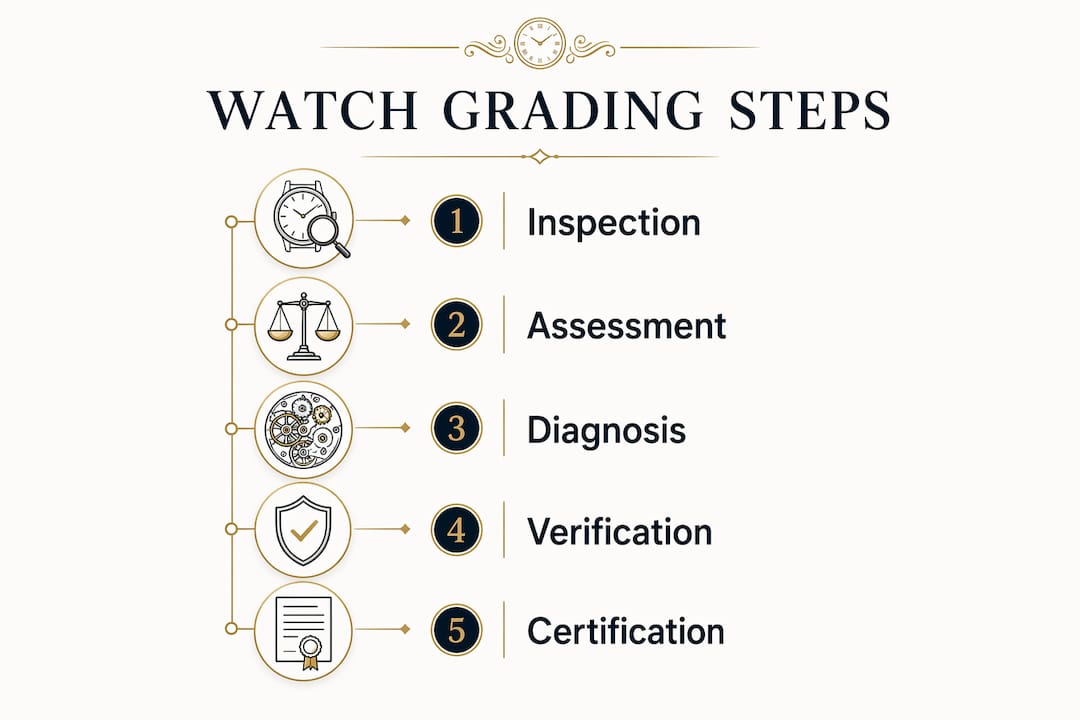
How to assess a watch’s cosmetic and mechanical condition
Visual inspection and mechanical testing work together. Neither tells the full story on its own.
Cosmetic inspection criteria
- Case edges and surfaces. Use a loupe after the initial naked-eye assessment. Look for tool marks around the caseback, which can indicate amateur opening attempts. On brushed surfaces, check whether the finish runs in the correct direction.
- Dial condition. Examine under raking light to catch hairline cracks, moisture staining, or reprint work. A dial that has been touched up often shows slightly different texture under magnification.
- Crystal. Sapphire crystals resist scratching well but can chip at the edges. Mineral glass scratches more easily. Deep scratches that catch a fingernail will affect the grade; light surface marks on mineral glass are generally acceptable on older pieces.
- Bracelet and strap. Stretch in a metal bracelet shows up as visible gaps between links when the bracelet hangs freely. Centre links on Oyster-style bracelets wear faster than outer links and are worth checking individually.
Pro Tip: Run your thumbnail lightly across the case flanks before using a loupe. You will feel polishing marks and rounded edges that are easy to miss under magnification alone.
Mechanical health evaluation
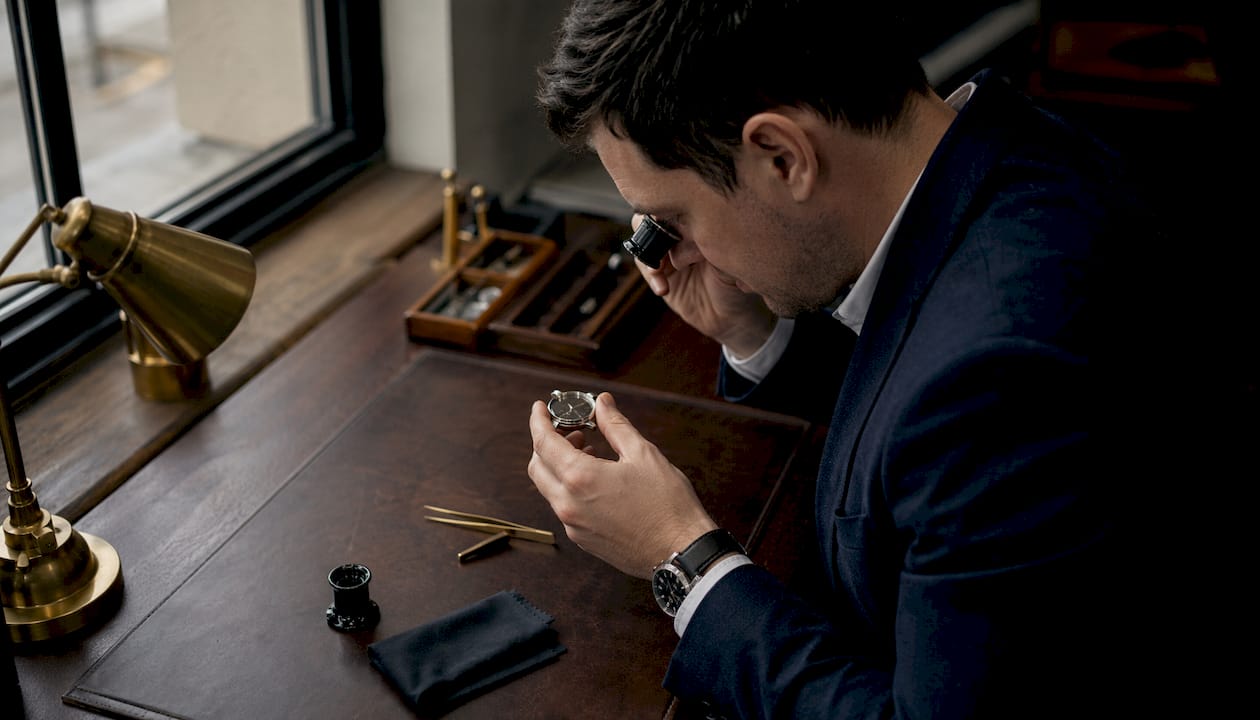
Mechanical performance encompasses more than just whether a watch keeps time. The physical feel of the watch tells its own story. Winding resistance should build gradually and feel smooth throughout. A crown that winds with no resistance, or one that slips, points to a broken or set mainspring. On a mechanical watch, the bezel click should be positive and consistent, not mushy or uneven.
Timing machines such as the Witschi Chronoscope X-1 measure rate deviation, amplitude, and beat error in milliseconds, giving a precise picture of movement health that visual inspection cannot provide. Amplitude values for modern wristwatches typically sit in the 260°–310° range; a reading below that band suggests dried lubricants or worn components, even when the watch looks pristine externally. Beat error, measured in milliseconds, reflects the symmetry of the balance wheel’s oscillation. High-quality movements can be adjusted to near-zero beat error.
Polishing deserves particular attention. Removing scratches through polishing also removes the factory-applied sharp case lines that serious collectors prize. A lightly worn watch with original finishing is almost always worth more than a polished example of the same reference. When you see “polished” in a condition note, treat it as a deduction, not an improvement.
A watch can look excellent externally and still have internal problems. Dried oil, worn pivots, and a set mainspring leave no visible trace on the case or dial. That is why mechanical testing is not optional for a complete condition evaluation.
Why originality and service history change everything
Originality is the single most contested aspect of watch condition grading, and the one most likely to separate a fair price from a great one.
A factory-correct watch carries all its original components: the dial, hands, movement, crown, and case back as supplied by the manufacturer. Replacement parts, even period-correct ones sourced from another example of the same reference, reduce authenticity. On high-value vintage pieces, a replaced dial alone can cut the market value significantly.
Key originality and service history factors that affect grading:
- Dial and hands. Confirm these match the correct variant for the reference number. Tritium plots that have aged unevenly, or lume that is brighter on the hands than the dial, can indicate a replacement.
- Movement. The calibre number should match the reference. On vintage pieces, check that the movement has not been swapped from a donor watch.
- Polishing history. As noted above, over-polishing rounds case edges and removes brushed finishing. A condition note should specify whether the case has been polished and, if so, how extensively.
- Service records. A documented service history from a qualified watchmaker adds confidence. It confirms the movement has been properly maintained and that any replaced parts were noted at the time.
- Completeness. Original box, papers, hang tags, spare links, and service receipts all contribute to the overall grade. Full sets command a measurable premium in the UK pre-owned market.
Buyers should always request photographs of the case edges, lugs, and dial under raking light, not just the standard front-facing shot. Sellers who provide this level of documentation signal that their condition claims are grounded in evidence rather than optimism. For collectors navigating the heirloom appraisal process, the same principle applies: provenance and documentation carry weight that cosmetic appearance alone cannot.
A common misconception is that a recently serviced watch automatically receives a higher grade. Servicing improves mechanical health, but if the service involved replacing original parts or polishing the case, it can actually lower the originality score. The grade reflects the whole picture, not just whether the movement runs well.
Advanced mechanical diagnostics used by UK watchmakers
Visual grading tells you what a watch looks like. Mechanical diagnostics tell you what it is actually doing.
Professional watchmakers in the UK use calibrated timing machines to measure the three core indicators of mechanical health: rate, amplitude, and beat error. Rate deviation shows how many seconds per day the movement gains or loses. Amplitude reflects the energy available to the balance wheel, and as the NAWCC’s technical documentation confirms, amplitude decreases gradually as lubricants age. Beat error, measured in milliseconds, indicates whether the balance wheel oscillates symmetrically. Together, these three readings give a watchmaker a precise picture of whether a movement needs service, adjustment, or both.
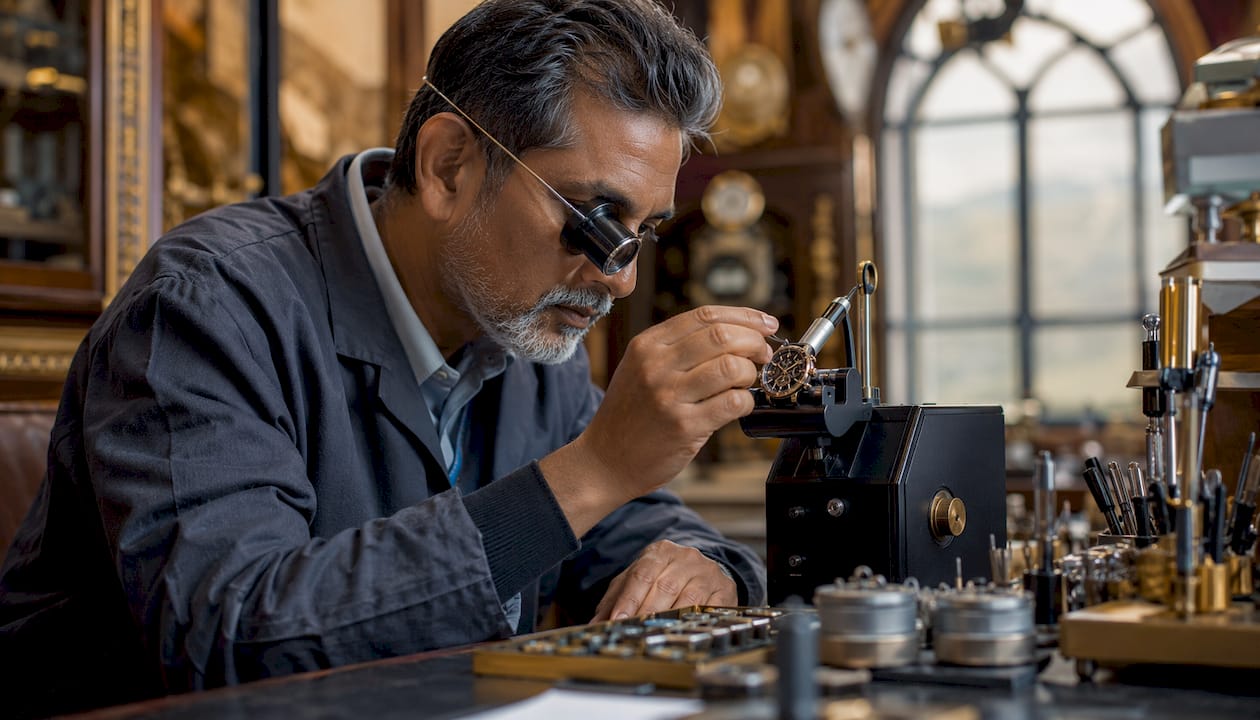
Quartz watches require a different diagnostic approach. The UK standards framework for quartz servicing specifies tests for coil resistance, circuit consumption, battery condition, lower working voltage, and end-of-life function. A quartz movement that passes visual inspection can still fail on current consumption, which points to a dirty gear train or thickened oil. If the average consumption reading is higher than the manufacturer’s published specification, the movement needs cleaning before the watch can be graded as mechanically sound.
The Watchmaker Apprenticeship Assessment Plan published by Skills England sets out the formal competency requirements for UK watchmakers, including the ability to assess movement condition using calibrated test equipment for both mechanical and quartz calibres. This is the professional benchmark against which trade-level condition assessments are measured in the UK.
Specific fault indicators that mechanical diagnostics can detect include:
- Low amplitude pointing to a set mainspring, worn pivots, or congealed oil
- High beat error suggesting the balance wheel needs adjustment or the pallet fork is worn
- Elevated current consumption in a quartz movement indicating a dirty train or failing motor
- Failed end-of-life function pointing to a defective electronic module
- Abnormal rate deviation across multiple positions suggesting escapement or balance spring issues
Water resistance testing adds a further layer. Non-destructive dry pressure chamber testing uses vacuum and pressure to verify that a watch meets its factory-rated depth without risking water intrusion during the test. A watch that fails this test carries a lower grade regardless of its cosmetic condition, because compromised seals expose the movement to moisture damage.
Watchrepairstation’s trade-only service model means every watch that passes through the workshop receives this level of diagnostic rigour, not just a visual once-over. For trade partners across the UK, that depth of assessment is what underpins a reliable professional watch repair outcome and a condition evaluation you can stand behind.
Get a professional condition assessment from Watchrepairstation

Watchrepairstation has provided trade-to-trade watch repairs and assessments across the UK since 2008. Every piece is handled by expert technicians using calibrated timing machines and professional diagnostic tools, with a “No Fix, No Cost” guarantee that removes financial risk for partner shops. Whether you need a full mechanical overhaul, a diagnostic check, or a condition evaluation to support a sale or purchase, Watchrepairstation delivers the trade-standard assessment your customers deserve.
Contact Watchrepairstation to discuss your requirements.
Key takeaways
A watch condition assessment covers cosmetic, mechanical, and originality factors together; no single category tells the full story without the others.
| Point | Details |
|---|---|
| No universal grading scale | Terms like Mint, Excellent, and Very Good vary by seller; always examine the evidence behind the label. |
| Originality affects value most | Factory-correct parts and unpolished case lines carry more weight than a recent service in collector pricing. |
| Timing machines reveal hidden faults | Amplitude, rate, and beat error readings expose worn components and dried oil that visual inspection misses. |
| Completeness adds a measurable premium | Original box, papers, spare links, and service records all contribute to the final grade and resale price. |
| Polishing reduces grade, not improves it | Over-polishing removes factory case sharpness; a lightly worn original finish is preferable to a buffed one. |

Leave a Reply