

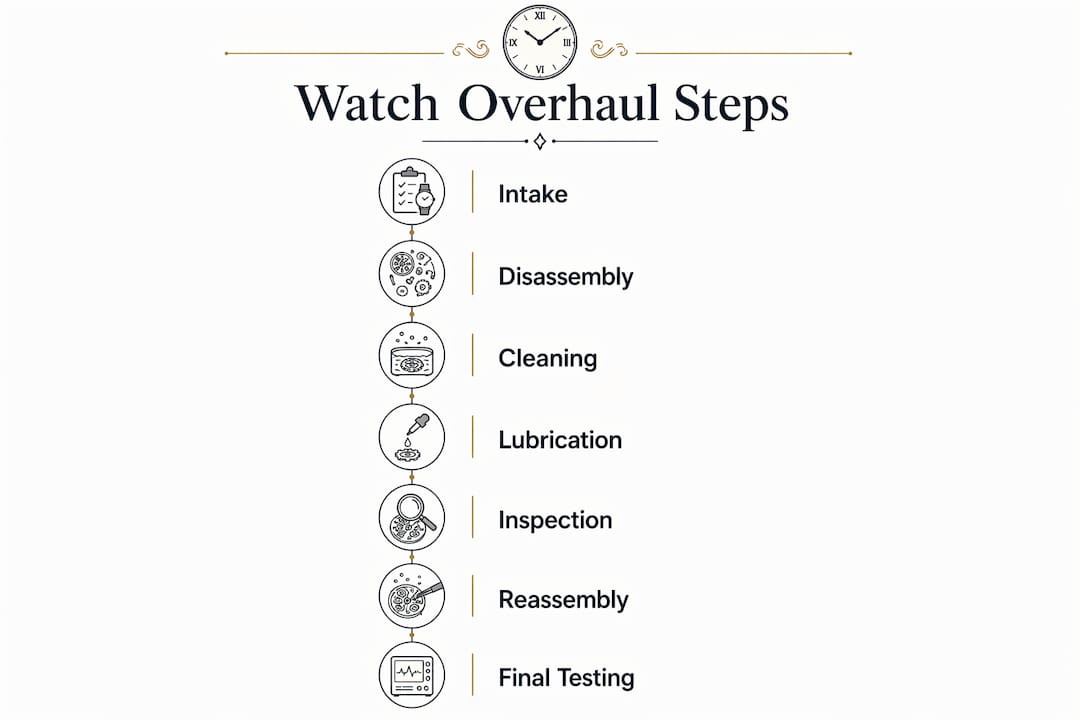
A full watch overhaul is a complete mechanical restoration, not a simple clean or battery swap. Every component is removed, inspected, cleaned, lubricated, and reassembled to manufacturer tolerances before the watch is tested for timing accuracy and water resistance. A professional overhaul typically takes 10 to 21 working days, though complex complications or rare parts can push that further. Here is what the process actually involves:
- Initial assessment: cosmetic and functional inspection on intake
- Full disassembly: every gear, spring, and screw removed individually
- Ultrasonic cleaning: all components stripped of old oils and debris
- Lubrication: manufacturer-approved oils applied in precise, measured amounts
- Part replacement: worn or damaged components swapped for authentic parts
- Reassembly and regulation: movement rebuilt and timed on professional equipment
- Final testing: pressure testing, timing verification, and visual refinishing
Table of Contents
- How the watch overhaul process works, step by step
- How long does a watch overhaul take?
- How do you know when your watch needs an overhaul?
- What happens when you skip a watch overhaul?
- How to care for your watch between overhauls
- Quality assurance and UK servicing standards
- Key takeaways
- Trust Watchrepairstation with your next overhaul
How the watch overhaul process works, step by step
The seven stages below reflect the standard professional process used by qualified watchmakers across the UK.
1. Initial assessment and intake
When a watch arrives for service, the watchmaker conducts a thorough intake inspection before touching anything inside. The case, crystal, dial, crown, and movement condition are all logged. Any cosmetic damage, functional irregularities, or signs of previous amateur repair are noted at this stage. Think of it as the medical charting that happens before surgery. A watch diagnostic check at this point determines whether a full overhaul is warranted or whether a targeted repair will suffice.
2. Complete disassembly
Every single component is removed with precision tools, from the hands and dial down to the escapement, balance wheel, and mainspring. Nothing is left assembled. Each part is logged individually and cross-checked against manufacturer specifications to identify wear before cleaning begins. This logging step is what separates a professional overhaul from a rushed service; a part that looks fine to the naked eye may show wear under magnification that would cause failure within a year.
3. Ultrasonic cleaning
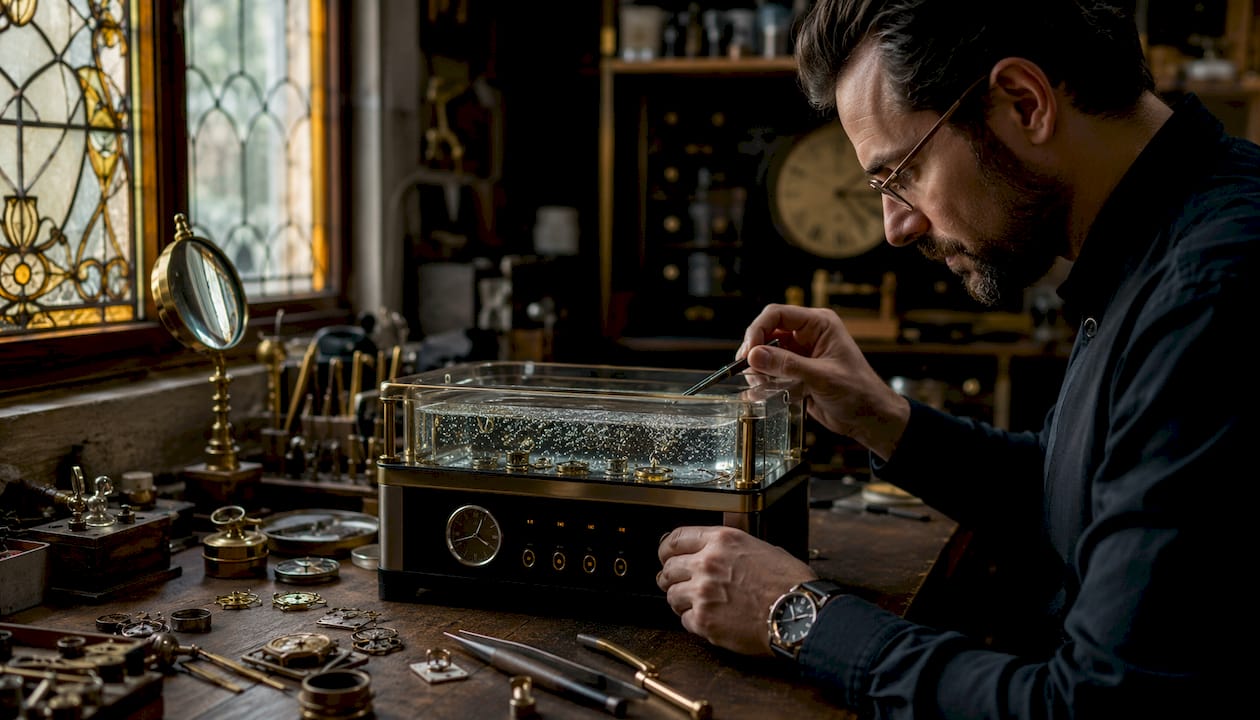
All disassembled parts go through an ultrasonic cleaner, which uses high-frequency vibrations to dislodge old lubricants, microscopic debris, and contaminants from every surface and pivot hole. Parts are then dried with specialist equipment to prevent any moisture retention, which can cause corrosion on steel components. This stage restores the internal cleanliness that accurate timekeeping depends on.
4. Precise lubrication
Lubrication is arguably the most technically demanding step in the entire process. Professional lubrication uses specific oils applied in measured amounts to different components. Moebius oils, for example, are matched by viscosity to function: a thin oil for escapement jewels, a medium oil for gear train pivot holes, a light grease for the keyless works. Too much oil migrates across surfaces and causes drag; too little accelerates wear. Getting this wrong is one of the most common causes of watch failure after an amateur service.
5. Inspection and replacement of worn parts
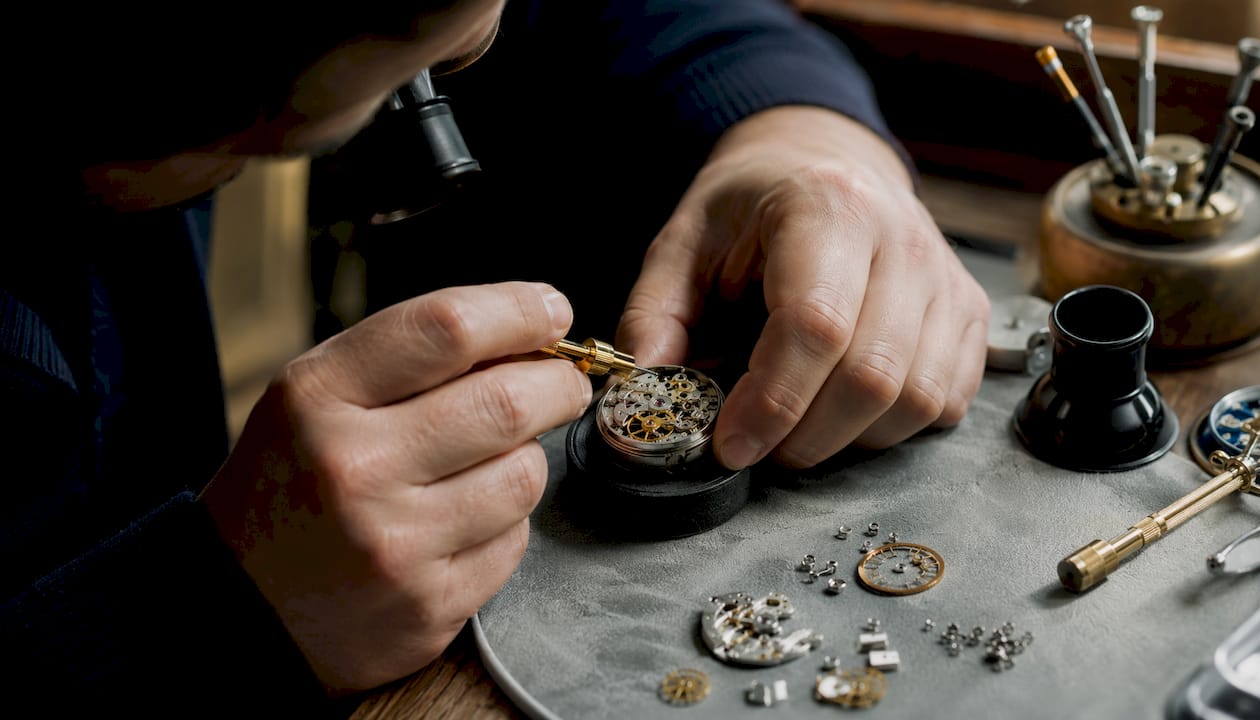
With parts clean and visible under magnification, the watchmaker inspects each component against manufacturer tolerances. Mainsprings, gaskets, jewels, crowns, and stems are the most frequently replaced items. Authentic components are used wherever possible, as non-genuine parts can affect both performance and resale value. For collectors, this step is where the value of a watch is either preserved or compromised.
6. Reassembly and timing regulation
The movement is rebuilt in reverse order of disassembly, with each screw seated by hand before being snugged with the correct driver. Spring orientation is critical here: a mainspring feeding incorrectly into the barrel arbor, or a hairspring not centred over the regulator pins, will cause the watch to run wildly out of rate or not run at all. Once assembled, the movement is placed on a timing machine, which reads the escapement’s beat rate and amplitude across multiple positions. A well-regulated movement will show consistent performance whether lying flat, crown-up, or crown-down.
7. Final testing, pressure testing, and refinishing
The last stage covers everything the owner actually sees and feels. Water resistance is verified by pressure testing the sealed case, with gaskets replaced as needed. Gaskets degrade over time regardless of how often a watch is submerged, so this step matters even for watches that rarely see water. The case and bracelet are then polished and brushed back to their original finish, scratches buffed out without compromising the lug geometry. Only once every test is passed does the watch leave the bench.
How long does a watch overhaul take?
The standard overhaul duration is 10 to 21 working days for most movements. That range covers a straightforward three-hand automatic at the lower end and a chronograph or perpetual calendar at the upper end. Vintage pieces or watches requiring factory-ordered parts can take considerably longer.
| Watch complexity | Typical bench time | Total turnaround (including delivery and parts) |
|---|---|---|
| Simple quartz | 3–5 working days | 10 to 21 working days |
| Standard mechanical/automatic | 7–10 working days | 10 to 21 working days |
| Chronograph or date complication | 10–15 working days | 10 to 21 working days |
| Grand complication or vintage | 15+ working days | 3–6 weeks or more |
Bench time refers to the actual hours a watchmaker spends working on the movement. Total turnaround is the figure that matters to the owner, and it includes waiting for parts, return shipping, and quality assurance sign-off. Understanding the difference between bench time and total turnaround helps set realistic expectations when booking a service.
Several variables influence where your watch lands within that range:
- Movement type: mechanical movements require more disassembly steps than quartz
- Parts availability: common movements have parts in stock; rare calibres may need factory ordering
- Brand and model: manufacturer-certified centres sometimes have longer queues than independent workshops
- Condition on arrival: heavy wear or previous damage adds inspection and repair time
- Service centre capacity: a busy workshop in peak season will have longer lead times than a quieter period
How do you know when your watch needs an overhaul?
The clearest signal is a change in behaviour. A watch that has been keeping good time for years and suddenly starts losing or gaining more than 15–20 seconds per day has a problem that a simple regulation will not fix permanently. Other symptoms worth acting on:
- Erratic timekeeping: gaining or losing time inconsistently, not just running slightly fast or slow
- Power reserve loss: the watch runs down faster than it used to, or stops shortly after being wound
- Moisture or condensation: any fogging under the crystal, even briefly, means water has entered the case
- Unusual crown feel: winding feels rough, gritty, or unusually stiff compared to normal
- Strange noises: grinding or rattling when winding or setting the time indicates internal wear
- Intermittent stopping: the watch stops and restarts without explanation
For scheduled maintenance, recommended service intervals are every few years depending on the type of watch. Major brands vary: Rolex and Tudor advise every 10 years for their modern movements, Omega every 5–8 years, and Seiko and Grand Seiko every 3–4 years. These are guidelines, not hard deadlines. A watch running well and showing no symptoms may not need immediate service at the interval mark.
That said, over-servicing carries its own risks. Opening the movement unnecessarily exposes it to contaminants, and each disassembly carries a small chance of introducing new wear. Maintenance should be needs-based rather than rigidly calendar-driven.
Pro Tip: Never wait until a watch stops completely before booking a service. Internal damage from dried lubricants begins long before any outward failure, and by the time a watch stops, worn components may need replacement rather than just cleaning. Early preventive servicing is almost always cheaper.
What happens when you skip a watch overhaul?
Lubricants do not simply dry out and become inert. As watch oils degrade, they thicken and eventually turn abrasive, grinding against the very components they were meant to protect. Dried lubricants acting abrasively cause accelerating internal wear that compounds with every passing month. What would have been a standard service becomes a parts replacement job, and what would have been a parts replacement job can become a movement rebuild.
The consequences of skipping servicing include:
- Accelerated wear on pivots and jewels from abrasive degraded oil
- Mainspring fatigue leading to reduced power reserve and eventual breakage
- Gasket failure allowing moisture ingress, which corrodes steel components and ruins dials
- Escapement damage from insufficient lubrication on the pallet fork and escape wheel
- Loss of water resistance even in watches rated to significant depths
- Reduced resale value as service history gaps raise questions for buyers
The financial argument for regular servicing is straightforward. A routine overhaul costs a fraction of what a movement rebuild or dial restoration costs. Watches are mechanical investments, and preventive care is what protects that investment over decades.
How to care for your watch between overhauls
A full overhaul is not something you do every year, but daily habits make a real difference to how long your watch stays in good condition between services.
- Wipe the case after wearing: a soft microfibre cloth removes sweat, skin oils, and dust that accelerate corrosion on case finishes and degrade gaskets over time
- Avoid strong magnets: keep the watch away from laptop speakers, tablet covers, and phone charging pads; magnetisation causes a mechanical watch to gain minutes per day rather than seconds
- Protect from extreme temperatures: thermal cycling stresses gaskets and lubricants; avoid leaving a watch in a hot car or near a radiator
- Crown discipline: never wind or set the time while the watch is wet or still on the wrist; winding off the wrist distributes pressure evenly across the stem and prevents the most common point of mechanical failure
- Store carefully: a watch box with individual compartments prevents scratching; for watches not worn regularly, a dry, temperature-stable environment away from direct sunlight is ideal
- Rotate straps: leather straps worn daily in a humid climate may last 6–12 months; rotating between two or three straps can extend each one to 2–3 years
- Annual pressure test: if you regularly wear your watch near water, an annual water resistance check is worthwhile regardless of the service interval, since gaskets can degrade between overhauls
Pro Tip: Wind a manual-wind watch until you feel resistance, then stop. Automatic watches need only 20–30 crown turns to start from stopped. Over-winding a manual movement does not break the mainspring in most modern watches, but it does stress the click spring unnecessarily over time.
Quality assurance and UK servicing standards
A professional overhaul is only as good as the quality assurance process that follows it. Reputable UK service centres apply multi-stage testing before any watch leaves the bench, covering timing calibration across multiple positions, pressure testing to verify water resistance, power reserve verification, and a final visual inspection of dial alignment, hand clearance, and case finishing.
Watchrepairstation applies stringent quality assurance protocols as standard, including genuine parts sourcing and comprehensive post-service testing. Established in 2008 and operating as a trade-only specialist across the UK, Watchrepairstation handles everything from battery replacements to full movement overhauls for watch and jewellery shops that need reliable turnaround without the risk of costly errors. The “No Fix, No Cost” guarantee means partnering shops carry zero financial risk on jobs that cannot be completed successfully.
Choosing the right service centre matters for reasons beyond price. Authentic parts preserve both performance and resale value; a watch serviced with non-genuine components can lose its manufacturer warranty and may perform inconsistently. For collectors following watch collecting best practices, documented service history from a reputable centre is one of the most important factors in long-term value retention.
Pro Tip: Always ask a service centre whether they use genuine manufacturer components or approved equivalents, and whether the overhaul comes with a written warranty. A reputable watchmaker will answer both questions without hesitation. If they cannot, look elsewhere.
Key takeaways
A full watch overhaul involves seven distinct stages from intake to final testing, and skipping regular service turns protective lubricants into abrasive compounds that cause accelerating internal damage.
| Point | Details |
|---|---|
| Standard overhaul duration | Most overhauls take 10–21 working days; complex complications or rare parts extend this further. |
| Service intervals by type | Mechanical watches need servicing every 4–6 years; quartz every 3–5 years, adjusted for symptoms. |
| Lubrication is critical | Incorrect or degraded lubrication causes drag, wear, and eventual movement failure. |
| Water resistance degrades | Gaskets deteriorate over time and require regular pressure testing, even in rarely submerged watches. |
| Preventive servicing saves money | Addressing wear early costs far less than repairing damage caused by prolonged neglect. |
Trust Watchrepairstation with your next overhaul

Watchrepairstation has been the UK’s trade-to-trade watch repair specialist since 2008, offering full overhauls, movement repairs, and battery replacements with a “No Fix, No Cost” guarantee. Quick turnaround times and competitive pricing mean partnering shops can offer their customers a professional result without the wait or the risk. Whether you need a straightforward service or a complex movement rebuild, the team at Watchrepairstation has the expertise to handle it.
Book a watch repair with Watchrepairstation and give your timepiece the professional restoration it deserves.
Recommended
- Watch repair bottlenecks checklist: 2026 guide for shops – Watch Repair Station
- Watch repair quality assurance best practices: 2026 guide – Watch Repair Station
- What is batch watch repair: a complete guide – Watch Repair Station
- What is express watch servicing? A clear 2026 guide – Watch Repair Station

Leave a Reply