

Require a signed work order at intake, publish your turnaround window, and commit to scheduled updates. That three-step habit, backed by the National Association of Jewellers (NAJ) and practiced by trade partners like Watchrepairstation, prevents the majority of complaints before they start. Industry data indicates that the average watch repair wait is about 14 days, and slow service is the single most-cited complaint. Get ahead of it at the counter, not after the phone call.
Immediate steps you can adopt this shift:
- Print a two-part work order; customer keeps one copy, signed at drop-off
- Photograph the watch on all four sides before the customer leaves
- State a realistic turnaround window in writing, not verbally
- Book the first status update for 48 hours after intake, regardless of progress
- Confirm whether the job falls under the Consumer Rights Act 2015 or is a chargeable repair
Table of Contents
- What does a proper intake work order look like?
- How do you quote costs so disputes stay rare?
- How do you set realistic turnaround times and manage capacity?
- What update schedule actually reduces complaints?
- How should you handle vintage or high-value watches differently?
- How do you train staff to handle intake and complaints consistently?
- What guarantees and pre-authorisation policies reduce financial risk?
- How can a trade partner cut your wait times?
- Key takeaways
- The one thing most shops still get wrong
- Watchrepairstation: trade repairs without the wait-time risk
- Useful sources
What does a proper intake work order look like?
The NAJ recommends a signed work order that records scope, cost estimate, and expected turnaround. Without it, every dispute becomes a memory contest. The table below shows the minimum fields; convert it to a printed pad or a digital form.
| Field | What to capture |
|---|---|
| Job reference | Unique ID, date, intake technician |
| Customer details | Name, phone, email, preferred contact method |
| Item description | Brand, model, serial/case number if visible |
| Visible defects | Scratches, missing crown, cracked crystal — noted before work begins |
| Intake photos | Timestamped images attached to job record |
| Bench diagnostic required? | Yes / No — determines whether a preliminary or confirmed estimate applies |
| Preliminary estimate | Labour range, parts allowance, diagnostic fee if applicable |
| Authorisation clause | Customer signature confirming scope, cost ceiling, and turnaround |
| Turnaround commitment | Stated window, e.g. “10–14 working days subject to parts” |
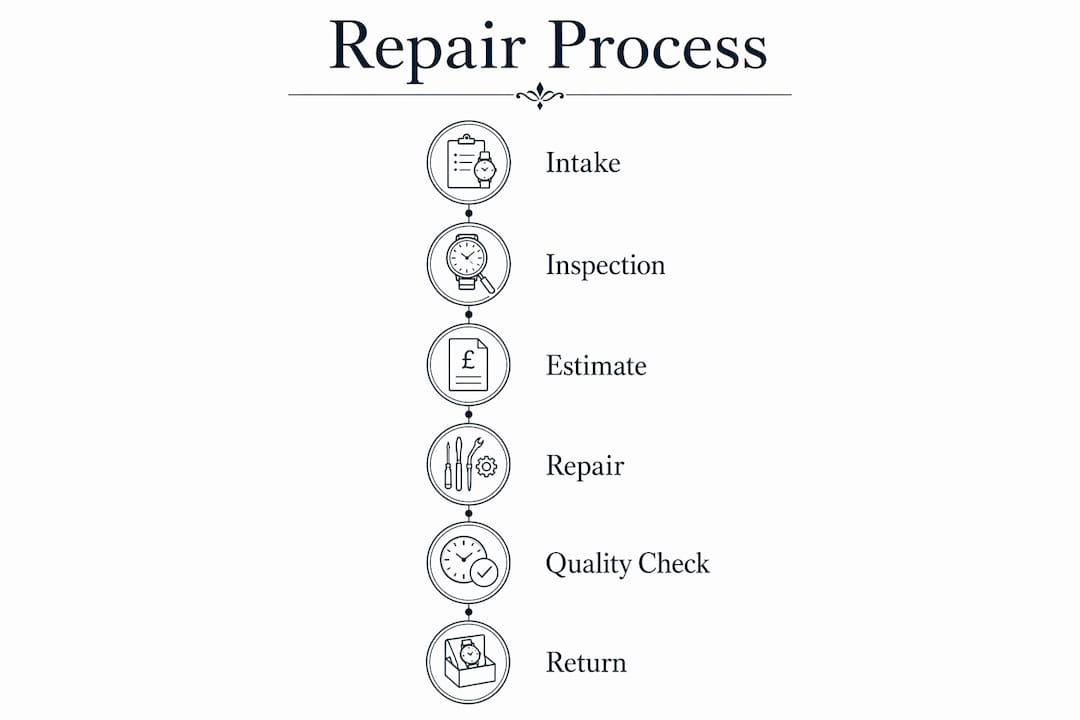
Timestamped photos on arrival are the single most effective defence against post-repair damage disputes. Photograph front, back, crown side, and clasp. Store images in the job record, not on a personal phone.
The authorisation clause should read plainly: “I authorise the work described above up to the estimate stated. I understand that additional costs will require my written approval before work proceeds. This repair is / is not covered under the Consumer Rights Act 2015 (delete as applicable).” Staff must understand the difference between a CRA repair and a chargeable job; the NAJ’s guidance on this point is explicit.
How do you quote costs so disputes stay rare?
Transparency on repair costs increases customers’ willingness to pay. The mechanism is a two-stage quotation: a preliminary estimate at intake, then a confirmed figure after bench diagnosis.
Practical pricing steps:
- State the diagnostic fee upfront and record customer approval before the watch goes to the bench
- Send the confirmed estimate by email or SMS so there is a written record
- Itemise labour and parts separately; customers accept costs more readily when they can see the breakdown
- Use capped pre-authorisations for straightforward jobs: “We will proceed up to £X without further sign-off”
Pro Tip: Set the pre-authorisation cap at a figure that covers 90% of typical jobs in that category. Anything above it triggers a call. This removes the approval bottleneck for routine work while protecting the customer on complex jobs.
Sample estimate phrasing: “Based on our initial inspection, we estimate £[X]–£[Y] for a movement service including parts. We will confirm the exact figure after bench diagnosis and will not proceed above £[Y] without your approval.”
How do you set realistic turnaround times and manage capacity?
Publish a base turnaround and a maximum window, then stick to them. The industry average of around 14 days is a useful benchmark, but your published figure should reflect your actual throughput, not an aspiration.

Calculate it by tracking completed jobs over the previous 90 days, adding your typical parts lead time, and building in a 20% buffer for complexity. If your honest average is 18 days, publish 10–20 working days. Overpromising and missing is far more damaging than a longer stated window.
Capacity tactics worth implementing:
- Set a daily job intake cap during peak periods (pre-Christmas, post-summer)
- Reserve two or three bench slots per week for urgent or high-value work
- Communicate queue position at intake: “We currently have a 12-day queue; your watch will be assessed by [date]”
Overflow policy. When the queue is full, loaner programmes and goodwill gestures measurably improve retention during delays. Offer a loaner where practical, or escalate the job to a trade partner. Present the trade-partner option as a benefit: “We work with a specialist trade workshop that can turn this around faster; your watch stays in expert hands and our guarantee still applies.” See the watch repair overflow guide for a full escalation framework.
What update schedule actually reduces complaints?
Proactive status updates reduce complaints more reliably than shaving a day from turnaround. Customers who feel informed do not call. Customers who feel ignored do.
Minimum notification schedule:
- Logged — confirmation SMS/email within 2 hours of intake
- Diagnostic complete — estimate sent for approval before bench work starts
- Bench work started — brief update once authorisation is confirmed
- Quality check passed — internal sign-off recorded
- Ready to collect / dispatched — final notification with collection details
SMS template (diagnostic stage):
“Hi [Name], your [Brand] watch (ref [ID]) has been assessed. Our estimate is £[X]–£[Y]. Please reply YES to authorise or call us on [number]. We aim to complete by [date].”
Email template (ready to collect):
“Your watch is ready. Ref [ID], [Brand model]. Collection available [days/hours]. Please bring this email. If you have any questions, call [number].”
Capture SMS and email consent at intake. Log every outbound message in the job record with a timestamp. A customer update system that automates these notifications removes the burden from front-desk staff entirely.
How should you handle vintage or high-value watches differently?
Treat every vintage or heritage piece as a special case. Require a detailed condition report, agree on fall-back outcomes in writing, and obtain explicit consent before any irreversible work begins.
Physical diagnostics are non-negotiable. Movement issues are rarely visible externally, and a watch condition assessment cannot be finalised from photographs alone. Photographs document the external state; the bench diagnostic reveals what actually needs doing.
Suggested disclosure wording for complex pieces: “This watch contains [treated gemstones / non-original parts / a previously repaired movement]. We will document all findings before work begins. If a component is non-repairable, we will contact you before proceeding.” Record any prior repair history the customer mentions; it protects both parties if a dispute arises later.
Pro Tip: Perform and record a water-resistance test before returning any watch to a customer. Gasket failure is the most common cause of avoidable post-service moisture damage. A failed test caught in-house is a minor fix; one caught by the customer is a complaint.
How do you train staff to handle intake and complaints consistently?
Consistent scripting at intake reduces escalation. When every staff member follows the same process, customers get the same experience regardless of who serves them.
Staff training checklist:
- Complete all intake fields before the customer leaves the counter
- Photograph the watch with the customer present
- Explain the two-stage estimate process and the diagnostic fee
- State the turnaround window and the first update timing
- Confirm CRA status and note it on the work order
- Log the job in the tracking system before the customer reaches the door
Intake script (opening): “Before we take this in, I’d like to note the condition and take a few photos with you here. I’ll give you a preliminary estimate now and a confirmed figure once our technician has assessed it on the bench. We aim to update you within 48 hours.”
Delay acknowledgement script: “I can see this has taken longer than we quoted. I’m sorry for that. Here’s where we are and what happens next. [Explain.] We’d like to offer [discount / free check] as a gesture of goodwill.”
Complaint response flow:
- Minor complaint: acknowledge, explain, offer a goodwill gesture
- Unresolved after one conversation: escalate to the manager
- Persistent dispute: refer to NAJ Resolve, the NAJ’s mediation service for member businesses
What guarantees and pre-authorisation policies reduce financial risk?
Clear, limited guarantees turn potential disputes into manageable outcomes. A well-worded statement protects the shop and reassures the customer.
| Guarantee element | What to include |
|---|---|
| Scope | What the guarantee covers (parts fitted, labour performed) |
| Exclusions | Accidental damage, water ingress after hand-back, pre-existing faults |
| Duration | Typically 12 months on parts and labour |
| Claims process | How the customer initiates a claim and the expected response time |
| Pre-authorisation cap | The maximum spend approved without further sign-off |
Customers who choose authorised, expert technicians do so because they trust parts quality and skill. A written guarantee reinforces that trust at the point of hand-back. For quality assurance practices that support your guarantee wording, a documented bench-check protocol is the foundation.
When a job exceeds the pre-authorisation cap, send a written amendment for the customer to approve before continuing. Keep a copy in the job record.
How can a trade partner cut your wait times?
Trade partners absorb peak demand and reduce published turnaround without the shop losing the customer relationship. The shop remains the customer’s point of contact; the trade partner handles the bench work.
Watchrepairstation has operated as a trade-only repair service since 2008, working exclusively with UK watch and jewellery shops. Their trade repair service covers battery installation, movement repairs, and full overhauls, with a “No Fix, No Cost” guarantee that removes financial risk for the referring shop. Expert technicians handle every job, which addresses the customer preference for authorised, skilled repair.
Onboarding checklist for trade referrals:
- Complete your standard intake form and photograph the watch before dispatch
- Package the watch securely with the job reference and customer contact details
- Log the trade referral in your job-tracking system with expected return date
- Notify the customer that the job has been referred to a specialist workshop
- Record the trade partner’s job reference against your own for tracking
Key takeaways
A signed work order at intake, a published turnaround window, and a scheduled update cadence are the three actions that prevent most watch repair complaints before they escalate.
| Point | Details |
|---|---|
| Signed work order at intake | Record scope, estimate, turnaround, and CRA status; customer signs before the watch leaves the counter. |
| Published turnaround window | Base your stated window on actual throughput plus a buffer; the industry average is around 14 days. |
| Two-stage estimates | Give a preliminary figure at intake; confirm after bench diagnosis before work begins. |
| Scheduled status updates | Send notifications at five fixed stages; proactive updates reduce complaints more than faster turnaround. |
| Water-resistance test before hand-back | Record the result; gasket failure is the most common cause of avoidable post-service damage. |
| Watchrepairstation for overflow | Trade-only, No Fix No Cost guarantee since 2008; absorbs peak demand without disrupting the customer relationship. |
The one thing most shops still get wrong
The signed work order gets all the attention in training guides, and rightly so. But the failure point most shops overlook is the silence between intake and collection. A customer who signed a form and then heard nothing for ten days will arrive at the counter anxious, and anxious customers escalate. The shops that consistently avoid complaints are not necessarily faster; they are simply more communicative. One proactive update, sent before the customer thinks to call, does more for retention than a same-day turnaround with no explanation of what happened. Pick one change to test this week: if you have the work order process in place, add the 48-hour update. If you have neither, start with the work order today and add the update cadence next shift.
Watchrepairstation: trade repairs without the wait-time risk
For UK shops that need overflow capacity without compromising on quality or customer trust, Watchrepairstation offers a practical alternative to managing every job in-house. Since 2008, the service has operated on a trade-only basis, meaning every repair is handled by qualified technicians working exclusively for watch and jewellery shops.
The “No Fix, No Cost” guarantee removes financial risk entirely: if a repair cannot be completed, the shop pays nothing. Competitive trade pricing, clear authorisation workflows, and fast turnaround mean your customers get their watches back on time, with a guarantee they can rely on. Battery replacements, movement repairs, and full overhauls are all covered under one trade account.
Submit a trade enquiry via the watch repair service page to discuss your shop’s requirements and get started.
Useful sources
- NAJ Guidance Note: Managing Customer Expectations — industry standard for signed work orders, CRA obligations, and dispute prevention
- Customer Experience in the Watch Industry Statistics — industry data on average turnaround times and complaint drivers
- Jewellery & Watch Repair by Mail: Accept and Track Repair (Luxare) — intake photo protocols, staged estimates, and automated notifications
- Overcoming Service Crises in Microbrand Watches — practical examples of proactive communication reducing reputational damage
- Watchrepairstation Trade Repair Service — trade-only repair offering, No Fix No Cost guarantee, and onboarding details

Leave a Reply