

A centre seconds hand is the seconds indicator mounted on the same central arbor as the hour and minute hands, sweeping the full diameter of the dial rather than ticking around a small sub-dial. That single design decision touches the going train, the dial layout, and the serviceability of the movement. Understanding it is one of the most useful entry points into mechanical watchmaking.
The practical difference from a subsidiary (small) seconds is immediate: you can confirm at a glance that the watch is running, and you can time short intervals against the minute track without squinting at a 6 o’clock sub-dial. For wristwatch design specifically, the centre seconds improves legibility because the hand sweeps a far larger arc than any sub-dial seconds indicator can manage.
Table of Contents
- What is a watch centre seconds, and how does it differ from small seconds?
- How the centre seconds evolved from pocket watches to wristwatches
- How does a watch centre seconds work? Direct drive versus indirect drive
- Sweep seconds, deadbeat seconds, hacking, and chronograph hands
- How to identify a centre-seconds watch on the dial and in the movement
- Servicing centre seconds watches: what watchmakers check
- Notable examples of centre seconds in historical and modern watches
- Performance implications: torque, sweep quality, and accuracy
- Key takeaways
- Why centre seconds deserves more attention than it gets
- Useful sources and further reading
What is a watch centre seconds, and how does it differ from small seconds?
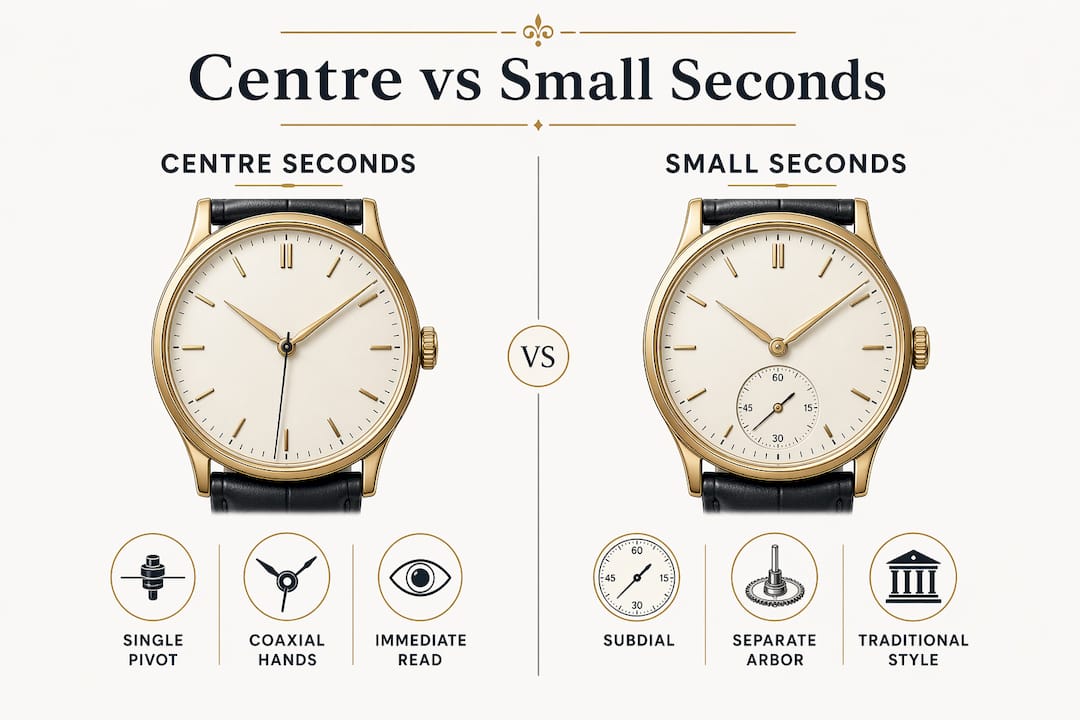
Centre seconds, also called central seconds or sweep seconds, positions the seconds hand coaxially with the hour and minute hands at the dial’s geometric centre. All three hands share the same pivot point, though they are driven by separate arbors stacked concentrically.
Subsidiary seconds, by contrast, connects the seconds hand directly to the fourth wheel pivot, which sits off-centre in a traditional going train. The result is the familiar small sub-dial, most often at 6 o’clock, sometimes at 9 o’clock in modern layouts. The differences matter in several ways:
- Dial legibility: A centre seconds hand sweeps a radius of roughly half the dial width; a sub-dial seconds indicator sweeps a radius of perhaps 4–6 mm. The larger arc is far easier to read quickly.
- Mechanical layout: Centre seconds requires either repositioning the fourth wheel or adding intermediate gearing. Small seconds requires neither.
- Historical origin: The sub-dial layout is the older form, inherited directly from pocket-watch architecture where the movement diameter was large enough that legibility was never a concern.
- Terminology note: In British English, “centre seconds” is the preferred spelling; American sources use “center seconds.” Both refer to the same feature. “Sweep seconds” is a colloquial synonym, though technically it describes the continuous motion rather than the hand’s position.
A quick diagram to brief an illustrator: show a dial with three concentric hands sharing one pivot (centre seconds) alongside a dial with a small sub-dial at 6 o’clock and only hour and minute hands at the centre (small seconds). The contrast is immediately legible.
How the centre seconds evolved from pocket watches to wristwatches
The pocket watch established the template for mechanical timekeeping: subsidiary seconds at 6 o’clock, driven directly off the fourth wheel. With a dial diameter of 45 mm or more, that layout worked perfectly well. Nobody struggled to read a 10 mm sub-dial on a pocket watch.
The wristwatch changed everything. Smaller dials, worn on a moving wrist, made the sub-dial seconds genuinely difficult to read. The transition to centre seconds accelerated through the mid-20th century as manufacturers rethought the going train to meet legibility demands. Key milestones in that shift:
- Pre-1940s: Virtually all mechanical watches used subsidiary seconds; the pocket-watch gear train was simply scaled down.
- Late 1940s: Zenith introduced calibre 133, reorganising the gear train so the fourth wheel sat at the movement’s centre, driving the seconds hand directly. The design also allowed a larger balance and mainspring barrel, improving performance.
- Early 1950s: Patek Philippe released a directly driven, hand-wound centre seconds design (calibre 12 SC) that placed the fourth and centre wheels coaxially, keeping both the minute and seconds hands in the direct power flow. It remained in production until 1970.
- Post-1950s: Direct-drive centre seconds became the Swiss industry standard; the ETA and Peseux families of movements adopted the layout, and it spread to almost every mainstream calibre.
- Contemporary: Some modern makers deliberately reintroduce small seconds for vintage aesthetics, occasionally by adding a module under the dial to relocate the seconds hand back to a sub-dial on an otherwise centre-seconds base movement.
The mid-20th century shift to centre seconds was not cosmetic. Reorganising the gear train to place the fourth wheel at the movement’s centre allowed larger balance wheels and mainspring barrels, with measurable performance gains, according to TimeZone’s historical analysis.
How does a watch centre seconds work? Direct drive versus indirect drive
There are two primary mechanical implementations, and the distinction matters both for understanding the movement and for servicing it correctly.
The going train: a quick orientation
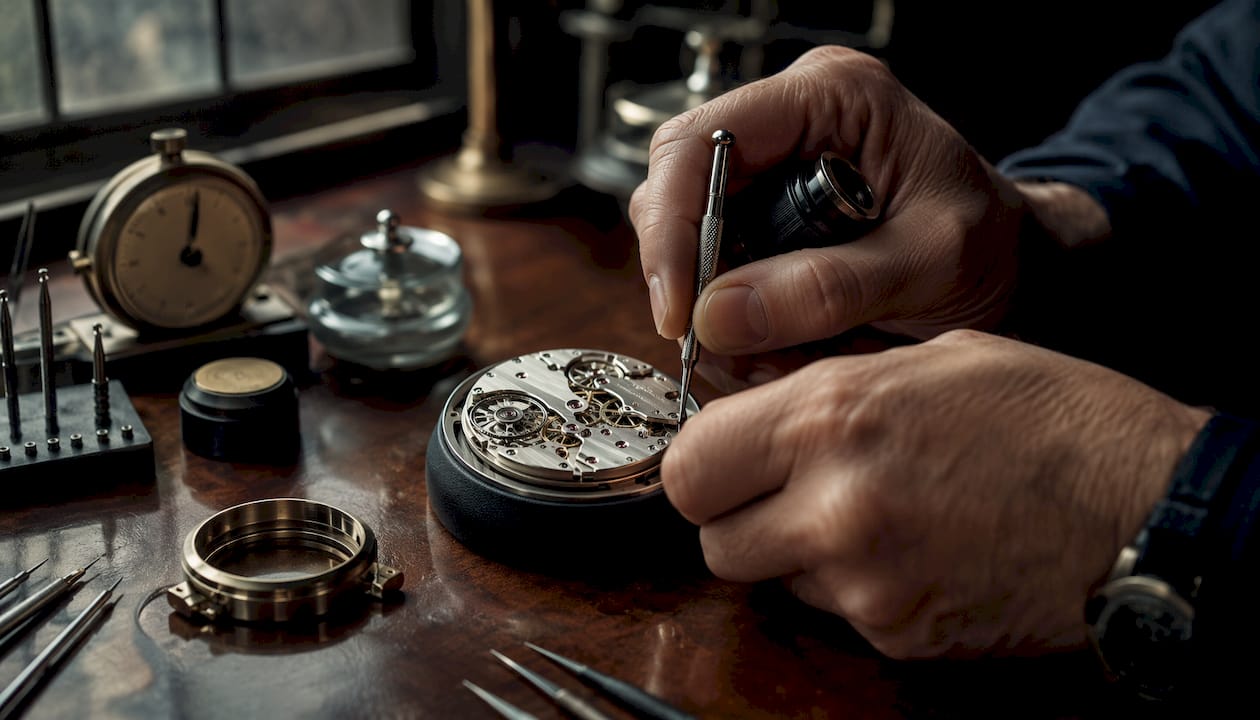
Power flows from the mainspring barrel through the centre wheel (first wheel in the train, carrying the cannon pinion and minute hand), then to the third wheel, then to the fourth wheel (which traditionally carries the seconds hand), and finally to the escapement. In a traditional small-seconds movement, the fourth wheel sits off-centre and its extended pivot carries the seconds hand directly.
Direct-drive centre seconds
The most common modern solution repositions the fourth wheel to the movement’s geometric centre. Because the centre wheel already occupies that position in a traditional train, the architecture must change:
- The fourth wheel moves to the centre of the movement.
- The centre (minute) wheel moves off-centre, driving the cannon pinion indirectly via an intermediate wheel.
- The fourth wheel’s extended pivot passes through the cannon pinion tube to carry the seconds hand at the dial.
- Because the fourth wheel remains in the direct power flow, the seconds hand is driven with full torque and remains completely stable.
The minute hand’s slow travel means any slight irregularity in the indirect minute drive is invisible in use. This rearrangement also tends to produce a thinner, less complex movement than indirect seconds designs, and it eliminates hand flutter entirely.
Indirect-drive centre seconds
The older and mechanically simpler approach leaves the traditional gear train untouched and adds an intermediate wheel to bring the seconds indication back to the centre. The fourth wheel stays in its original off-centre position; the added wheel picks up the drive and routes it to a central seconds pinion.
The problem is that the seconds pinion now sits outside the direct power flow. Without something to take up the backlash, the hand jitters visibly with each escapement beat. The standard remedy is a tensioning spring (sometimes called a friction spring) bearing on the seconds pinion. Setting it correctly is critical: too little tension allows jitter; too much increases the torque demand and can reduce the movement’s amplitude.
Direct vs indirect: a comparison
| Feature | Direct-drive centre seconds | Indirect-drive centre seconds |
|---|---|---|
| Seconds hand stability | Excellent; hand is in power flow | Prone to flutter without tensioning spring |
| Movement thickness | Generally thinner | Slightly thicker due to added wheel |
| Torque demand | Standard | Higher if spring tension is excessive |
| Gear train complexity | Moderate rearrangement | Simpler base train, added module |
| Serviceability | Straightforward | Spring tension must be reset at service |
| Historical prevalence | Industry standard post-1950s | Common in earlier and budget designs |
Pro Tip: When servicing an indirect centre seconds movement, always check the tensioning spring before reassembly. A spring that has lost its set will allow visible jitter even after a full overhaul. Conversely, a spring bent too aggressively will drag on the seconds pinion and reduce amplitude by several degrees.
Sweep seconds, deadbeat seconds, hacking, and chronograph hands
Centre seconds is an architectural position, not a description of how the hand moves. Several distinct behaviours can be combined with it:
- Sweep (continuous) seconds: The hand advances with every escapement beat, typically at 6, 8, or 10 beats per second (3, 4, or 5 Hz). At 3 Hz the motion is visibly stepped; at 5 Hz it appears almost continuous. This is the most common form.
- Deadbeat (true beat) seconds: A specialised escapement or mechanism causes the seconds hand to advance in exactly one-second steps, like a quartz watch, despite the movement being mechanical. The centre position makes deadbeat seconds far more dramatic to watch than a sub-dial version.
- Hacking (stop-seconds): Pulling the crown stops the seconds hand by applying a lever to the balance or seconds wheel. On a centre seconds watch this is visually unambiguous: the hand stops dead. On a small-seconds watch, hacking is harder to confirm at a glance.
- Central chronograph hand: A chronograph’s elapsed-seconds hand also sits at the centre of the dial, which is a frequent source of confusion. The key distinction is function: a running centre seconds hand indicates the current time continuously; a central chronograph hand is stopped at zero and only moves when the chronograph is started. Many chronographs have both a running small seconds (to show the watch is running) and a central chronograph hand.
- Faux small seconds via module: Some contemporary movements add a module under the dial to redirect a centre seconds base movement’s output to a sub-dial, recreating a vintage layout. Identifying these requires movement inspection rather than dial reading alone.
How to identify a centre-seconds watch on the dial and in the movement
Dial cues
- Three hands all originating from the dial centre, with the longest (seconds) sweeping close to the chapter ring.
- No sub-dial at 6 o’clock (or 9 o’clock).
- The seconds hand typically reaches within 1–2 mm of the minute track.
Movement inspection cues
- The fourth wheel pivot is at the movement’s geometric centre, with an extended seconds pinion passing through the cannon pinion tube.
- In a direct-drive design, the centre (minute) wheel sits off-centre, usually visible as a wheel between the barrel and the third wheel that does not align with the dial centre.
- In an indirect-drive design, look for an additional small wheel between the off-centre fourth wheel and the dial centre, often accompanied by a fine spring bearing on the central seconds pinion.
- A module-based faux small seconds will show additional wheels or spacers under the dial plate; a native small seconds will have the fourth wheel pivot in its traditional off-centre position with no added components.
What to photograph for study
Photograph the dial face to record hand alignment, then remove the dial and photograph the movement from the dial side to show the going train layout and any intermediate wheels. A side-on photograph of the cannon pinion area will reveal whether the seconds pinion passes through a tube or sits on a separate arbor.
Servicing centre seconds watches: what watchmakers check
Centre seconds watches are not inherently difficult to service, but they have specific failure modes that a watchmaker must address systematically. Watchrepairstation’s trade technicians approach centre seconds overhauls with a structured checklist.
Service checklist
- Seconds jitter test: Before disassembly, observe the seconds hand under magnification. Any flutter or irregular stepping indicates a tensioning spring issue (indirect drive) or a worn seconds pinion pivot (either type).
- Amplitude check with seconds engaged: Run the movement on a timing machine with the seconds hand fitted. A significant amplitude drop compared to the movement’s specification suggests excess friction at the seconds pinion or cannon pinion.
- Seconds pinion and pivot inspection: Examine the extended seconds pinion for wear, scoring, or bent pivots. On indirect designs, inspect the tensioning spring for loss of set or fracture.
- Endshake on the extended pivot: The seconds hand arbor must have correct endshake (axial play). Too tight causes friction and amplitude loss; too loose allows the hand to wobble vertically.
- Cannon pinion friction: The cannon pinion must slip on the centre arbor under a calibrated load for hand-setting. Worn cannon pinions are a common cause of seconds hand instability on centre seconds movements.
Common faults
- Flutter from a worn or incorrectly tensioned spring on indirect designs.
- Excess friction from added gearing that has not been properly cleaned and lubricated.
- A bent or scored seconds pinion pivot causing irregular stepping.
- Incorrect endshake on the extended pivot after a previous service.
Owner-level checks
Pull the crown to the hacking position (where available) and confirm the seconds hand stops cleanly. Release the crown and watch the hand restart: it should resume smoothly without a jump or stutter. Photograph the seconds hand against a white background under good light; jitter that is invisible to the naked eye often shows clearly in a still image taken at 1/30 s or slower.
Pro Tip: If a centre seconds watch returns from service with visible flutter that was not present before, ask the watchmaker specifically about the tensioning spring. On indirect designs, this spring is the most common casualty of an overhaul where the technician has not reset the tension correctly after cleaning.
For UK trade shops, understanding why regular servicing matters for centre seconds watches helps set accurate customer expectations around turnaround and cost.
Notable examples of centre seconds in historical and modern watches
Centre seconds is not a complication in the traditional sense; it is an architectural choice. These examples illustrate how different makers have approached it:
- H. Moser & Cie. Heritage Centre Seconds: The HMC 200 movement drives a centre seconds hand across a deliberately sparse dial. H. Moser & Cie. frames centre seconds as a statement of minimalism rather than a technical flourish, which is a useful corrective to the idea that complications are always additive.
- Zenith calibre 133 (late 1940s): The movement that established the direct-drive template for the Swiss industry. Its reorganised gear train allowed a larger balance and mainspring, and its architecture became the basis for decades of subsequent designs.
- Patek Philippe calibre 12 SC (early 1950s): A hand-wound direct-drive design that placed the fourth and centre wheels coaxially, keeping both seconds and minutes in the direct power flow. A technically unusual solution that remained in production for nearly two decades.
- Moritz Grossmann CENTRAL SECOND: Grossmann’s model uses a large centre seconds hand as a deliberate design statement, demonstrating that the feature can be the primary visual focus of a dial rather than a background detail.
- ETA 2892 family: The base movement for a vast number of Swiss watches, this calibre uses a direct-drive centre seconds with an indirect minute drive, making it an excellent study piece for the standard modern architecture.
For UK enthusiasts seeking examples to study or purchase, authorised dealers and specialist retailers are the most reliable starting point. Watchrepairstation’s watch purchasing page is a useful resource for trade-level guidance on sourcing movements.
Performance implications: torque, sweep quality, and accuracy
The centre seconds hand is not a passive indicator. It places real demands on the movement, and those demands have measurable consequences.
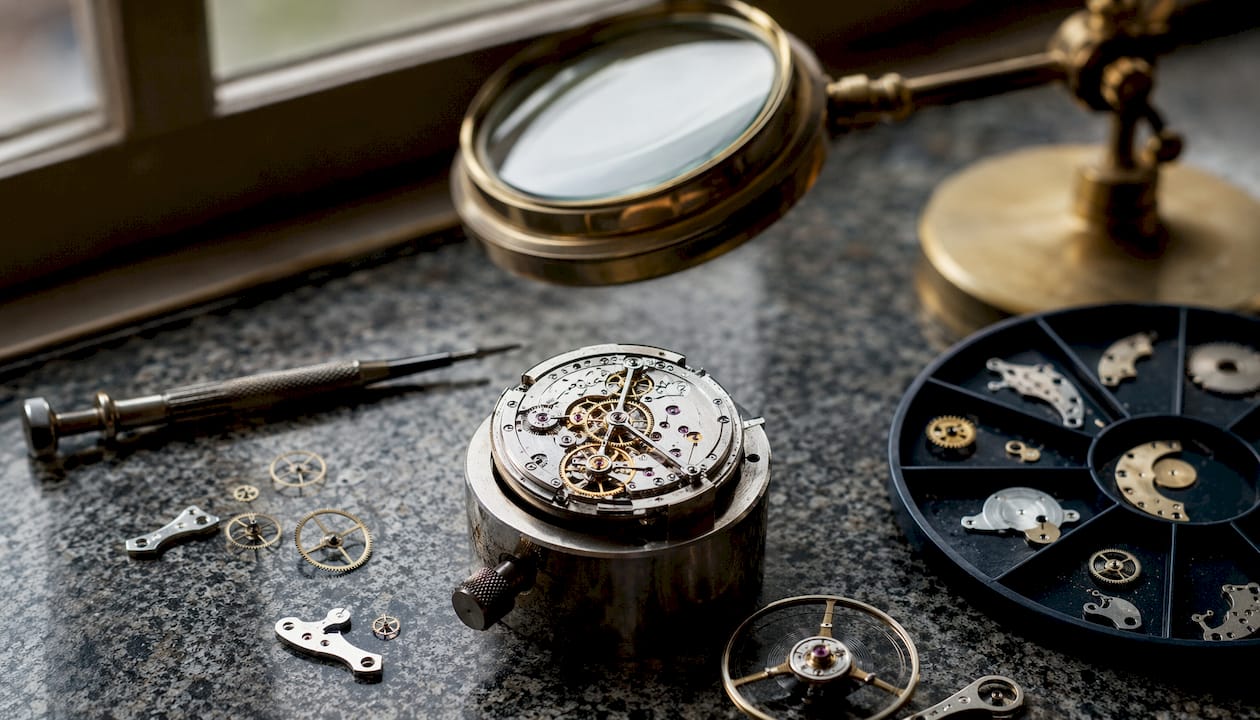
A direct-drive centre seconds hand is in the power flow, which means it adds inertia to the fourth wheel. That inertia is small but not negligible: a heavier or longer seconds hand increases the load on the escapement and can reduce amplitude slightly. Movement designers account for this when specifying the balance spring and mainspring, which is why fitting a non-original seconds hand can alter a movement’s rate.
Sweep quality, the smoothness of the hand’s motion, depends on beat frequency. At 18,000 vph (2.5 Hz) the hand advances in 1/5-second steps that are clearly visible. At 28,800 vph (4 Hz) the steps are much smaller and the motion appears nearly continuous. High-beat movements at 36,000 vph (5 Hz) produce the smoothest sweep, though at the cost of increased wear on the escapement components.
Accuracy is not directly affected by whether a movement uses centre or small seconds, but the gear train rearrangement required for centre seconds does affect the torque available to the escapement. A poorly executed indirect design with an overtightened tensioning spring can reduce amplitude to the point where the movement becomes rate-sensitive to position, meaning it gains or loses significantly more in different wearing positions. This is why amplitude testing with the seconds hand fitted is a non-negotiable step in any competent overhaul.
Key takeaways
The centre seconds hand is an architectural evolution of the going train that trades mechanical complexity for legibility, and understanding it unlocks a broader understanding of how modern movements are designed.
| Point | Details |
|---|---|
| Definition | Centre seconds places the seconds hand coaxially with hour and minute hands at the dial centre. |
| Direct vs indirect | Direct drive repositions the fourth wheel to the centre; indirect adds gearing and requires a tensioning spring to prevent flutter. |
| Historical shift | The mid-20th century transition, led by Zenith and Patek Philippe, made direct-drive centre seconds the Swiss industry standard. |
| Servicing priority | Always check seconds jitter, tensioning spring condition, and amplitude with the seconds hand fitted during any overhaul. |
| Identification | No sub-dial at 6 o’clock and three hands from the dial centre; confirm by inspecting fourth wheel position in the movement. |
Why centre seconds deserves more attention than it gets
Most discussions of watch complications focus on the dramatic: perpetual calendars, tourbillons, minute repeaters. Centre seconds rarely appears on that list, and that is a mistake.
The shift to centre seconds in the mid-20th century required movement designers to rethink the entire going train, not just add a module. Moving the fourth wheel to the centre changed torque distribution, affected barrel and balance sizing, and forced a new approach to the cannon pinion drive. Zenith’s calibre 133 and Patek’s 12 SC were not incremental refinements; they were genuine re-architecturings of the mechanical watch. The fact that the result looks simple on the dial is precisely the point.
There is also something instructive about how contemporary makers use centre seconds. H. Moser & Cie. and Moritz Grossmann both deploy it as a deliberate aesthetic signal: a single sweeping hand on a clean dial communicates confidence in the movement beneath. That is a design language worth understanding, because it reveals what the maker considers worth showing and what they consider worth hiding.
For horology students, centre seconds is an ideal study subject because it connects so many foundational topics: cannon pinion mechanics, fourth wheel placement, torque management, and the relationship between gear train architecture and dial design. Pull apart an ETA 2892 and an ETA 7001 side by side, and the difference in fourth wheel position tells you almost everything you need to know about why one has centre seconds and the other does not.
Useful sources and further reading
These sources vary in depth and focus; knowing what each contributes will help you use them efficiently.
- TimeZone: The Pursuit of Center Seconds, Parts 1 and 2 — The most detailed historical and technical account available online. Part 1 covers the legibility argument and early history; Part 2 analyses the Zenith calibre 133 and Patek 12 SC in movement-diagram detail. Essential reading for any horology student.
- Hodinkee: Center Seconds, Small Seconds, and Mechanical Fauxtina — Accessible explanation of why direct drive prevailed, with a useful section on module-based faux small seconds. Good for understanding the contemporary market context.
- H. Moser & Cie.: Centre Seconds Explained — A brand perspective that frames centre seconds as a design philosophy rather than a technical necessity. Useful for understanding how makers communicate movement architecture to collectors.
- Moritz Grossmann: Central Second — A contemporary example of centre seconds used as the primary design statement. Study the dial photography alongside the movement description.
- Watch Wiki: Central Seconds — A concise encyclopaedic entry covering terminology, gear train rearrangement, and the Patek 12 SC coaxial design. Good for quick reference.
- Watchrepairstation: Watch Repair Services — For UK trade context on overhaul procedures, turnaround, and the practical servicing considerations covered in this article. Watchrepairstation has operated as a trade repair specialist since 2008 and handles centre seconds movements as part of standard overhaul work.
- Watchrepairstation: Watch Overhaul Process Explained — Detailed procedural guide to what a full overhaul involves, useful for understanding where centre seconds servicing steps fit within the broader process.

Leave a Reply