

Watch crown repair typically means replacing or refitting the external crown, the internal stem, and often the crown tube and gaskets to restore winding, time-setting, and water resistance. If your crown feels gritty, wobbles, or you can see moisture under the crystal, stop using it immediately and seek a professional inspection. Forcing a damaged crown risks cross-threading the case tube, which turns a straightforward fix into a far more expensive job.
The British Horological Institute sets the training standards that qualified watchmakers in the UK work to, and any reputable workshop will follow up crown or stem work with a formal pressure test to verify the seals are intact. Watchrepairstation, a UK trade repair specialist established in 2008, handles exactly this kind of work under a “No Fix, No Cost” guarantee.
Key symptoms at a glance:
- Crown wobbles or feels loose in position 0 (pushed in)
- Gritty or stiff resistance when turning or pulling out
- Crown pops back out after being pushed in
- Moisture or fogging visible under the crystal
- Hands fail to respond when the crown is turned
- Date changes at the wrong time
Most basic crown and stem replacements take 30–60 minutes on the bench when parts are available. Complex cases involving sourcing rare parts, tube replacement, or movement servicing take considerably longer.
Table of Contents
- How a watchmaker assesses crown and stem problems
- How a technician safely removes the stem and crown
- Fitting a replacement stem and crown
- Crown, tube, and stem varieties: what changes the repair
- When the crown is not actually the problem
- What post-repair testing actually involves
- Turnaround times and cost expectations in the UK
- DIY versus professional: where the line sits
- Practitioner tips and common mistakes to avoid
- Watchrepairstation’s crown and stem repair service
- Key takeaways
- The workshop view on crown repairs
- Useful sources
How a watchmaker assesses crown and stem problems
Diagnosis is the most underrated part of the job. Many owners arrive convinced the crown is broken when the actual fault lies deeper in the movement. A skilled technician works through a structured sequence before touching a single tool.
Visual inspection first. The watchmaker checks crown alignment relative to the case, looks for corrosion on the crown or tube threads, and examines the crystal for any condensation or fogging. A crooked crown almost always means a bent stem. Visible moisture means the seal has already failed and the movement may need drying before anything else.
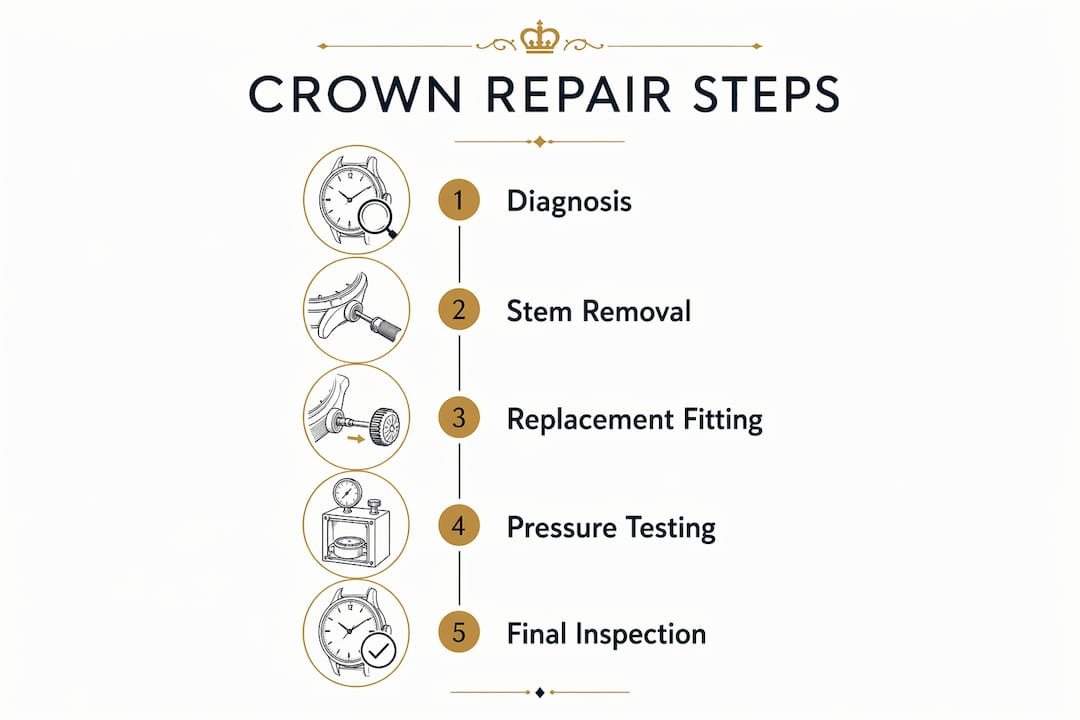
Tactile checks come next. The technician feels for grit when turning the crown, tests whether each detent position clicks cleanly, and notes any free-spinning (which can indicate a slipping cannon pinion rather than a crown fault). A stiff crown after swimming or salt exposure is treated as an urgent service warning, not a simple DIY fix, because salt crystallisation can seize the tube threads.
Movement response without opening. Where possible, the technician tests winding action, date engagement, and hand movement through the crown positions before the case is opened. This narrows the fault to either the external crown assembly or the internal keyless works.
A stiff or gritty crown is an early warning sign. Forcing it — especially a screw-down crown — risks permanent cross-threading of the case tube, turning a £30 gasket job into a £150+ tube replacement.
Pro Tip: When describing symptoms to a watchmaker, note exactly which crown position causes the problem. “It’s stiff when I push it back in” and “it’s stiff when I try to pull it out” point to completely different faults.
Signs that demand immediate professional attention: visible fog or condensation, a crown that has seized solid, or one that sits at an angle to the case. None of these should be forced.
How a technician safely removes the stem and crown
Removing a stem looks simple. Done wrong, it sends a tiny set screw into the movement and converts a crown repair into a full strip-down. The sequence matters.
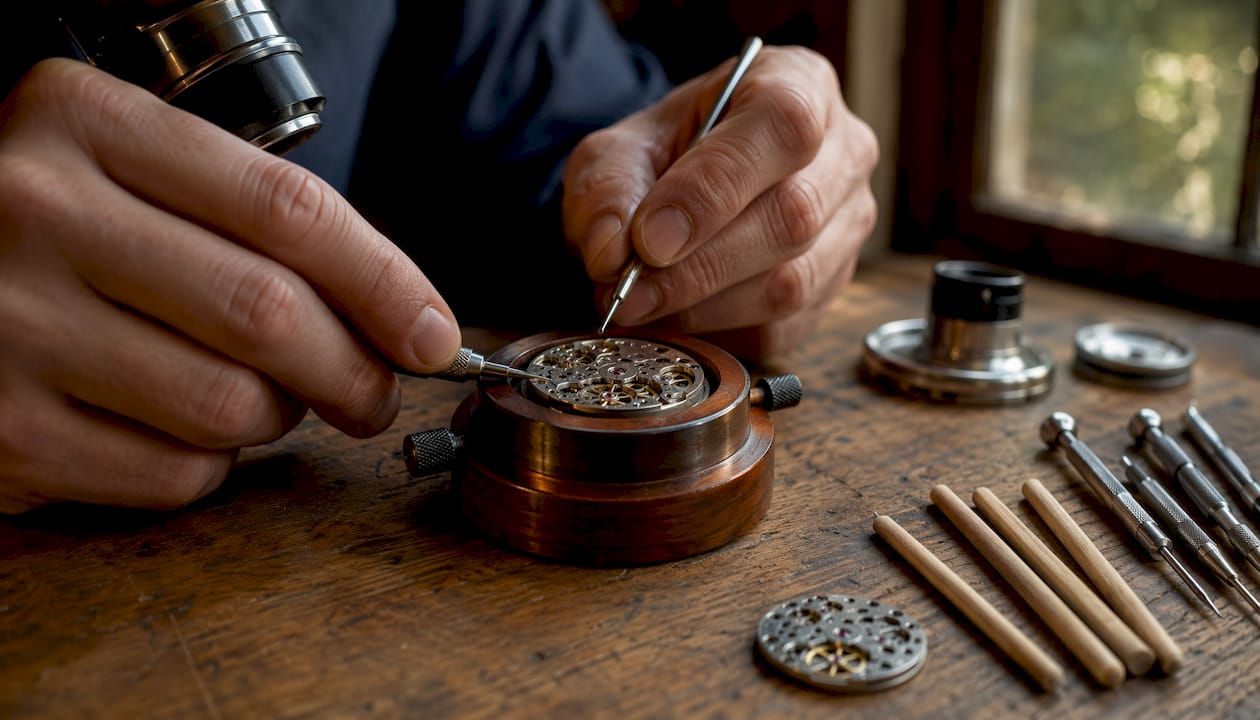
- Secure the movement. The case back is removed and the movement is placed in a movement holder or supported on a soft pad. Nothing moves until everything is stable.
- Identify the release type. Most movements use either a set screw (a tiny screw beside the stem entry point) or a push-button detent (a small lever or shoulder pressed with pegwood). The technician identifies which before applying any force.
- Release with minimal movement. For a set screw, loosening by no more than a quarter to a half turn is sufficient. Backing it out further risks the screw falling free into the movement. For a detent, light pressure with pegwood while holding the crown is all that is needed.
- Pull the crown to the time-setting position first. This disengages the stem from the winding mechanism and allows it to slide out cleanly.
- Extract stem and crown together. The technician draws the assembly out in a single smooth motion, holding the movement steady throughout.
- Inspect under magnification. The extracted stem is examined for bends, mushroomed ends, or broken flats before the replacement is selected.
Tools used at this stage: a quality loupe (typically 5× to 10×), a movement holder, pegwood sticks, and a set of fine watchmaker’s screwdrivers. Improvised tools — standard jeweller’s screwdrivers, pliers, or anything that applies lateral force — risk bending the stem or scoring the movement plate.
Fitting a replacement stem and crown
Selecting the right replacement is not guesswork. The technician matches the stem type (friction-fit, screw-in, or tapered) and crown style to both the movement calibre and the case tube. Getting this wrong means the crown either sits proud of the case or fails to engage the winding gears.
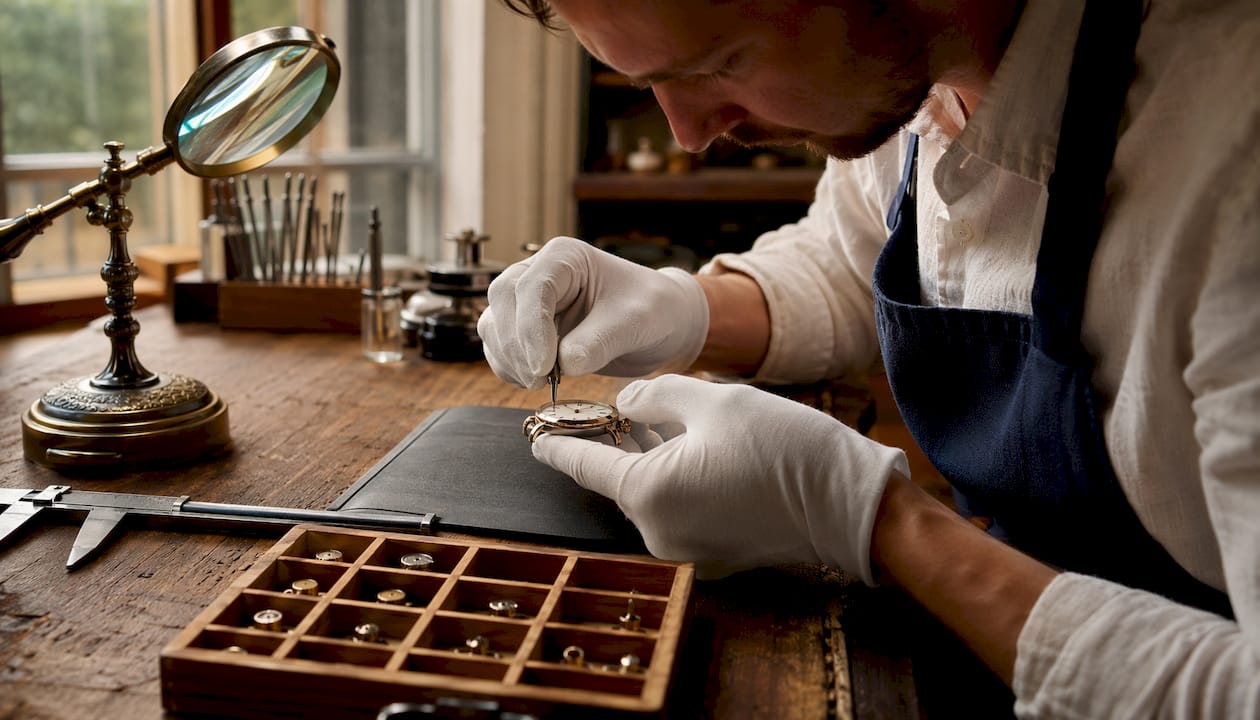
The measure-fit routine. The new stem is laid alongside the old one and compared for length, diameter, and end profile. It is then inserted partially into the movement to check crown height against the case. If the crown sits too far out, the stem needs trimming.
Pro Tip: Trim a little at a time. Cut 0.3–0.5 mm, deburr the end, test-fit, and repeat. Over-cutting a stem means starting again with a new part.*
Attaching the crown to the stem depends on the design. Press-fit crowns seat onto a knurled or shouldered post. Threaded crowns wind clockwise onto the stem, sometimes with a small amount of low-strength threadlocker to prevent loosening. Epoxy is occasionally used on non-threaded crowns, but only sparingly on the thread interface. Excess adhesive that migrates into the tube or movement makes future servicing destructive rather than routine.
The case tube deserves its own check. If the tube threads are worn, corroded, or cross-threaded, fitting a new crown onto a damaged tube achieves nothing. Re-threading or tube replacement adds time and cost but is the only correct fix. On some cases the tube is pressed in rather than threaded, which requires a staking tool and precise alignment — not a job for improvised equipment.
Crown, tube, and stem varieties: what changes the repair
Not all crowns work the same way, and the design directly affects how the repair is approached.
- Push-pull crowns are the most common on dress and everyday watches. They rely entirely on the crown gasket for water resistance. Gasket condition is the first thing to check on any push-pull crown that has been near water.
- Screw-down crowns thread into the case tube and provide significantly better water resistance. They require clean, undamaged threads on both the crown and the tube. A screw-down crown that feels gritty to thread should never be forced; dried gaskets or salt residue are common culprits and can be cleaned, but damaged threads cannot be un-damaged.
- Crown guards and canteen/lever-cap systems protect the crown from impact on sports and tool watches. These add complexity to removal and require the guard or cap to be addressed before the crown itself.
- Proprietary manufacturer fitments (certain integrated crown-tube assemblies on higher-end pieces) often require manufacturer-specific parts. Aftermarket crowns may fit dimensionally but differ in finish, engraving, or gasket design, which affects both appearance and water resistance.
Vintage crowns present a sourcing challenge. Original parts may be unavailable, and fitting an aftermarket crown is sometimes the only option. A good workshop will discuss the trade-off between authenticity and function before proceeding.
The crown is the primary entry point for water ingress on most watches, which is why crown tube condition matters as much as the crown itself. A worn or damaged tube means no crown, however good, will seal reliably.
When the crown is not actually the problem
Accurate diagnosis is the critical skill here. Many owners assume the crown is faulty when the keyless works or detent springs are the real cause. The keyless works is the small mechanism inside the movement that translates crown rotation into winding or setting action. When it wears, the symptoms look identical to a crown fault from the outside.
| Symptom | Likely cause | First action |
|---|---|---|
| Crown turns but hands don’t move | Slipping cannon pinion or transmission failure | Professional inspection — movement work required |
| Crown clicks but date won’t advance | Worn or broken setting lever / yoke | Workshop diagnosis needed |
| Crown spins freely with no resistance | Detached or stripped stem, or slipping keyless works | Stop use; professional assessment |
| Date changes mid-afternoon or randomly | Bent stem not engaging date mechanism correctly | Stem inspection and replacement |
| Crown wobbles in position 0 | Worn keyless works or bent stem | Tactile and visual inspection by watchmaker |
A slipping cannon pinion is a common misdiagnosis: the crown turns, the stem moves, but the hands stay still. The fault is inside the movement, not at the crown. Replacing the crown in this scenario achieves nothing. For deeper movement faults, a full mechanical overhaul may be the correct route rather than a crown-only repair.
What post-repair testing actually involves
Fitting a new crown and stem is only part of the job. A professional workshop runs a structured set of checks before the watch leaves the bench.
Function checks: The technician tests each crown position in sequence. Position 0 (pushed in) should wind the mainspring smoothly on a mechanical watch. The first click out should advance the date cleanly. The second click should move the hands without slipping or binding. Crown detents must click positively into each position.
Pressure and water-resistance testing. After any crown or tube work on a water-resistant watch, a formal pressure test is required to verify the seals. Visual inspection alone cannot confirm water resistance under daily conditions. The test applies controlled air pressure and checks for leakage at the crown, case back, and crystal. Skipping it exposes the movement to water ingress despite the physical repair looking correct.
Workshops insist on pressure testing and documented proof of sealing after crown work, because visual inspection alone cannot guarantee water resistance under daily conditions.
Pro Tip: Ask your workshop for a written record of the pressure test result. A reputable service will provide this as standard — it is your evidence that the seal was verified, not assumed.
Documented test results and a short warranty (such as Watchrepairstation’s “No Fix, No Cost” policy) matter because they transfer the risk back to the workshop if a seal fails shortly after repair. For workshop quality assurance on trade repairs, this documentation is standard practice.
Turnaround times and cost expectations in the UK
Simple jobs (crown and stem replacement when parts are in stock): most take 30–60 minutes on the bench. Factor in transit time if you are posting the watch to a trade workshop, but the bench time itself is short.
When jobs extend:
- Sourcing original parts for less common movements or proprietary crowns can add days to weeks depending on supplier availability.
- Tube replacement or re-threading adds bench time and may require specialist tooling.
- If the movement needs servicing alongside the crown work (moisture ingress, worn keyless works), the job becomes a partial or full overhaul.
Typical UK cost bands:
- Basic crown and stem replacement (parts in stock, standard movement): modest bench fee, often under £50 for straightforward cases at trade rates.
- Crown tube replacement or re-threading: higher, reflecting additional parts and bench time.
- Crown work combined with movement service or part fabrication: significantly more, depending on movement complexity and parts availability.
Prices vary by workshop, movement type, and parts sourcing. A trade service like Watchrepairstation offers competitive pricing specifically because it operates workshop-to-workshop rather than retail-to-consumer, removing the retail margin from the equation.
DIY versus professional: where the line sits
Some checks are safe to do yourself. Others will make the repair more expensive.
Safe DIY actions:
- Dry-wipe around the crown with a soft cloth to remove surface grit.
- On a screw-down crown, check whether it is simply not fully tightened (unscrew counter-clockwise until it releases from the threads, then re-seat and tighten clockwise with light pressure).
- Note the exact symptoms and crown position where the problem occurs before contacting a workshop.
Stop and call a professional when:
- You see moisture, fog, or condensation under the crystal.
- The crown feels gritty or stiff after water exposure, especially salt water.
- The crown is visibly crooked or sits at an angle.
- The crown pops out on its own or spins with no resistance.
- The watch is vintage, a luxury piece, or has significant resale value.
- The watch is still under manufacturer warranty (opening the case voids it).
A stiff crown after beach or pool use should be treated as an urgent service warning. Salt crystallisation inside the tube can seize the threads, and forcing the crown converts a gasket replacement into a tube repair.
Pro Tip: If you are unsure whether a screw-down crown is simply undertightened or genuinely damaged, try unscrewing it fully and re-seating it on clean, dry threads. If it still won’t thread smoothly, stop — the tube or crown threads need professional inspection.
Professional tooling, proper magnification, and trained hands reduce the risk of dropping set screws into the movement, bending the stem, or scoring the movement plate. These are not theoretical risks. Excessive force on a detent or set screw is one of the most common causes of a simple crown repair escalating into a full strip-down. Protecting your watch with a quality screen protector during daily wear also reduces the chance of impact damage to the crown area.
Practitioner tips and common mistakes to avoid
Gasket maintenance is the most neglected part of crown care. Gaskets typically harden and shrink within 2–5 years of regular wear, depending on UV exposure, temperature cycling, and contact with solvents or chemicals. A screw-down crown that suddenly feels tight is often a gasket problem, not a sign to force the threads. Replacing gaskets as part of a routine service interval costs far less than repairing a cross-threaded tube.
Stem release errors to avoid:
- Never back out a set screw by more than a quarter to a half turn. A fully loosened set screw can fall into the movement and require a strip-down to retrieve.
- Never press a detent with a metal tool. Pegwood or a plastic pusher prevents scoring the lever.
- Never pull the stem while the crown is in position 0. Always move to the time-setting position first.
Epoxy misuse is a recurring workshop problem. Adhesive should be a last resort, applied only to the thread interface and in the smallest possible amount. Excess epoxy that migrates into the crown tube or movement makes future servicing destructive. If a crown needs adhesive to stay on, the stem diameter is likely wrong.
Workshop-level habits that prevent problems:
- Trim the stem incrementally and test-fit after each cut. Over-cutting is irreversible.
- Document pressure test results in writing after every crown or tube job.
- Use original manufacturer parts where possible. Aftermarket crowns may fit but differ in gasket profile, which affects sealing performance.
- Clean the crown tube threads with pegwood before fitting any screw-down crown. Dried sealant or metal shavings cause the gritty feel that owners mistake for thread damage.
Watchrepairstation’s crown and stem repair service
For trade customers across the UK, Watchrepairstation handles crown and stem repairs with the same structured approach described throughout this guide: diagnose, source, fit, pressure-test, and warranty.

The service is trade-to-trade, which means competitive pricing without the retail margin, and a “No Fix, No Cost” guarantee that removes financial risk for partnering shops. Straightforward crown and stem jobs are turned around quickly when parts are available. For rarer crowns or proprietary fitments, the team handles parts sourcing directly, so you are not left chasing suppliers. Every water-resistant watch that goes through crown or tube work is pressure-tested before it leaves the bench, with results documented.
To arrange a trade repair or request a quote, visit the watch repair service page or contact the team directly through Watchrepairstation’s service portal. Established since 2008, the workshop’s technicians bring the qualifications and tooling that crown and stem work genuinely demands.
Key takeaways
Watch crown repair covers the crown, stem, tube, and gaskets as a system — pressure testing after any crown work is the step that confirms the repair is actually complete.
| Point | Details |
|---|---|
| Stop forcing the crown | Forcing a gritty or stiff crown risks cross-threading the tube, turning a minor fix into a major repair. |
| Moisture means urgent action | Fog or condensation under the crystal signals seal failure; the movement needs professional attention promptly. |
| Typical bench time | Most basic crown and stem replacements take 30–60 minutes when parts are available. |
| Pressure testing is non-negotiable | A formal pressure test after crown or tube work is the only way to verify water resistance — visual inspection is not enough. |
| Watchrepairstation for trade repairs | UK trade workshops can arrange crown and stem repairs with a “No Fix, No Cost” guarantee and documented pressure test results. |
The workshop view on crown repairs
Crown and stem work sits at an interesting intersection: it looks simple from the outside, but the margin for error is genuinely small. The standard process at a professional workshop runs in a fixed sequence for good reason. Diagnose first, because the crown is often not the root cause. Source the correct parts before opening the case, because improvising with a close-enough stem creates problems downstream. Fit and trim incrementally, because over-cutting a stem means starting again. Pressure-test before the watch leaves the bench, because a seal that looks correct can still fail under water pressure.
The “No Fix, No Cost” model works because it aligns the workshop’s incentive with the customer’s outcome. If the repair cannot be done correctly, it should not be done at all. That principle applies especially to crown work on vintage or high-value pieces, where an incorrect aftermarket crown or a poorly fitted tube can affect both function and resale value. The right answer is sometimes to tell a customer that a part needs fabricating or that the movement needs servicing first — and to be transparent about what that means for time and cost.
Useful sources
- British Horological Institute (BHI) — the UK’s primary body for watchmaker training and professional standards; useful for verifying technician qualifications.
- Mechanical watch — Wikipedia — clear overview of mechanical watch components including the keyless works and crown mechanism.
- Watch crown explained — Iglisi Watch blog — detailed breakdown of crown positions, screw-down operation, and gasket lifespan guidance.
- Watch pressure testing: UK price guide — Atoz Watch Repair — UK-specific guidance on pressure testing costs and what the test involves.
- Is watch gasket important for water resistance? — Soflypart — explains gasket lifespan, failure modes, and why hardened gaskets mimic mechanical seizure.
- Beginner’s guide to automatic watch repair — Atoz Watch Repair — practical stem release guidance and common DIY errors.
- Troubleshooting time-setting issues — Atoz Watch Repair — covers slipping cannon pinion and other internal causes of crown-related symptoms.
- Watch repair service — Watchrepairstation — trade repair service page with contact and service details for UK workshops.

Leave a Reply