

Yes, a damaged sapphire crystal can be replaced, and in most cases it is the only sensible fix. Polishing is rarely effective on sapphire: because sapphire rates 9 on the Mohs scale, only diamond abrasives can cut it, and any attempt to buff out deep scratches strips the anti-reflective coating and often leaves a cloudy patch worse than the original damage. Replacement restores full optical clarity and, critically, water resistance.
In the UK, a professional sapphire crystal replacement typically costs more for bespoke OEM crystals on luxury pieces than for simple aftermarket flat crystals on entry-level watches. Turnaround time depends on part availability and whether additional work is needed, often taking about one to two weeks.
Before you do anything else:
- Photograph the damage clearly, including the case profile and bezel
- Note the watch model, reference number and case diameter
- Decide whether you need an OEM (factory) or quality aftermarket crystal
- Get written quotes from at least two repairers specifying part origin and whether water-resistance testing is included
- Only consider DIY if the watch is inexpensive and non-waterproof
Table of Contents
- How much does sapphire crystal replacement cost in the UK?
- What actually drives the price of a crystal replacement?
- Can you upgrade from acrylic or mineral glass to sapphire?
- How professionals replace a sapphire crystal, and where things go wrong
- Should you attempt a DIY sapphire crystal replacement?
- How to pick a UK repairer: the right questions and red flags
- Watchrepairstation’s professional option for sapphire crystal replacement
- Key takeaways
- A trade perspective on what actually goes wrong
- Get a quote from Watchrepairstation for your trade crystal jobs
- Sources and further reading
How much does sapphire crystal replacement cost in the UK?
Price varies more than most people expect, and the crystal itself is often the smaller part of the bill.
| Watch type | Typical UK price (part + labour) | Turnaround |
|---|---|---|
| Entry-level (flat aftermarket crystal) | Moderate cost | Few working days |
| Mid-range (quality aftermarket or OEM) | Higher cost | Up to two weeks turnaround |
| Luxury / fitted / domed OEM crystal | Considerably higher cost | Up to two weeks or more |
| OEM crystal ordered from brand | Premium cost | Up to three weeks or more |
These figures cover part and fitting. They do not automatically include gasket replacement, water-resistance pressure testing, or return postage, all of which reputable workshops charge separately or bundle into a service. Ask upfront.
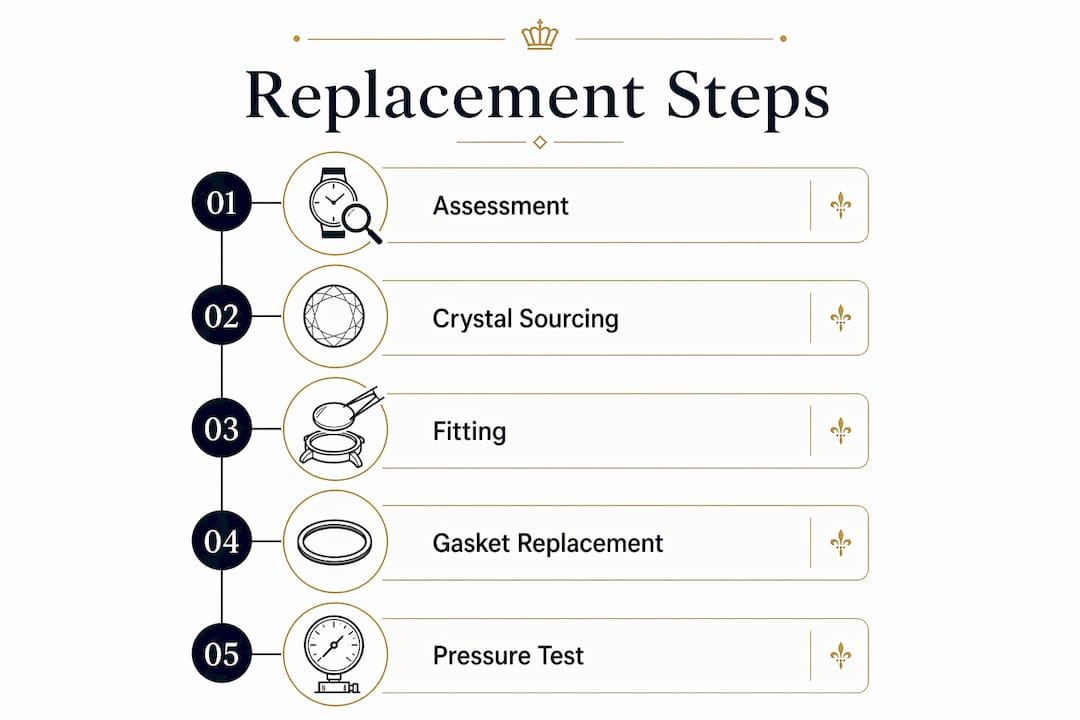
Turnaround stretches when a part needs ordering directly from a manufacturer. A flat generic aftermarket crystal for a Seiko or similar can often be fitted within a few days; a bespoke OEM crystal for a Swiss luxury piece may take three weeks or more to source.
Pro Tip: Ask any repairer for a written quote that itemises the crystal cost, labour, gasket replacement and pressure testing separately. A single lump-sum quote makes it impossible to compare fairly across workshops.
What actually drives the price of a crystal replacement?
Part origin: OEM vs aftermarket vs generic
An OEM (original equipment manufacturer) crystal comes directly from the watch brand or its authorised parts supplier. It is guaranteed to match the original dimensions, curvature and coating specification. Genuine aftermarket crystals, made by specialist suppliers to match specific references, sit in the middle: usually good optical quality and correct dimensions, but not factory-issued. Generic crystals are cut to approximate sizes and can introduce fitment problems. Low-grade generic parts can harm water resistance and optical performance compared with factory-specified parts, so the cheapest option is not always the wisest one.
Shape and complexity
Flat crystals are the most straightforward and cheapest to source. Domed or fitted crystals require bespoke shaping and precise fitting, which pushes both the part cost and the fitting time higher. Box crystals (with four curved faces) and crystals with a cyclops date magnifier are more complex still. If your watch has an unusual profile, expect to pay more and wait longer.
Size, thickness and coatings
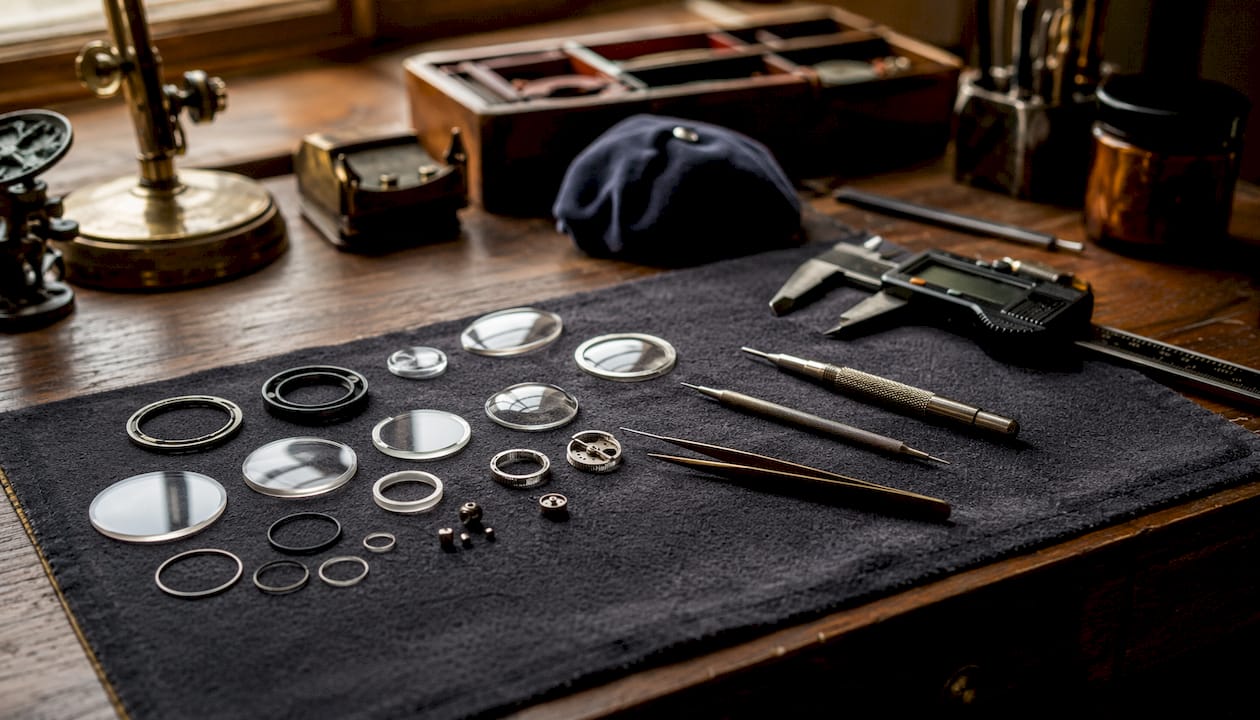
A 0.1mm mismatch in diameter or an incorrect gasket profile is enough to compromise water resistance. Thicker crystals for dive watches, or those with multi-layer AR coatings, are harder to source and cost more. The coating itself matters: a replacement with a poor-quality AR coating will show reflections the original never did.
Service route
- Authorised dealer or brand service centre: highest cost, guaranteed OEM parts, longest wait
- Independent experienced watchmaker: mid-range cost, flexibility on part origin, quality varies
- Mail-in trade service: competitive pricing, faster turnaround, depends on the workshop’s sourcing relationships
Can you upgrade from acrylic or mineral glass to sapphire?
An upgrade is feasible on many watches, but it requires precise compatibility checks before committing. Upgrading to sapphire requires exact checks of diameter, thickness and case-sealing method to preserve water resistance. Get those wrong and you end up with a scratch-resistant crystal sitting in a case that leaks.
Here is the compatibility checklist to work through before ordering a replacement crystal:
- Diameter: measure the existing crystal and the bezel seat to 0.1mm. Even a slight oversize will prevent the crystal seating correctly.
- Thickness: the replacement must match or the bezel will not close flush, and the gasket will not compress correctly.
- Profile: flat, domed or box. A domed sapphire in a case designed for a flat crystal will sit proud and may not seal.
- Gasket profile: the gasket must match the new crystal’s edge profile. Reusing the old gasket with a different crystal is a common mistake.
- Sealing method: some cases use adhesive (UV or GS cement), others use a compression gasket. The replacement crystal must suit the same method.
- Bezel clearance: on some vintage or dress watches, the bezel lip is too shallow for a thicker sapphire.
When an upgrade makes sense: you want better scratch resistance on a daily-wear watch with a standard round case and a straightforward sealing method. When to avoid it: vintage models with unusual profiles, watches with rare or brand-specific gasket systems, or any piece where originality affects value.
Pro Tip: Before ordering an upgrade crystal, photograph the case opening and bezel seat and send those images to your supplier or repairer. A good supplier will confirm compatibility before you buy.
How professionals replace a sapphire crystal, and where things go wrong
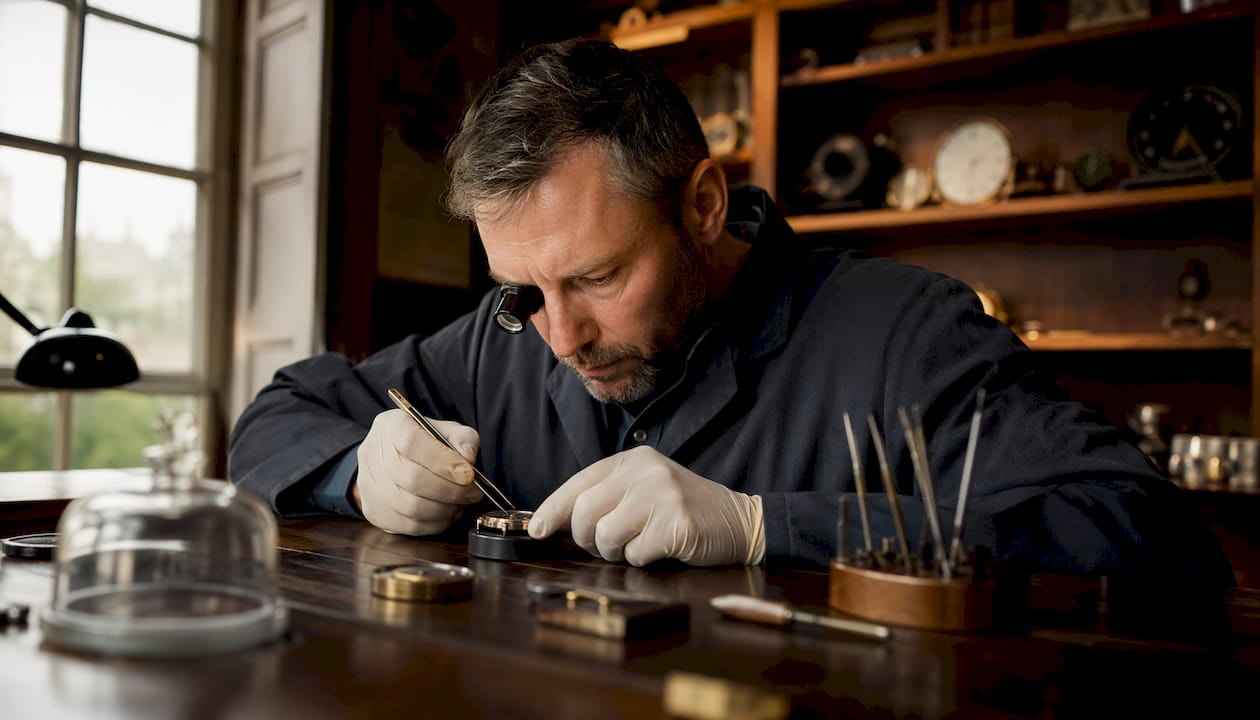
The process looks simple from the outside. It is not.
- Remove the caseback (screw-down or snap-off) and, where necessary, extract the movement to protect it from debris and pressure.
- Remove the old crystal using a crystal lift or press, applying even pressure to avoid shattering. A cracked crystal is already fragile; uneven force turns it into fragments.
- Clean the bezel seat thoroughly. Any residue from the old gasket or adhesive will prevent a proper seal.
- Fit the new crystal using a crystal press with the correct die size. Alignment must be exact; a slightly canted crystal will not seal and may crack under pressure.
- Replace the gasket with a new one matched to the crystal profile. Reusing the old gasket is a false economy.
- Reseal and reassemble, then perform a water-resistance pressure test before returning the watch.
The biggest technical risk is shattering during removal or fitting. Shattered sapphire can deposit microscopic shards into the movement; in that scenario, a crystal swap alone is insufficient and a full movement clean or service is often necessary to prevent future mechanical failure. This is why a repairer who quotes for a crystal replacement and then recommends a movement service is not always upselling: if shards are present, they are telling you something real.
Post-fit checks a reputable repairer should always perform:
- Visual inspection for correct seating and alignment
- Water-resistance pressure test (to the watch’s rated depth)
- Timekeeping check after reassembly
- Confirmation that AR coating is intact and undamaged
Should you attempt a DIY sapphire crystal replacement?
Honestly, it depends on the watch and your experience level. For an inexpensive, non-waterproof watch and a hobbyist who has done case work before, a flat crystal swap is manageable. For anything with water-resistance ratings, a luxury movement, or a domed OEM crystal, send it to a professional.
The tools you genuinely need for a safe DIY fit:
- Crystal press with a full set of dies (the correct die size matters; a near-fit will shatter the crystal)
- Crystal lift for removal
- Correct replacement gasket, not the old one
- Lint-free tools and a clean workspace
- Adhesive appropriate to the sealing method (UV glue, GS Hypo cement, or similar)
- Access to a pressure tester, or a plan to send the watch for water-resistance verification after fitting
Professional watchmakers recommend replacement over polishing for scratched or cracked sapphire, and the same logic applies to fitting: the tools and technique matter as much as the part. Forum reports show that diamond paste can address superficial scratches on plain sapphire, but it strips AR coatings and is not a substitute for replacement on a damaged crystal.
Clear red flags that mean do not DIY:
- The watch is rated water-resistant to any depth
- The crystal is domed, box-shaped, or has a cyclops window
- There is visible cracking or the crystal has already shattered
- The movement is visible through the crystal and debris may be present
- The watch has significant monetary or sentimental value
Pro Tip: If you do attempt a DIY fit, do not skip the pressure test. Fitting a crystal without verifying the seal is the single most common cause of water damage after a home repair.
How to pick a UK repairer: the right questions and red flags
Not all watch repair workshops are equal, and the questions you ask before handing over a watch tell you a great deal about the quality of what you will get back.
Questions to ask every repairer:
- Is the replacement crystal OEM, genuine aftermarket, or generic? Can you confirm the source?
- Is water-resistance pressure testing included, or is it an additional charge?
- What is the warranty or guarantee? Do you offer a No Fix, No Cost policy?
- What is the realistic turnaround, including parts sourcing?
- What are your technicians’ qualifications or trade credentials?
Red flags:
- Vague or evasive answers about part origin
- No pressure testing offered or mentioned
- No written guarantee or warranty
- Insisting on a full service for a straightforward crystal swap without explaining why shards or debris are present
- No itemised quote
Use this template when requesting quotes:
| Comparison point | What to ask / confirm |
|---|---|
| Crystal origin | OEM, genuine aftermarket, or generic? |
| Water-resistance test | Included or extra charge? |
| Guarantee | Written No Fix, No Cost or equivalent? |
| Turnaround | Working days, including parts lead time |
| Credentials | Trade qualifications or years in trade |
Where to look in the UK: brand-authorised service centres for high-value watches where OEM parts are non-negotiable; experienced independent watchmakers for mid-range pieces; and trusted mail-in trade services for competitive pricing with reliable turnaround. Always ask for references or check verifiable reviews before sending a watch you care about.
Watchrepairstation’s professional option for sapphire crystal replacement
Watchrepairstation has offered trade watch repair services across the UK since 2008, working exclusively with watch and jewellery shops rather than the general public. For trade partners, that means every sapphire crystal replacement goes through experienced technicians who understand both the fitting process and the downstream risks: shard contamination, gasket matching, and post-fit pressure testing.
Key trust signals for trade partners:
- No Fix, No Cost guarantee: if the repair cannot be completed, there is no charge
- Water-resistance testing included as standard after crystal replacement
- Nationwide UK coverage with clear logistics for sending and returning watches
- Experienced technicians with a track record across a full range of watch repair services, from battery installation to full overhauls
- Competitive trade pricing with no financial risk to the partner shop
When sending a watch for assessment, trade partners should include: the watch model and reference number, clear photographs of the crystal damage and case profile, any known service history, and a note on preferred turnaround. Watchrepairstation’s team will confirm the quote, part origin and timeline before work begins.
Key takeaways
Sapphire crystal replacement is a reliable, widely available repair in the UK: the right part, correctly fitted and pressure-tested, restores both clarity and water resistance.
| Point | Details |
|---|---|
| Replacement beats polishing | Polishing strips AR coatings and rarely fixes deep scratches; replacement is the professional standard. |
| Turnaround | Most replacements complete in 5–14 working days; OEM parts from brands can extend this to three weeks or more. |
| Upgrade feasibility | Acrylic or mineral can be upgraded to sapphire, but diameter, thickness, gasket profile and sealing method must all match. |
| Watchrepairstation | Trade partners benefit from a No Fix, No Cost guarantee, water-resistance testing, and nationwide UK coverage since 2008. |
A trade perspective on what actually goes wrong
The mistake that comes up most often in crystal replacements is not the fitting itself. It is the gasket. Shops and hobbyists alike focus on sourcing the right crystal and then reuse the original gasket to save a few pounds. A worn or mismatched gasket will not compress correctly against a new crystal profile, and the watch fails its pressure test, or worse, passes a basic test and leaks in use. A new gasket matched to the replacement crystal is not optional; it is part of the repair.
The second most common issue is skipping the pressure test entirely. A crystal can look perfectly seated and still allow ingress at depth. Any watch with a water-resistance rating needs a proper pressure test after a crystal swap, not a visual check and a hopeful assumption.
From a trade perspective, the cost calculus also shifts when a crystal has shattered rather than cracked. Shards in the movement mean the crystal replacement is the start of the job, not the end. A full movement service is the only way to be confident the debris has been cleared. Quoting for a crystal swap and ignoring the movement in that scenario is a short-term saving that creates a long-term problem.
Get a quote from Watchrepairstation for your trade crystal jobs
For watch and jewellery shops that need a dependable trade partner for sapphire glass repair, Watchrepairstation offers something the high street cannot: a No Fix, No Cost guarantee, water-resistance testing as standard, and nationwide UK coverage with fast turnaround. No long waits, no unexplained markups, and no financial risk to your shop if a repair cannot be completed.

To request a quote, send the watch model and reference number, clear photographs of the crystal damage and case profile, any relevant service history, and your preferred turnaround window. Watchrepairstation’s technicians will confirm the part origin, price and timeline before any work begins. Trade partners can submit a repair request here and expect a prompt response with full details.
Sources and further reading
The following sources informed the technical guidance in this article. Where price and turnaround expectations are concerned, treat these as reference points rather than fixed quotes: UK labour rates and parts costs vary by workshop and watch brand.
- How to Replace Your Damaged Watch Crystal, Part II — detailed walkthrough of professional crystal replacement tools and technique, including shard contamination risks
- How to Repair a Scratched Watch Sapphire Crystal — professional horologist’s case for replacement over polishing, with clarity and water-resistance context
- How to Remove Deep Scratches from a Sapphire Crystal Glass — covers AR coating vulnerability and why polishing often worsens the result
- Replacing existing crystal with sapphire (WatchRepairTalk forum) — practical community discussion on upgrade compatibility and measurement checks
- Sapphire scratched (WatchUSeek forum) — anecdotal reports on diamond paste polishing; useful context but not a substitute for professional guidance
- Does sapphire crystal scratch? (Praesidus) — explains domed crystal sourcing difficulty and the impact of part quality on the final result
When requesting a quote from any repairer, bring photographs, the watch reference, and any source citations or forum threads that describe your specific crystal. A repairer who can see the exact damage and model upfront will give you a more accurate quote and a faster turnaround.

Leave a Reply