

Trade watch valeting is a specialist, trade-only process of ultrasonic cleaning, precision polishing and cosmetic restoration. For shop owners, the fastest way to protect customer value and cut in-store bottlenecks is to partner with a vetted trade workshop. Watchrepairstation operates on a trade-only basis across the UK, backed by a “No Fix, No Cost” guarantee and pressure testing on every resealed watch.
Outsource immediately if any of these apply: your bench is at capacity, you lack specialist polishing equipment, or a cosmetic job is beyond your technician’s training. Reputation damage from a poorly polished case is permanent.
Immediate next steps:
- Request a written SLA before sending a single job
- Ask for a paid sample job with stated acceptance criteria
- Confirm insured transit is included, not optional
Table of Contents
- What does professional trade watch valeting actually include?
- Why should a retailer outsource valeting to a specialist?
- How do you evaluate and choose a trade valeting partner?
- What affects turnaround time and cost for trade valeting?
- What does the operational workflow look like end to end?
- How do you protect quality and manage risk on outsourced valeting?
- How do you trial and onboard a trade valeting partner?
- Key takeaways
- The case for trade-only workshops
- Watchrepairstation: trade valeting with no financial risk
What does professional trade watch valeting actually include?
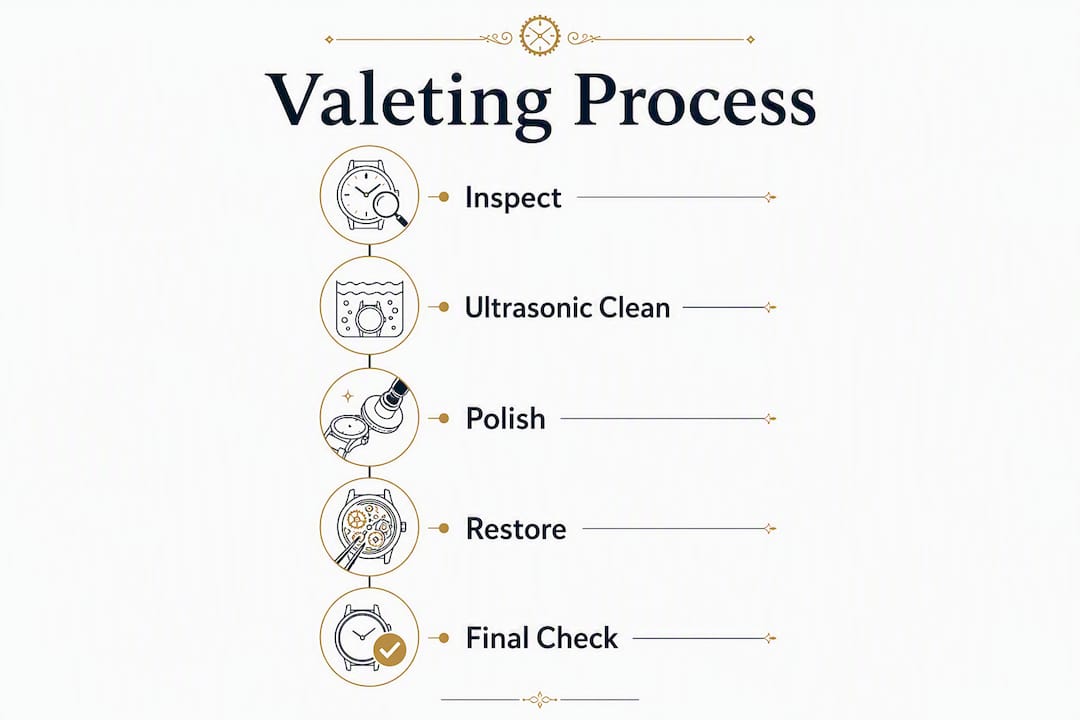
The industry term is cosmetic restoration, and it covers far more than a wipe-down. A competent trade workshop will disassemble the case and bracelet, run components through a temperature-controlled ultrasonic bath with proper degassing cycles, then hand-polish each surface to its original specification.
Core procedures in a full trade valeting cycle:
- Ultrasonic cleaning: controlled temperature and degassing to remove oils, debris and oxidation without damaging seals
- Case and bracelet disassembly: links removed, clasps stripped, end-pieces separated for individual attention
- Precision polishing: brushed surfaces re-brushed in the correct direction; polished surfaces brought up without rounding bevels
- Cosmetic restoration: refinishing of worn areas, replating on gold-plated or plated cases where the retailer requests it
- Crystal replacement: mineral or sapphire crystal swapped where cracked or deeply scratched
- Resealing and pressure testing: new gaskets fitted, crown and caseback torqued to specification, then water-resistance tested
- Bracelet and clasp servicing: pin replacement, link adjustment, clasp tension corrected
The distinction between trade valeting and consumer polishing matters. A retail polishing cloth removes surface scratches. A trade workshop preserves the original case geometry, bevel angles and brushing patterns — the details that determine whether a watch looks factory-fresh or worn-down. Equipment is the other gap: professional ultrasonic machines with degassing capability are not found in most retail environments.
One category of exclusion deserves a specific mention. Vintage components, particularly hairsprings, certain soldered parts and porous dials, must never enter an ultrasonic bath. Ultrasonic cavitation can cause solder failure or structural damage on older assemblies. A trade partner should identify these before intake, not after.
Pro Tip: Ask any prospective workshop: “How do you identify components that must avoid the ultrasonic bath?” A vague answer is a red flag.
Why should a retailer outsource valeting to a specialist?
Many retailers already outsource cleaning and finishing to specialist trade workshops because in-house capacity and the right equipment are simply not there. That is not a weakness; it is sensible procurement.
Independent UK watchmaking capacity has declined, which makes trade partnerships more important for retailers who cannot sustain a full in-house team. Outsourcing to a specialist unlocks skills and technology that would be prohibitively expensive to replicate, alongside clearer turnaround times and a lower cost-per-job when structured as a trade relationship.
Trust signals to demand from any trade partner:
- Trade-only focus (no competing directly with your customers)
- Named, qualified technicians on polishing and restoration work
- Insured transit both ways
- Written SLAs with defined turnaround windows
- Before/after photography on every job
- Full traceability from intake to return
- “No Fix, No Cost” or an equivalent written guarantee
Professional polishing protects long-term value; poor work or DIY attempts can remove original bevels and permanently reduce resale value. That is the risk a shop takes when it attempts cosmetic work without the right equipment or training.
Pro Tip: Position your trade partner as a silent partner, not a referral. Your customer should never know the work left your premises. The relationship, the guarantee and the finished watch all come back through you.
How do you evaluate and choose a trade valeting partner?
Start with a structured checklist before you commit to any volume.
Evaluation checklist:
- Confirm the workshop uses temperature-controlled ultrasonic equipment with degassing
- Ask for technician qualifications or evidence of specialist polishing training
- Request a paid sample job on a watch you can inspect against your own standards
- Obtain a written SLA with specific turnaround windows, not vague estimates
- Verify insured transit is included and ask for the coverage limit
- Confirm the warranty terms: what happens if a job comes back wrong?
- Ask for references from other trade customers, not end consumers
Interview questions worth asking:
- “Do you provide pressure-testing results with every resealed watch?”
- “How do you handle vintage cases that must not be ultrasonically cleaned?”
- “What is your insured transit limit per item?”
- “Can I see before/after photographs from recent trade jobs?”
- “What is your remedial process if I reject a finished job?”
Red flags to walk away from:
- Turnaround times given as “approximately” with no written commitment
- No trade references, or references that are all end consumers
- Reluctance to run a paid sample job before you commit volume
- No written SLA or traceability process
- Pricing that changes after the job is received
On pricing, ask specifically whether the workshop offers per-piece rates, fixed bundles or volume discounts. Each model affects your cashflow differently, and the right structure depends on your monthly throughput.
What affects turnaround time and cost for trade valeting?
Typical trade valeting turnaround runs from a few working days for straightforward cases to one to two weeks when crystal replacement, replating or pressure testing is involved. Same-day collection is not realistic for precision polishing work. Build that into your customer promises from the outset. A guide on managing customer expectations for watch repairs can help you frame timelines without losing trust.
Primary cost drivers:
- Scope of finish: a full polish-and-brush on a complex case with multiple surface types costs more than a single-finish case
- Materials: crystal replacement, new gaskets, replating consumables and specialist bracelet pins all add to the per-job cost
- Labour complexity: bracelets with many links, integrated designs or unusual clasp mechanisms take longer
- Water-resistance testing: adds time and equipment cost but is non-negotiable on any resealed watch
- Parts sourcing: non-standard crystals or proprietary gaskets may require sourcing lead time
Valeting sits at different points in the service cycle depending on workshop practice. Some workshops valet before a movement service (so the technician works on a clean case), others valet after (so the finished watch is presented in its best state). Ask your partner which approach they use and why. Understanding where valeting fits in the full service cycle helps you set accurate timelines for customers.
What does the operational workflow look like end to end?
A clean workflow prevents disputes and speeds every job through the system. A structured intake process with job sheets, photos and a signed condition report reduces disputes and keeps turnaround predictable.
Workflow steps:
- Book the job with the workshop and confirm the SLA in writing
- Package each watch individually in a padded, sealed bag with a printed label
- Use an insured courier service; confirm the declared value matches the watch
- Include a completed job sheet with every item
Suggested job sheet fields:
| Field | Purpose | Completed by |
|---|---|---|
| Customer contact name | Dispute resolution and return authorisation | Retailer |
| Watch make, model, serial | Traceability and parts sourcing | Retailer |
| Requested valeting scope | Defines what the workshop should do | Retailer |
| Known issues or damage | Prevents disputes about pre-existing condition | Retailer |
| Finish specification | Brushed, polished or mixed; bevel preservation notes | Retailer |
| Workshop intake check | Condition confirmed on arrival | Workshop |
| Before photographs | Visual baseline for QC and dispute resolution | Workshop |
| Pressure test result | Pass/fail with test pressure noted | Workshop |
| Technician sign-off | Named accountability for the finished job | Workshop |
On return, the workshop should send digital before/after photographs and a pressure test certificate for any resealed watch before the item is dispatched. Do not accept a finished job without them.
Pro Tip: Require a signed brief condition report from the workshop on arrival. If a scratch appears after the job, you need that baseline to resolve the dispute without damaging your customer relationship.
How do you protect quality and manage risk on outsourced valeting?
Poor polishing permanently damages design integrity. Over-polishing rounds bevels, removes brushing patterns and reduces resale value in ways that cannot be undone. A trade partner’s QC process is your last line of defence before the watch goes back to your customer.
Required QC checkpoints from any trade partner:
- Pre-intake condition report signed by the receiving technician
- Before photography taken under consistent lighting before work begins
- Technician sign-off on each procedure as it is completed
- Preservation check: bevels and brushing patterns match the original specification
- Pressure/water-resistance test on every resealed watch, with a written result
- Senior technician final sign-off before dispatch
Risk management goes beyond the workshop floor. Insured transit protects you if a watch is lost or damaged in transit. A written warranty gives you a remedial route if a job fails your inspection. A clear returns policy tells you how quickly a rejected job will be corrected and at whose cost.
Pro Tip: Keep a small reference board of typical case finishes — a brushed Submariner-style panel, a polished dress-watch surface, a mixed-finish sports case. Use it as the physical standard against which you accept or reject polishing work.
How do you trial and onboard a trade valeting partner?
Follow this sequence and you will know within 30 days whether a partner is worth committing volume to.
- Initial vetting: confirm equipment, qualifications, SLA terms and insurance before sending anything
- Paid sample job: send two or three watches with different finish types; state your acceptance criteria in writing before the job starts
- Inspection: assess against your reference board and the before/after photographs; note any defects
- SLA and reporting agreement: agree turnaround windows, photo format, pressure test documentation and escalation contacts
- Pilot period (30–90 days): agree a defined volume; track defect rate, on-time delivery and condition disputes
- Full rollout: negotiate volume pricing once the pilot confirms consistent quality
Documents to exchange before the pilot begins:
- Written SLA with turnaround commitments and remedial terms
- Insurance certificates covering transit and workshop liability
- Returns and remedial policy
- Technician qualifications or training evidence
- Escalation contact list
The trade watch repair checklist from Watchrepairstation is a practical model for structuring this exchange. Track three metrics during the pilot: defect rate on finished jobs, percentage of jobs delivered on time, and the number of condition disputes raised. If all three are low after 90 days, you have a partner worth keeping.
Contractual essentials to include: liability limits per item, written turnaround commitments, and the “No Fix, No Cost” guarantee or its equivalent in writing.
Key takeaways
Trade watch valeting requires a specialist trade partner with ultrasonic equipment, precision polishing expertise, written SLAs, insured transit, and a “No Fix, No Cost” guarantee to protect both the retailer and the customer’s watch.
| Point | Details |
|---|---|
| Outsource when capacity is limited | Send valeting work out when your bench is full or specialist equipment is absent. |
| Demand written SLAs and photography | Insist on before/after photos and pressure test certificates for every resealed watch. |
| Run a paid sample job first | Test a partner on two or three watches with stated acceptance criteria before committing volume. |
| Protect value with precision polishing | Poor polishing permanently removes bevels and reduces resale value; verify QC checkpoints before committing. |
| Watchrepairstation as your trade partner | Watchrepairstation offers trade-only valeting across the UK with a “No Fix, No Cost” guarantee and insured transit. |
The case for trade-only workshops
The conventional wisdom in retail watch servicing is that keeping work in-house protects the customer relationship. The reality is the opposite. A shop that attempts cosmetic restoration without the right equipment or training risks permanent damage to a customer’s watch, and that damage lands on the shop’s reputation, not the technician’s.
The trade-to-trade model works precisely because it separates the commercial relationship (yours, with your customer) from the technical execution (the workshop’s). Your customer sees a finished watch returned on time, in better condition than it arrived. They do not need to know how that happened.
What shops underestimate is the cost of a single bad polishing job. One rounded bevel on a vintage Rolex or a scratched crystal on a luxury dress watch can cost more in goodwill than a year of outsourcing fees. The maths strongly favours a reliable trade partner with a written guarantee over an in-house attempt that goes wrong.
Watchrepairstation: trade valeting with no financial risk
Watchrepairstation is the trade-only alternative to attempting cosmetic restoration in-house, and the concrete difference is straightforward: no fix, no charge, and insured transit both ways across the UK.
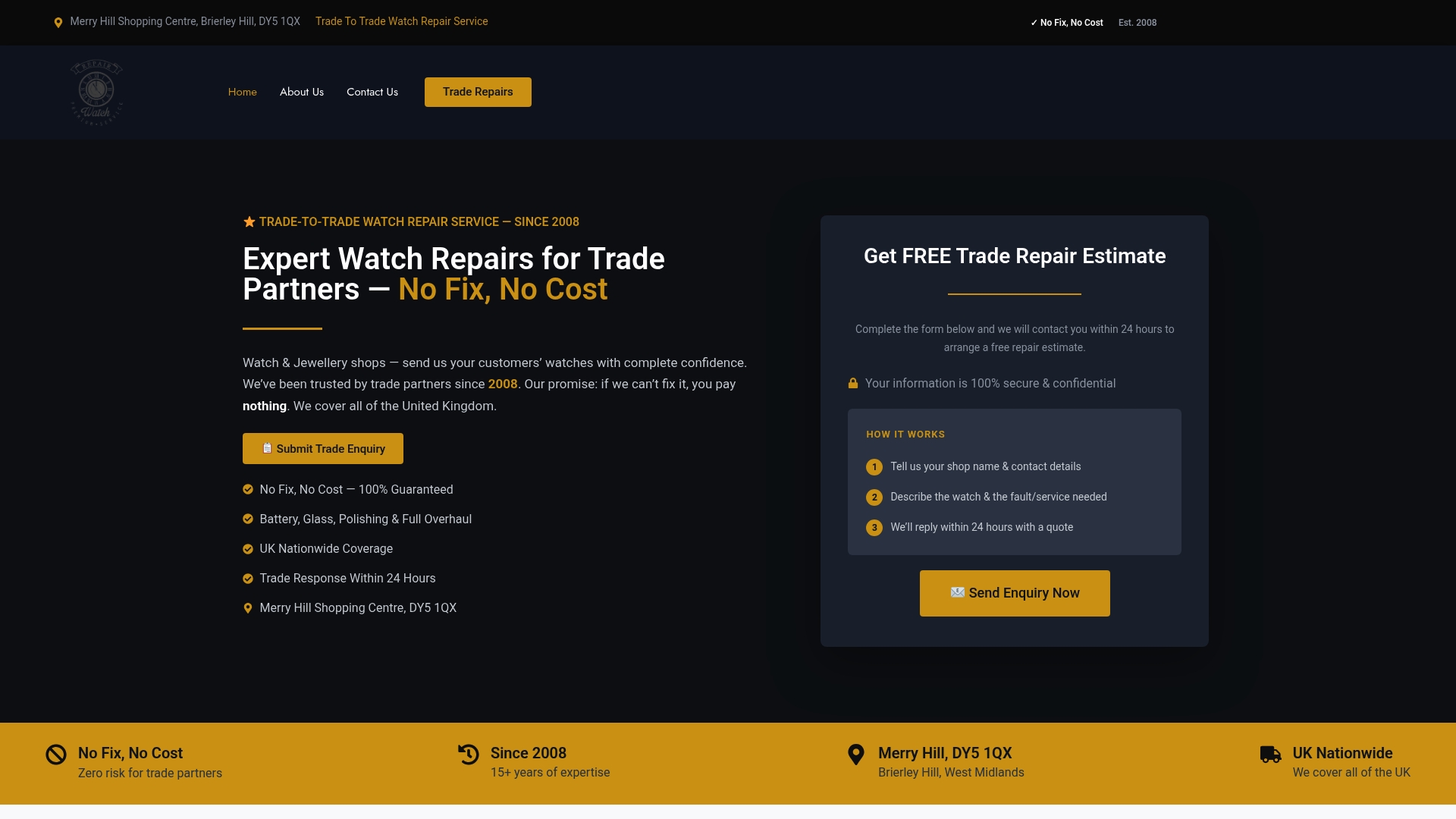
The full trade service covers ultrasonic cleaning, precision polishing, case and bracelet restoration, crystal replacement, resealing and pressure testing, and movement servicing, all handled by specialist technicians. Every resealed watch comes back with a pressure test certificate and before/after photographs as standard. The “No Fix, No Cost” guarantee means you carry no financial risk on jobs that cannot be completed to standard.
To get started: request a trade quote, download the trade checklist, or send a paid sample job to see the standard for yourself before committing any volume.

Leave a Reply