

Ultrasonic cleaning is safe for detached metal watch parts — solid stainless steel or titanium bracelets, and cases with the movement fully removed — but never for a fully assembled mechanical or automatic watch. The cavitation energy that makes ultrasonic baths so effective at stripping grime from metal surfaces is precisely what displaces lubricants inside a movement, degrades gaskets, and can shatter adhesive-set crystals. If you are holding a complete watch, the only safe path is either to remove the bracelet and clean that alone, or to send the watch to a trade service for proper disassembly first.
Quick reference:
- Safe: Detached solid stainless steel or titanium bracelets; cases with movement, seals, and crystal removed; bare metal components stripped for service.
- Conditional: Plated or PVD-coated bracelets (shorter cycles, higher frequency, inspect between passes); quartz watches with confirmed extreme water resistance and no adhesive-set crystal.
- Never: Fully assembled mechanical or automatic movements; leather, rubber, or NATO straps; smartwatches; any watch with a glued or tension-fit crystal still in place.
If the bracelet is solid metal and detached, you can proceed. Everything else warrants a professional.
Table of Contents
- How does ultrasonic cleaning actually work?
- Which watch parts are safe to put in an ultrasonic bath?
- What ultrasonic cleaning does to an assembled watch
- What machine settings and solutions should you use?
- What does a professional ultrasonic clean look like?
- How to clean a metal bracelet at home: step-by-step
- When should you send the watch to a professional?
- Key takeaways
- The case for disassembly first
- Watchrepairstation handles the jobs that need a professional
- Useful sources and further reading
How does ultrasonic cleaning actually work?
The mechanism is acoustic cavitation. A transducer bonded to the tank wall converts electrical energy into high-frequency sound waves, which propagate through the cleaning fluid and create millions of microscopic bubbles. Each bubble expands and then implodes violently, generating a micro-jet of fluid that strikes the surface at high velocity. That jet dislodges oils, salts, and particulate matter from crevices no brush can reach.
The cavitation sequence in brief:
Transducer energises fluid → standing wave creates pressure differentials → bubbles nucleate and grow → bubbles collapse at the surface → micro-jet action strips contamination → particulate suspends in solution and is removed.
Frequency determines bubble size and, therefore, cleaning intensity. At 40 kHz, bubbles are relatively large and energetic — ideal for heavy contamination on robust steel. At 80 kHz, bubbles are smaller and gentler, preferable for plated surfaces or delicate parts. Temperature amplifies cavitation activity: warmer fluid lowers surface tension and increases bubble collapse energy, which is why most workshop protocols specify a controlled temperature rather than running cold. The combination of frequency, temperature, and fluid chemistry is what separates a precise cleaning tool from a blunt instrument.
Which watch parts are safe to put in an ultrasonic bath?
Safe
- Detached solid metal bracelets (stainless steel, titanium, ceramic): the most common and straightforward application. Remove from the watch head completely before loading.
- Stripped cases with movement, crown, gaskets, and crystal all removed: the bare metal shell can be cleaned without risk.
- Sapphire crystals removed from the case: hard, chemically inert, and unaffected by cavitation at normal parameters.
Conditional
- Plated or PVD-coated bracelets: cavitation erodes thin coatings if cycles are too long or frequency too low. Use 80 kHz or above, keep passes to two minutes, and inspect the finish after each pass. If the plating shows any signs of lifting, stop immediately.
- Glued decorative elements: stones or inserts set with adhesive can loosen. Manual cleaning is safer unless you are certain the adhesive is ultrasonic-compatible.
- Quartz watches with confirmed extreme water resistance: some sealed quartz cases can tolerate a brief bath, but only if the manufacturer explicitly permits it and the gaskets are known to be in good condition. When in doubt, disassemble.
Never
- Fully assembled mechanical or automatic movements: cavitation displaces lubricants immediately, causing performance degradation that may not be apparent until the watch starts losing time or stopping.
- Smartwatches: display adhesives and electronic seals are not designed for cavitation stress, and submersion will destroy them.
- Leather, rubber, or NATO straps: porous materials absorb cleaning fluid and degrade. For strap replacement options, watch strap services are the practical alternative.
- Any watch with a glued or tension-fit crystal still in place: the crystal will likely pop free or crack.
If you are uncertain about a component, remove it or send it to a professional. That rule covers most edge cases.
What ultrasonic cleaning does to an assembled watch
The damage is not always immediate, which makes it deceptive. A watch cleaned assembled may run fine for a day or two before the displaced lubricants cause timing drift, and by then the connection to the cleaning session is easy to miss.
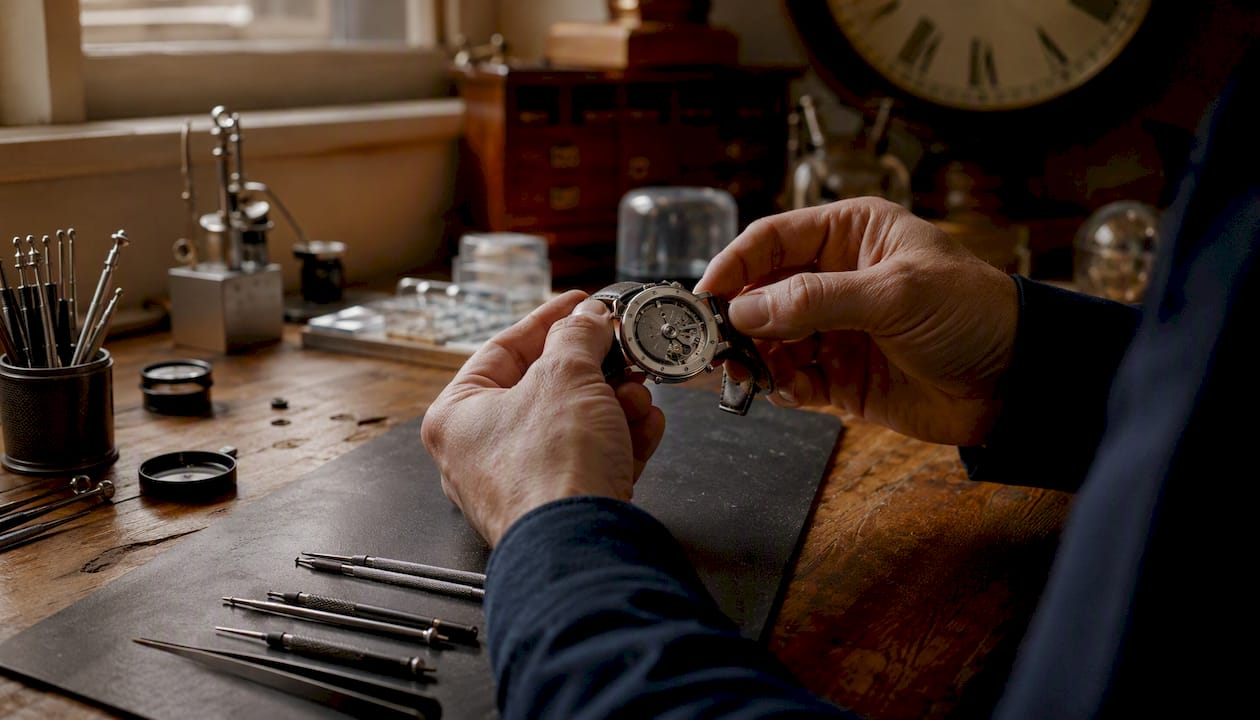
Lubricant displacement is the primary failure mode. Watch movements use precisely applied oils and greases at specific points — pallet fork jewels, mainspring coils, keyless works. Cavitation energy drives these lubricants away from their intended locations. The result is metal-on-metal contact, accelerated wear, and eventually a movement that loses time erratically or stops under load.
Gasket compression and degradation follows. Rubber and silicone gaskets in the crown tube and caseback are not designed for sustained cavitation exposure. Even a short cycle can compress or micro-crack a gasket, destroying the water resistance the watch relied on. The watch may pass a visual inspection and still fail a pressure test.
Adhesive failure is the third risk. Many crystals, particularly on dress watches and vintage pieces, are held with UV-cure or contact adhesive. Cavitation breaks the bond. The crystal may not fall out immediately, but it will be loose enough to admit moisture.
Micro-pitting on polished surfaces is a subtler problem. Prolonged exposure at high intensity creates microscopic surface damage on polished steel that dulls the finish. It is not visible to the naked eye after one session, but repeated cleaning accelerates it. Abrasive debris released during cleaning can also work into bracelet pins if the rinse stage is skipped, increasing wear at the pivot points rather than reducing it.
What machine settings and solutions should you use?
Parameter table for common watch components
| Component | Frequency | Temperature | Max duration per pass | Notes |
|---|---|---|---|---|
| Solid stainless steel bracelet | 40–47 kHz | 40°C | 4–6 minutes | Multiple passes with rinse between |
| Titanium bracelet | 40–47 kHz | 40°C | 4–6 minutes | Titanium is robust; same parameters as steel |
| Plated or PVD bracelet | 80 kHz+ | — | 2 minutes | Inspect after each pass; stop if coating lifts |
| Ceramic bracelet | 40 kHz | 40°C | 4 minutes | Ceramic is hard but brittle; avoid tank-floor contact |
| Stripped case (steel) | 40–47 kHz | 40°C | 4–6 minutes | All seals and movement removed first |
| Sapphire crystal (removed) | 40 kHz | 40°C | 3–4 minutes | Chemically inert; no special precautions needed |
Cleaning fluids
Distilled water is the correct base for any watch-component cleaning solution. Tap water introduces mineral deposits that leave white residue in pin holes and on polished surfaces. Add a neutral-pH, watch-compatible detergent at the manufacturer’s recommended dilution — typically a small amount per litre. Avoid alkaline or acidic cleaners, which attack plating and can stain steel.
For the rinse stage, distilled water alone is sufficient for most applications. A final rinse with 99% isopropyl alcohol (IPA) is recommended in many trade workflows because IPA displaces water rapidly and evaporates cleanly, reducing the risk of trapped moisture in crevices.
Solvent-based solutions (such as petroleum-based watch cleaning fluids) are used in some professional machines for movement parts, but they are not appropriate for consumer-grade tanks and require proper ventilation and disposal procedures.
Operational discipline
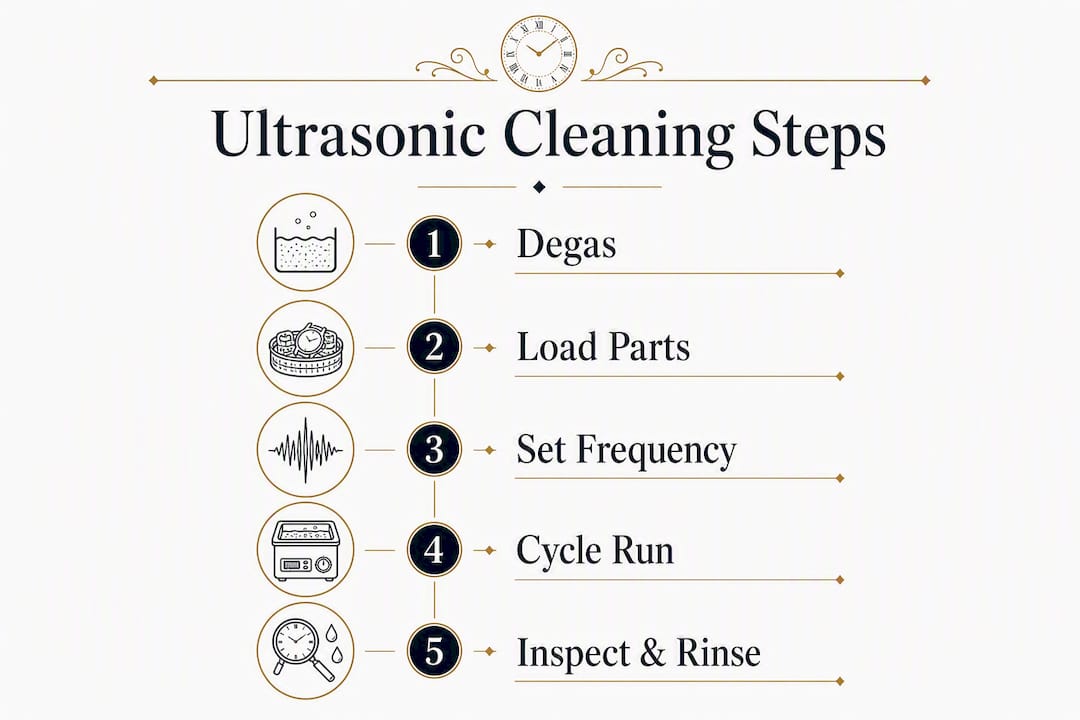
Degas the machine before loading any parts. Run it empty, or with water and cleaning agent, for around ten minutes. Dissolved gases in fresh fluid cushion cavitation bubbles and reduce cleaning efficiency significantly. Skipping this step is one of the most common reasons a new machine seems to underperform.
Always suspend parts in a mesh basket, never resting on the tank floor. Direct contact causes acoustic shadowing — the part blocks the sound wave from reaching its underside — and risks scuffing polished surfaces against the tank.
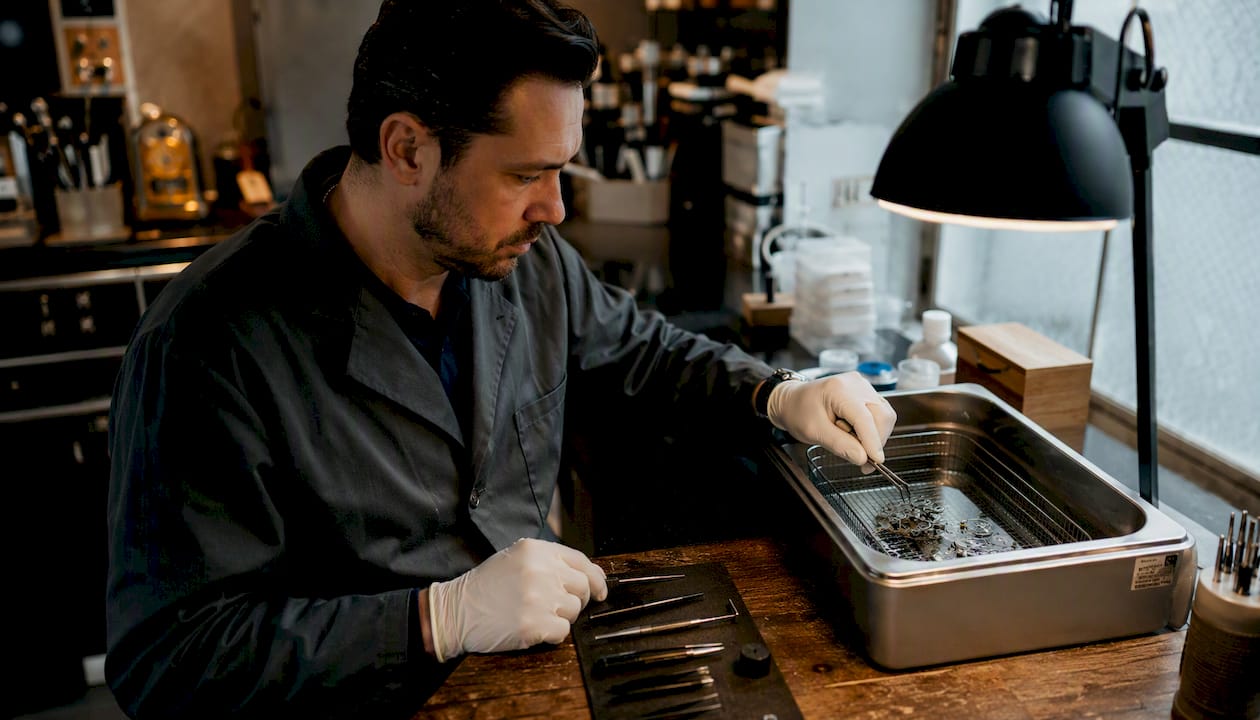
Run multiple short passes rather than one long cycle. Four minutes on, remove and inspect, rinse in distilled water, then repeat if needed. This approach gives you control and prevents surface damage from over-exposure.
Consumer-grade ultrasonic units typically lack precise temperature control, a degas function, and adjustable frequency. They will clean a bracelet, but they cannot replicate the controlled parameters of a trade machine. If you are working on a valuable or plated bracelet, a trade unit is worth the investment.
Pro Tip: Before running an unfamiliar machine or a new cleaning solution on a good bracelet, test it on a scrap piece of steel or a piece of kitchen foil. Foil develops characteristic pitting patterns that reveal whether cavitation is even and whether the frequency is appropriate for the task.
What does a professional ultrasonic clean look like?
A trade workshop does not simply drop a watch into a tank. The process is staged, and each stage has a quality-control purpose.
Stage checklist
- Full disassembly — movement removed, crown and stem withdrawn, gaskets extracted, crystal removed if adhesive-set or if a reseal is planned.
- Pre-clean manual degrease — heavy contamination removed by hand with a soft brush and appropriate solvent before ultrasonic exposure, so the tank solution is not immediately saturated.
- Ultrasonic wash — parts suspended in mesh baskets in the primary cleaning solution at the correct frequency and temperature for the material.
- Ultrasonic rinse — a second tank with clean distilled water removes detergent residue.
- Solvent or IPA final rinse — displaces water from crevices and accelerates drying.
- Forced heated air drying — controlled temperature drying at around 60–70°C drives out residual moisture from pin holes and internal surfaces. Air-drying at room temperature is not sufficient for professional work.
- Re-lubrication and reassembly — movement serviced and re-lubricated to manufacturer specification before being returned to the case.
- Pressure and water-resistance testing — the reassembled watch is tested to its rated depth using calibrated equipment. This is not optional; it is the only way to confirm the reseal has held.
Quality-control checks
A professional service should include a loupe inspection of all cleaned surfaces for residue, pitting, or plating damage. Mechanical movements get a timing and beat-rate check on a timing machine after reassembly. Gaskets are replaced as a matter of course during any service that involves opening the case, not reused unless they are demonstrably in perfect condition. For trade partners, documentation of the work carried out — including pressure test results — should accompany the returned watch. These are the trust signals that distinguish a calibrated trade service from a quick clean. For a broader view of what quality assurance looks like across a repair workflow, watch repair quality assurance covers the full picture.
How to clean a metal bracelet at home: step-by-step
This method applies to detached solid stainless steel or titanium bracelets only. Do not attempt it on plated bracelets without first reading the conditional guidance above.
What you need: ultrasonic cleaner with a mesh basket, distilled water, neutral-pH watch-safe detergent, 99% IPA (optional), soft lint-free cloth, loupe or magnifier.
- Remove the bracelet from the watch head completely. Use the correct spring bar tool. Do not attempt to clean the bracelet while it is attached.
- Inspect the bracelet. Check for loose pins, damaged links, or any plating. Note the condition before you start so you can compare afterwards.
- Fill the tank with distilled water and add the detergent at the recommended dilution. Do not use tap water.
- Degas the machine. Run it for ten minutes without the bracelet loaded. This step materially improves cleaning efficiency.
- Place the bracelet in the mesh basket. It should hang freely, not rest on the tank floor or touch the sides.
- Set frequency to 40–47 kHz and temperature to 40°C. Run the first pass for four minutes.
- Remove the basket, rinse the bracelet in clean distilled water. Inspect under a loupe. If contamination remains, repeat from step 6.
- Run a maximum of three passes before reassessing. More than three passes in a single session increases micro-pitting risk on polished surfaces.
- Final rinse with 99% IPA (optional but recommended). This displaces water from the pin holes.
- Dry thoroughly. Use forced heated air if available, or a lint-free cloth followed by at least 30 minutes in a warm (not hot) environment. Never reattach a bracelet that has any moisture in the links.
- Reattach to the watch head only once fully dry. Inspect the spring bars before refitting.
For plated bracelets, reduce each pass to two minutes, raise frequency to 80 kHz if your machine allows it, and inspect after every pass without exception.
When should you send the watch to a professional?
Some jobs are simply outside the scope of a home ultrasonic setup, and attempting them risks a watch that was worth repairing becoming one that is not.
Send it to a trade service when:
- The movement needs cleaning or servicing — any job that requires opening the case and handling the movement belongs in a workshop.
- The gaskets show any sign of ageing, compression, or cracking. A reseal requires calibrated pressure testing to confirm it has worked; a home setup cannot do this.
- The crystal is glued or adhesive-set. Removal and refitting require the right tools and a replacement gasket or adhesive.
- The watch is vintage or collectible. Plating, lacquer, and aged finishes on older pieces are far more vulnerable than modern surfaces, and the cost of a mistake is disproportionate.
- You have no reliable water-resistance history for the watch. If you do not know when it was last pressure-tested, assume it needs one before any cleaning that involves the case.
- The bracelet shows loose pins or worn links. Ultrasonic cleaning will not fix mechanical wear, and a loose pin can be lost in the tank.
A professional trade service will disassemble the watch, clean all parts ultrasonically, re-lubricate the movement, reseal the case with new gaskets, and pressure-test to the watch’s rated specification. For UK trade customers, turnaround times and pricing vary by job complexity, but a straightforward reseal and pressure test is typically a quick-turnaround job. A full service and overhaul takes longer. Watchrepairstation operates on a “No Fix, No Cost” basis, so trade partners carry no financial risk on jobs that cannot be completed. For a broader view of what regular servicing involves and why it matters for long-term watch health, why watches need regular servicing is worth reading before you decide whether a clean alone is sufficient.
Key takeaways
Ultrasonic cleaning is a precision tool for detached metal components, not a shortcut for servicing an assembled watch — anything requiring disassembly, resealing, or pressure testing belongs with a qualified trade partner.
| Point | Details |
|---|---|
| Assembled watches: never | Never place a fully assembled mechanical or automatic watch in an ultrasonic bath; cavitation displaces lubricants and degrades gaskets immediately. |
| Safe parameters for steel bracelets | Use 40–47 kHz, 40°C, and 4–6 minute passes with distilled water and a neutral-pH detergent; degas the machine first. |
| Plated finishes need care | Run plated or PVD bracelets at 80 kHz+, and no more than 2 minutes per pass; inspect after each pass. |
| Pressure test after any case work | Any service involving case opening and resealing must be followed by a calibrated pressure and water-resistance test. |
| Watchrepairstation for trade jobs | Watchrepairstation handles disassembly, ultrasonic part cleaning, re-lubrication, resealing, and pressure testing for UK trade partners under a “No Fix, No Cost” guarantee. |
The case for disassembly first
The most persistent misconception about ultrasonic cleaning is that it is a substitute for servicing. It is not. It is one stage within a service, and its value depends entirely on what happens before and after it.
In a proper workshop workflow, the ultrasonic bath never sees a complete movement. Parts arrive at the tank already stripped, degreased by hand, and sorted by material. The bath removes what manual cleaning cannot reach — the oils and salts embedded in the pivot holes of a plate, the grime packed into the links of a bracelet that has not been off the wrist in three years. After the bath, everything is dried under controlled heat, inspected under magnification, re-lubricated to specification, and reassembled. Then it is pressure-tested. That sequence is not bureaucratic caution; it is the only way to know the watch is actually better than when it arrived.
The consumer ultrasonic market has created a reasonable expectation that you can drop a watch in a tank and retrieve something cleaner. For a bracelet, that is largely true. For anything containing a movement, it is a gamble with a predictable outcome. The watches that come into a trade workshop with timing problems after an owner-cleaned session are not rare. The damage is usually repairable, but it adds cost and time that a correct first approach would have avoided entirely.
Watchrepairstation’s position is straightforward: ultrasonic cleaning is a tool we use on components, not on complete watches. The discipline of disassembly first is not a trade secret — it is just the right way to do it.
Watchrepairstation handles the jobs that need a professional
For UK watch and jewellery shops, the jobs that require disassembly, resealing, and pressure testing are exactly where Watchrepairstation adds the most value. A bracelet clean is something a well-equipped shop can handle in-house. A movement service, a reseal, or a pressure test on a customer’s water-resistant watch is a different matter entirely.
Watchrepairstation’s trade service covers the full workflow: disassembly, ultrasonic cleaning of individual components, re-lubrication, new gasket fitting, reassembly, and calibrated pressure testing. Every job comes with the “No Fix, No Cost” guarantee, so your shop carries no financial risk on work that cannot be completed. Turnaround is fast, nationwide UK coverage means no geographic restriction, and your customer gets their watch back with documented pressure-test results rather than a guess. To send your next job or discuss trade terms, visit the watch repair service page and get started.
Useful sources and further reading
These sources provide technical depth on machine parameters, workshop workflows, and safe cleaning practice for anyone wanting to go further than this guide covers.
-
Ultrasonic cleaner watch bracelet safe — Sonirity: Covers which bracelet types are safe for ultrasonic baths, parameter guidance for plated versus solid metal, and the core case against cleaning assembled movements. A practical starting point for bracelet-specific questions.
-
Ultrasonic watch cleaner: how to get great results — Watch Repair Tutorials: Detailed guidance on frequency selection, cleaning fluid chemistry, and the rationale for higher-frequency settings on delicate surfaces. Useful for anyone calibrating a new machine.
-
Ultrasonic cleaning watches — Kemet: Workshop-grade technical reference covering degassing, mesh basket technique, forced heated air drying parameters, and why each stage of the professional workflow exists. Kemet supplies industrial ultrasonic equipment and the technical detail reflects that.
-
Can you clean a watch with an ultrasonic cleaner? — Hong Ultrasonic: A process-focused guide covering the multi-stage wash, rinse, and drying sequence used in professional settings, with notes on when solvent rinses are appropriate.
-
Can you clean a watch in an ultrasonic cleaner? — Yunyisonic: Addresses the band-versus-watch-head distinction clearly, with specific guidance on smartwatch exclusions and the risks of cleaning electronic components.
-
Watch repair quality assurance best practices — Watchrepairstation: Covers the calibration, pressure-testing, and QA processes that a trade partner should expect from any professional service, including post-cleaning checks.
-
Watch overhaul process explained — Watchrepairstation: Explains where ultrasonic part cleaning fits within a full overhaul, useful for shops comparing the scope of a clean versus a complete service.

Leave a Reply