

For UK trade partners, the accepted workflow is reseal plus a combined dry air pressure test and wet bubble diagnostic, with full overpressure chamber testing added for any watch rated beyond mid-range depths. Watchrepairstation has operated as a trade-only UK provider since 2008, covering nationwide reseal and water resistance testing under a No Fix, No Cost guarantee and ISO 22810:2010 compliance.
Three things to know before you send your first batch:
- Turnaround: same-week for basic reseal plus dry test; 7–14 working days for reseal plus full wet and overpressure test; longer when parts must be ordered.
- Paperwork: trade order reference, declared prior water damage, movement type, and crown/chronograph positions. That is all the lab needs to begin.
- Standard quoted: ISO 22810:2010 for general water-resistant watches; ISO 6425 for certified diving watches.
Key takeaways
Professional water resistance testing requires a sequenced combination of dry air, wet bubble, and overpressure methods, verified against ISO 22810:2010, with a written certificate returned to the shop for every watch.
| Point | Details |
|---|---|
| Test sequence matters | Dry air certification plus wet bubble diagnostic covers most watches; add overpressure only for deep-rated divers. |
| Send after every opening | Battery changes, reseals, and crystal replacements all disturb seals and require a follow-up pressure test. |
| Vintage watches need a declaration | Non-waterproof or fragile cases should be flagged on intake; the lab will advise whether pressurisation is safe. |
| Certificate fields to check | Confirm the report states test standard, method, pressure applied, result, parts replaced, and technician ID. |
| Watchrepairstation for trade | Trade-only UK service since 2008: No Fix, No Cost, same-week turnaround for standard reseals, written certificate per watch. |
Table of Contents
- What water resistance tests does a trade lab actually perform?
- Which standards apply, and when should you send a watch for testing?
- What should you include when sending a watch for testing?
- What drives turnaround time and cost?
- What happens when a watch passes or fails?
- What equipment does a professional lab use?
- What QA, guarantees, and paperwork should you expect?
- Why the certificate matters more than the rating stamp
- Watchrepairstation: trade reseal and testing, no risk
- Sources
What water resistance tests does a trade lab actually perform?
Professional labs run a diagnostic sequence, not a single test. Each stage reveals something the previous one cannot.
Visual check. The technician inspects the crown, crystal, caseback, and pushers for obvious damage before any pressure is applied. A cracked crystal or stripped crown thread will fail regardless of gasket condition, so catching it early saves time.
Dry air pressure test. The watch sits in a sealed chamber pressurised with air. A micro-measurement sensor detects case deformation: any flex beyond tolerance indicates a leak path. Dry testers are the preferred tool for final certification because water never contacts the case. Experienced workshops use a dry tester for the pass/fail certificate and reserve the wet tester for pinpointing the leak source before dismantling.
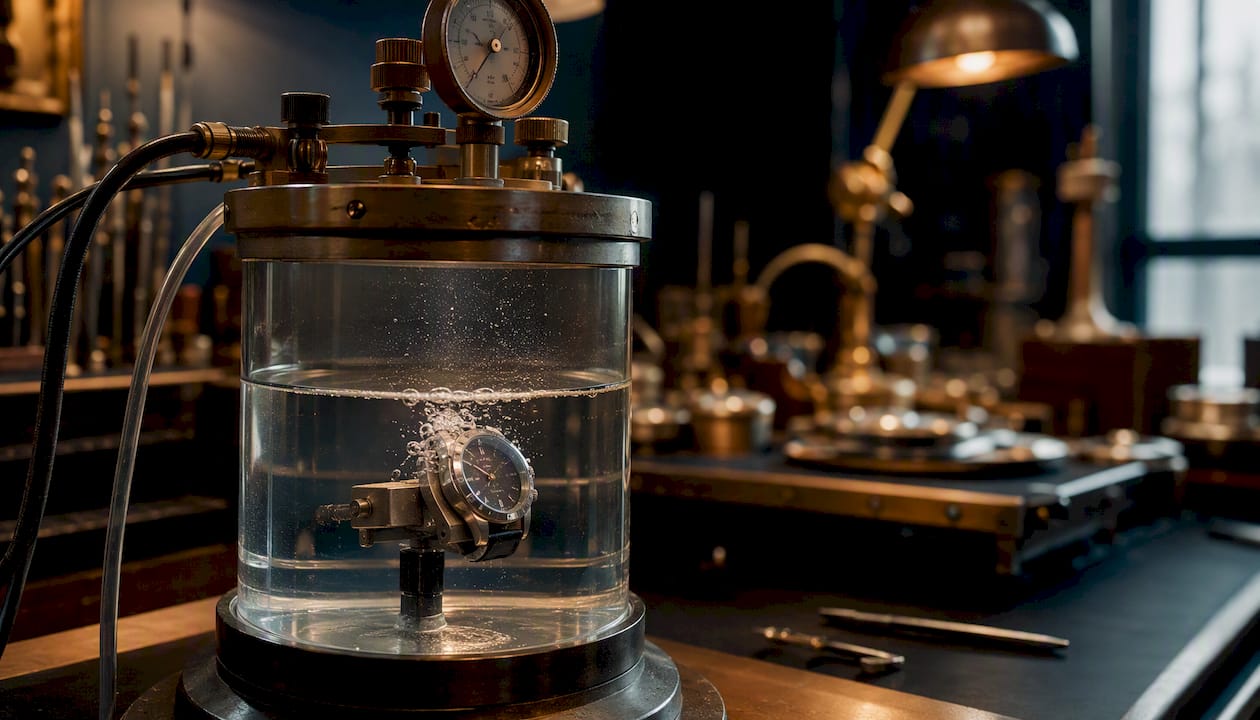
Wet bubble diagnostic. The Calypso wet pressure tester submerges the watch and applies pressure up to 10 ATM via a manual hand pump. A continuous stream of bubbles shows exactly where the seal has failed: crown, crystal edge, or caseback. That precision matters because it tells the technician which gasket to replace before the watch goes back into the dry chamber for certification.
Condensation check. A water droplet or humidity exposure test confirms no moisture is entering through micro-paths invisible to bubble testing. Useful for watches with suspected intermittent ingress.
Full water overpressure test. Reserved for deep-rated divers. High-pressure water chambers used by specialist labs can reach pressures up to approximately 150 bar, with some facilities testing to around 160 bar for ISO 6425 diving watch certification, as Laboratoire Dubois documents.
Pro Tip: Use the wet bubble test as a diagnostic step when a watch has failed a dry test but the leak source is unclear. Skip straight to the overpressure chamber only when the watch is already rated beyond 100 m and the gaskets are freshly replaced.
Which standards apply, and when should you send a watch for testing?
ISO 22810:2010 is the governing standard for general water-resistant watches. It sets the test methods, pressure thresholds, and the authorised markings a watch may carry. ISO 6425 goes further: it covers certified diving watches and adds requirements for legibility, luminosity, and a unidirectional bezel, alongside the deeper pressure tests.
For practical purposes, ISO 22810 covers the vast majority of watches your customers bring in. ISO 6425 applies when a customer’s watch is explicitly marked as a diving instrument.
Send a watch for testing after any of these events:
- Reseal or gasket replacement (always verify the work)
- Battery change, because opening the caseback disturbs the seal
- Full service or overhaul
- Crown, crystal, or pusher replacement
- Suspected water ingress (fogging, condensation on the dial)
- Customer request before a diving or swimming holiday
UK trade services recommend routine testing after any reseal or battery change, and note that real-world movement places greater pressure on seals than static lab figures suggest. Annual testing is a reasonable default for any watch the customer wears near water regularly. For regular servicing schedules, the guidance is broadly consistent: treat water resistance as a perishable property, not a permanent one.
Vintage and non-waterproof watches are a different matter. If a case was never designed to be sealed, pressurisation risks damaging the movement. Declare these clearly on the intake form and let the lab advise rather than assuming a test is appropriate.
What should you include when sending a watch for testing?
A complete intake pack prevents delays. Include the following with every watch:
- Trade order number or purchase reference
- Customer contact details (name, phone or email)
- Declared prior water damage: yes, no, or unknown
- Movement type (quartz or mechanical) and calibre if known
- Crown and chronograph positions for testing (typically crown screwed down or pushed in)
- Parts pre-approved for replacement on inspection (gaskets, crown, crystal)
- Any instruction to withhold pressurisation (e.g. fragile vintage case)
For packaging, wrap each watch individually in bubble wrap or foam, place it in a rigid box, and seal the outer carton. Use a tracked and insured courier service. Royal Mail Special Delivery or a specialist watch courier covers loss and damage; standard parcel services do not provide adequate cover for watch values. Label the outer box clearly with the lab’s address and your trade account reference.
Pro Tip: Write “CROWN SCREWED DOWN” or “CROWN PUSHED IN” on a card inside the box. Technicians handle dozens of watches daily; a physical note eliminates any ambiguity about the watch’s state on arrival. For pieces that must not be pressure-tested, write “NO PRESSURE TEST — VISUAL INSPECTION ONLY” in red on the intake form.
A trade repair checklist covers the full intake process if you want a printable reference for your counter staff.
What drives turnaround time and cost?
Basic reseal plus dry air test: same week for most watches. Add a wet bubble diagnostic and the timeline extends slightly, typically still within five working days. Full reseal, wet diagnostic, and overpressure chamber testing for a diver: allow 7–14 working days. If parts need ordering, add lead time accordingly.
The main cost drivers:
- Test depth required (deeper-rated watches need more equipment time)
- Parts: gaskets, crowns, crystals, and stems vary considerably in price by brand
- Movement complexity and condition
- Vintage watches requiring period-correct or custom-machined parts
- Remedial work discovered during testing (a failed crown thread, for example)
Pro Tip: Quote your customer a range, not a fixed price, until the lab has completed its initial assessment. Tell them the test itself has a fixed cost, but parts and remedial work are subject to inspection. That framing sets honest expectations and avoids disputes when a crown seal turns out to need replacement.
Charging a diagnostic fee is reasonable practice. If the watch fails and the customer declines repair, the shop has still incurred lab costs. Agree your policy before sending the first batch.
What happens when a watch passes or fails?
A pass means the case held pressure within the tolerance the standard requires. The lab issues a written certificate and returns the watch. A fail triggers a remedial report.
Common remedial actions after a fail:
- Gasket replacement (crown, crystal, caseback, or pusher seals)
- Crown and stem repair or replacement
- Crystal reseating or full crystal replacement
- Caseback thread repair
- Re-test after each remedial stage
A reseal restores water resistance by replacing worn gaskets, and the wet pressure test is the verification step that confirms the work has held. For watches rated 30 m/3 bar and above, a successful reseal and test restores the watch to its rated everyday use.
Vintage and fragile watches present a hard limit. If the case was not designed for pressurisation, or if the crystal is held by friction rather than a sealed bezel, the lab will decline the overpressure stage to avoid causing damage. The report will note this clearly.
Sample fields in a pass/fail report:
What equipment does a professional lab use?
Three categories of equipment cover the full diagnostic and certification range.
Dry air deformation testers measure micro-movement of the caseback under air pressure. They are the standard tool for certification because the watch stays dry throughout. The W.E. Clark workshop describes using a dry tester capable of testing to 300 metres equivalent for final pass certification.
Calypso wet pressure testers apply water pressure up to 10 ATM and reveal the leak source visually through bubble streams. They are diagnostic instruments, not certification tools. The Calypso 19406 uses a manual hand pump and is widely used across UK trade workshops.
High-pressure water chambers are the specialist tier. Edox documents pressures up to approximately 150 atmospheres for deep-water testing, and Laboratoire Dubois lists overpressure tests to very high levels for diving watch certification. Not every lab operates at this level; confirm maximum test pressure before sending a deep-rated diver.
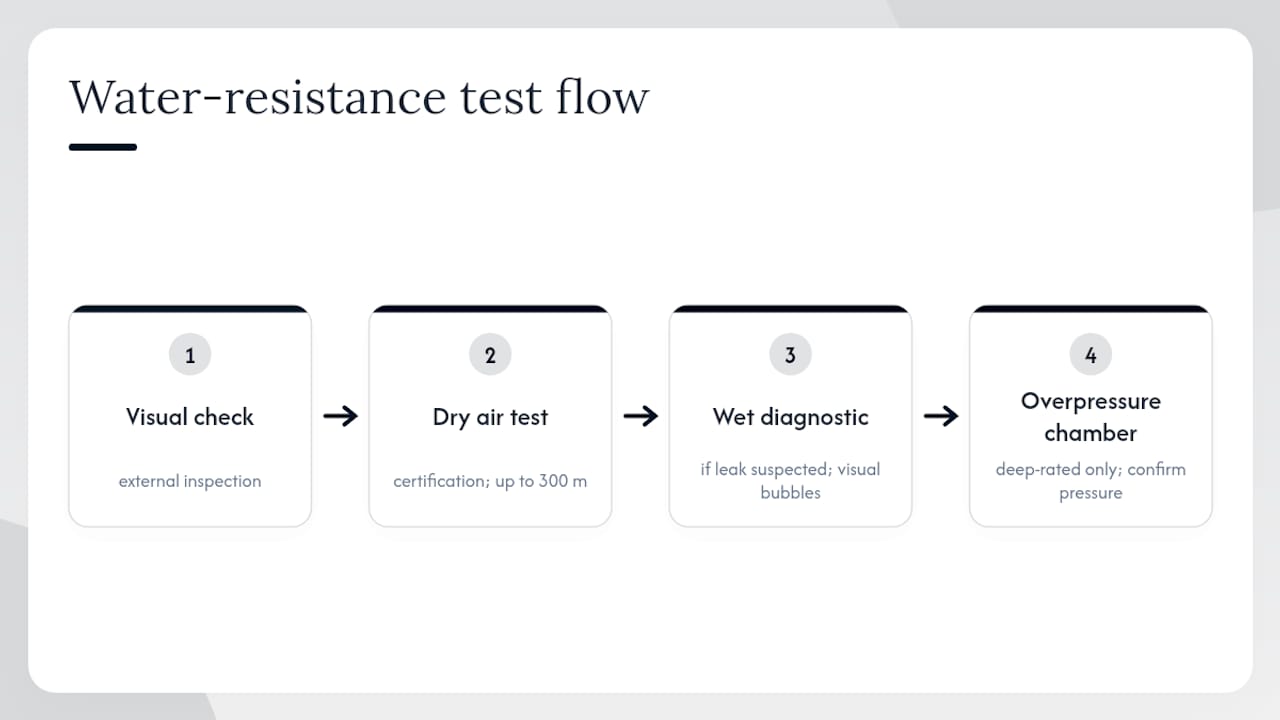
The method flow runs: visual check → dry air test → wet bubble diagnostic (if a leak is suspected or found) → overpressure chamber (for deep-rated watches only). Operators working with high-pressure chambers follow PPE protocols; pressurised water chambers carry genuine risk if a seal fails catastrophically during testing.
What QA, guarantees, and paperwork should you expect?
Every watch returned from a trade lab should come with a written certificate. The minimum fields are: test standard referenced (ISO 22810:2010 or ISO 6425), test method used, pressure applied, result (pass/fail), parts replaced, date, and technician identification. Laboratoire Dubois sets a useful benchmark for what professional test documentation looks like.
Guarantee and liability points to confirm with any supplier:
- How long the reseal guarantee runs (typically 12 months for gaskets under normal use)
- Whether the No Fix, No Cost policy covers diagnostic costs when a watch is unrepairable
- Liability limits for pre-existing water damage declared on intake
- Re-test policy if a watch fails within the guarantee period
Watchrepairstation publishes trade QA best practices that set out the reporting and retesting standards trade partners can expect. Ask any prospective supplier whether they offer batch traceability and a re-test policy before committing to a volume account.
Why the certificate matters more than the rating stamp
Most shops focus on whether a watch passes. The more useful question is what the certificate actually says. A pass at 3 ATM on a watch marked 10 ATM tells you the seals held at the minimum test pressure, not that the watch is fit for diving. The test standard, the pressure applied, and the method used are the three fields that tell you whether the result is meaningful for the customer’s intended use.
Shops that hand customers a certificate with those three fields visible are giving them something they can act on. Shops that hand back a watch with a verbal “it passed” are giving them nothing they can rely on if the watch leaks on holiday. The paperwork is the product, not an afterthought.
Watchrepairstation: trade reseal and testing, no risk
UK watch and jewellery shops that need a reliable trade partner for reseal and liquid ingress testing get a straightforward offer from Watchrepairstation: trade-only pricing, a No Fix, No Cost guarantee, and nationwide insured courier collection. No retail customers, no mixed queues, no ambiguity about who the service is built for.
Watchrepairstation has handled trade repairs since 2008. Every job comes back with a written test certificate referencing the applicable standard, the pressure applied, and the parts replaced. Turnaround for a standard reseal plus dry test is same-week; full wet and overpressure testing for divers runs 7–14 working days. To open a trade account or send your first batch, visit the trade repair service page and request trade terms.
Sources
The following references underpin the technical and procedural guidance in this article.
- ISO 22810:2010 – Horology — Water-resistant watches
- Water Resistance Tests – Edox
- Watch water resistance test – Laboratoire Dubois
- Calypso Wet Pressure Tester – 19406
- Investigating Leaks with the Calypso Wet Tester – W.E. Clark & Son Limited
- Water Resistant Tests – Prestige Time Services
- FAQ: What are the benefits of getting a watch resealed?

Leave a Reply